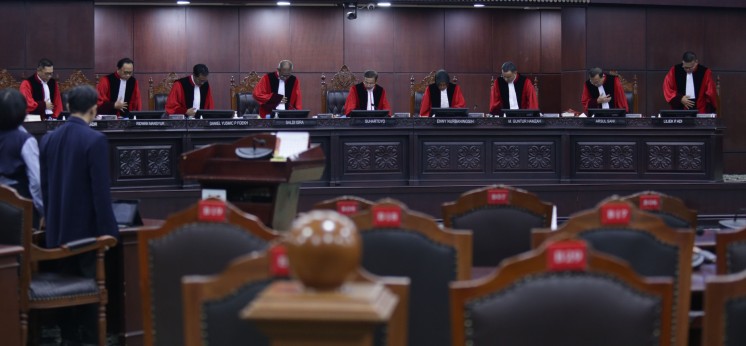
Jakarta (MKRI) - The Constitutional Court (MK) held a further hearing on Monday, April 13, 2026, in the material review of Articles 263 and 264 of Law No. 1 of 2026 on Sentencing Adjustments. The fourth hearing in Case No. 26/PUU-XXIV/2026, filed by Rianjani Pajar Salusih, Muhammad Amyusril Baramirdin, Devina Futriyani, and Bernita Matondang, was scheduled to hear the DPR’s explanation.
Commission III member Rudianto Lallo, speaking for the DPR, said Articles 263 and 264 of the Criminal Code contain both subjective and objective elements needed to classify conduct as a measurable criminal offense. As an improvement on earlier provisions on “spreading false news,” the legislature reformulated the offense by altering its constituent elements and consequences in material terms, making public unrest a condition for punishment. The a quo provisions narrow the scope of the offence by deleting Article 263 paragraph (2), which had grounded fault in the phrases “it is reasonably suspected” and “may result in public unrest.”
“The deletion does not remove the regulation of broadcasting or disseminating false news or information, because it has been accommodated in Article 263 paragraph (1) of the Criminal Code and adjusted into Article 263 of the Sentencing Adjustments Law,” Rudianto explained from the DPR building online.
Rudianto also noted that in Decision No. 115/PUU-XXII/2024, the Constitutional Court drew clear distinctions between criticism, incitement, and insult, and underscored the importance of public‑interest parameters in assessing the permissible limits of freedom of expression.
Also read:
Phrases on Dissemination of Hoaxes in Penal Adjustment Law Challenged for Ambiguity
Petitioners Broaden Review of Several Phrases in Hoax News Provision
Govt Outlines Limits and Criteria for Criminal Liability of Hoax Spreaders
During the Preliminary Hearing on Monday, January 26, 2026, a representative of the Petitioners stated that provision a quo is contrary to Article 28D paragraph (1), Article 28E paragraphs (2) and (3), Article 28F, and Article 28G of the 1945 Constitution. They argued that According to the Petitioners, the provision contains several phrases such as “uncertain news,” “exaggerated,” and “incomplete,” as well as the mens rea element formulated as “while knowing,” which they believe are vague, open to multiple interpretations, and lack clear objective parameters.
The Petitioners further stated that they are law students who, in the course of their academic activities, actively engage in the search for, processing, analysis, and dissemination of legal information through academic forums and digital platforms. In that capacity, the Petitioners require a safe space free from the threat of criminalization in order to access, process, and convey information, as guaranteed under Article 28E paragraph (3), Article 28F, and Article 28G of the 1945 Constitution.
In academic practice, the Petitioners observed that the use of data that has not yet been updated or documents in older versions is commonplace and unavoidable, given the rapidly changing dynamics of information. In such circumstances, information that is accurate at a given time may later appear different following updates issued by official institutions, thereby potentially being misconstrued by law enforcement authorities as “uncertain,” “incomplete,” or “exaggerated” information.
This could place the Petitioners in a vulnerable position. Because the provision a quo employs vague elements without objective parameters, it opens the possibility of criminalization of legitimate academic activities. Accordingly, the application of the norm a quo gives rise to direct and potential constitutional harm to the Petitioners as students who depend on academic freedom and the right to information.
Case tracking: Petition No. 26/PUU-XXIV/2026 (in Indonesian).
Author: Sri Pujianti
Editor: N. Rosi.
PR: Andhini S. F.
Translators: Rizky Kurnia Chaesario/Yuniar Widiastuti (NL)
Disclaimer: The original version of the news is in Indonesian. In case of any differences between the English and the Indonesian versions, the Indonesian version will prevail.
Monday, April 13, 2026 | 17:11 WIB 79