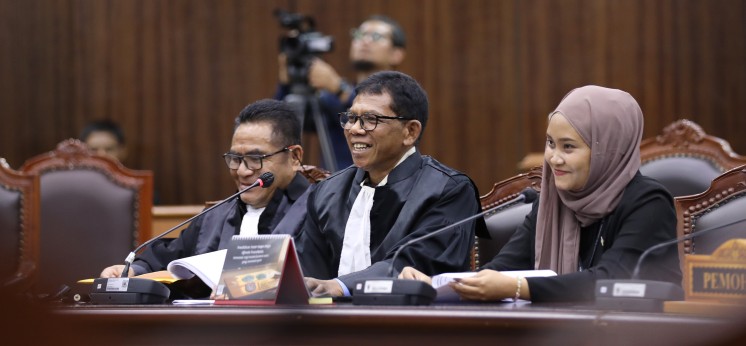
Petitioners attending the preliminary panel hearing on the judicial review of Law No. 20 of 2025 on the Criminal Procedure Code on Thursday (09/04). Photo by MKRI/Ifa.
Jakarta (MKRI) – The Constitutional Court held a material judicial review hearing on Article 235 paragraph (1) letter g of Law No. 20 of 2025 on the Criminal Procedure Code (KUHAP) on Thursday, April 8, 2026. Petition No. 118/PUU-XXIV/2026 was filed by Harribertus Satori Nabit, Hani Yudina, Muhammad Alif Saputra, and Yuprianto Waruwu. The hearing was presided over by Deputy Chief Justice Saldi Isra, alongside Justices Ridwan Mansyur and Adies Kadir.
“To declare the phrase “judges’ observation” in Article 235 paragraph (1) letter g of Law No. 20 of 2024 on the Criminal Procedure Code contrary to the 1945 Constitution of the Republic of Indonesia,” stated Harribertus Satori Nabir, reading out the petitum.
In the petition, the Petitioners question the phrase “judges’ observation” as evidence under Article 235 paragraph (1) letter g of the KUHAP. They consider the phrase unconstitutional, especially regarding the guarantee of just law.
The Petitioners contend that the phrase “judges’ observation” lacks a clear limitation, objective parameter, or testing mechanism. This causes the norm not to fulfill the principle of lex certa and due process of law, and may create subjectivity in the process of criminal evidence.
The petitioners also consider the provision enabling discrimination because the evaluation depends on the judge’s perception. This condition, the petitioners argue, may lead to different judgments in cases with similar facts, thereby violating the principle of equality before the law guaranteed by the Constitution.
Moreover, the Petitioners state that the phrase also contradicts the rule of law principles by extending the judges’ authority beyond adjudication. They argue that judges not only assess the evidence but may themselves become a source of evidence, thereby blurring the line between the functions of evaluating and proving.
In the aspect of the judiciary, the norm is considered to violate the principle of judges’ independence and impartiality. The absence of a review mechanism against the “judges’ observation” may lead to a lack of transparency in the assessment that cannot be challenged.
The Petitioners also highlighted the potential violation of the right to personal protection, dignity, and security, arguing that without objective standards and verification mechanisms, “judges’ observation” can lead to assessments based on personal impressions rather than measurable evidence.
They further contended that recognizing “judges’ observation” as a means of proof conflicts with the audi et alteram partem principle because it does not allow the parties to test or confront the basis of that observation, and risks undermining the presumption of innocence by allowing a judge’s conviction to form outside the evidence presented by the prosecution.
From the standpoint of the law of evidence, the Petitioners argued that “judges’ observation” does not meet the criteria for rational proof because it is neither traceable, verifiable, nor accountable, and that the provision undermines what has traditionally been a closed system of evidence.
During the advice session, Justice Ridwan Mansyur recommended that the Petitioners study Constitutional Court Regulation No. 7 of 2025 on Procedures in Judicial Review Cases (PMK 7/2025), noting that it is an essential reference for drafting petitions and can be downloaded from the Court’s website.
The Panel granted the Petitioners 14 days to amend their application, with the revised petition to be received by the Court no later than Wednesday, April 22, 2026.
Author: Utami Argawati.
Editor: N. Rosi.
PR: Fauzan F.
Translator: Rizky Kurnia Chaesario
Disclaimer: The original version of the news is in Indonesian. In case of any differences between the English and the Indonesian versions, the Indonesian version prevails.
Thursday, April 09, 2026 | 17:17 WIB 118