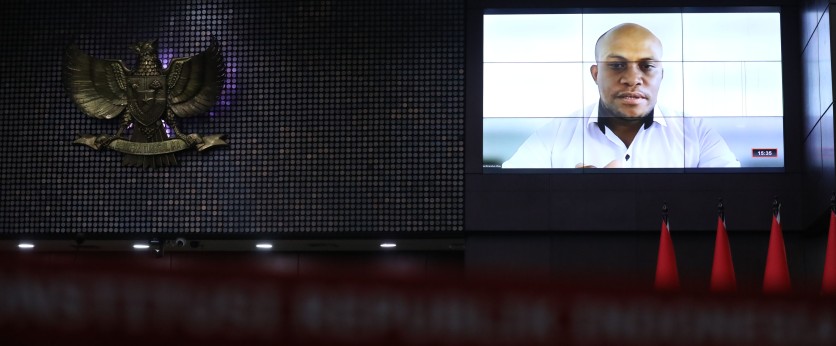
Ferdinandus Klau, petitioner for the judicial review of Law No. 1 of 2024 on Electronic Information and Transactions (EIT), presenting his petition online, Wednesday (4/8/2026). Photo by MKRI/Panji.
JAKARTA (MKRI) — Ferdinandus Klau, resident of North Central Timur Regency, East Nusa Tenggara Province, has filed for the material judicial review of Article 4 letter e of Law No. 1 of 2024 on the Second Amendment to Law No. 11 of 2008 on Electronic Information and Transactions (EIT Law) to the Constitutional Court. He questions the phrase “providing a sense of security” in the form, as photos he uploaded onto his social media account were disseminated by netizens, resulting in defamation that harmed his honor.
“However, it is not elaborated in detail in the EIT Law, especially in Article 4 letter e. It does mention a sense of security, but it does not explain in detail the extent of the intended sense of security,” Klau stated during the preliminary hearing for Case No. 116/PUU-XXIV/2026, which he attended virtually on Wednesday, April 8, 2026.
In full, Article 4 letter e of the EIT Law provides: “The utilization of information technology and electronic transactions shall be carried out with the objective of: e. providing a sense of security, justice, and legal certainty for users and providers of Information Technology.” According to the Petitioner, this provision should require social media platform users to use images and/or facial photographs and/or other forms of identifiable identity as part of ensuring a sense of security in activities across all social media platforms.
He explained that the obligation to use real, easily recognizable identities in social media activities is intended to prevent the spread of hoaxes and to limit the movement of perpetrators of crime. Accordingly, the protection of personal data and identity should become the responsibility of social media users as well as government institutions tasked with and authorized to safeguard such personal data.
The Petitioner cited a scholarly article by Zahra Zakiya et al. (2025), titled “Penegakan Hukum Terhadap Pelaku Pencemaran Nama Baik Melalui Media Sosial” (“Law Enforcement on Perpetrators of Defamation Through Social Media”), which notes a continuing increase in defamation cases through social media year by year. It records that from approximately 300 cases in 2019, the number rose to around 700 reported cases by 2024. He also referred to a press release by the Ministry of Communication and Digital, which stated that 1,923 hoax-related issues were detected throughout 2024, including cases of defamation.
Furthermore, according to Zahra Zakiya et al. (2025), evidentiary challenges in digital defamation cases on social media require valid electronic evidence, while many complainants are unable to preserve such evidence in accordance with digital forensic standards, including images of the perpetrator’s face and other identifiable forms of identity. The Petitioner added that the layered bureaucratic process involved in uncovering and tracing perpetrators using fake accounts is time-consuming and therefore ineffective for timely evidence-gathering.
As a result of these obstacles, perpetrators of defamation may deactivate their social media accounts and easily and quickly change their identities. The ease with which users can alter identities and access social media for the purpose of committing criminal acts, including defamation, further demonstrates the lack of security on social media platforms.
In his petitums, the Petitioner requests the Court to declare Article 4 letter e of the EIT Law contrary to Article 28G paragraph (1) of the 1945 Constitution and to have no binding legal force.
For context, Petition No. 116/PUU-XXIV/2026 was heard together with Petition No. 115/PUU-XXIV/2026. Both petitions were filed by Ferdinandus Klau and, in substance, concern the same object and issues. Klau explained that the submission of two identical petitions resulted from his lack of understanding of procedural rules governing judicial review cases before the Constitutional Court. He further stated that he would withdraw Petition No. 115/PUU-XXIV/2026.
The petition was examined by a panel consisting Constitutional Justices Enny Nurbaningsih (chair), Ridwan Mansyur, and Arsul Sani. During the advisory session, Justice Arsul Sani noted that the Petitioner had not yet comprehensively explained the constitutional harm he suffered as a result of the application of the challenged provision.
The Petitioner was also instructed to elaborate on the causal relationship (causa verband) between the alleged constitutional harm and the constitutional provision used as the basis for review. Such elaboration is essential to establish the Petitioner’s legal standing in filing the judicial review.
“That is what we have not yet seen in your submission—the point of contradiction and the argument explaining the inconsistency between Article 4 letter e of the EIT Law and the constitutional basis you rely on, namely Article 28G paragraph (1) [of the Constitution],” Justice Arsul stated.
Before adjourning the session, Justice Enny announced that the Petitioner would have 14 days to revise the petition only once. The softcopy or hardcopy of the revised the petition must have been received by the Court no later than 12:00 WIB on Tuesday, April 21, 2026.
Explore cases No. 115, 116/PUU-XXIV/2026 (in Indonesian).
Author : Mimi Kartika
Editor : N. Rosi
PR : Fauzan F.
Translator : Yuniar Widiastuti (NL)
Disclaimer: The original version of the news is in Indonesian. In case of any differences between the English and the Indonesian versions, the Indonesian version will prevail.
Wednesday, April 08, 2026 | 17:09 WIB 108