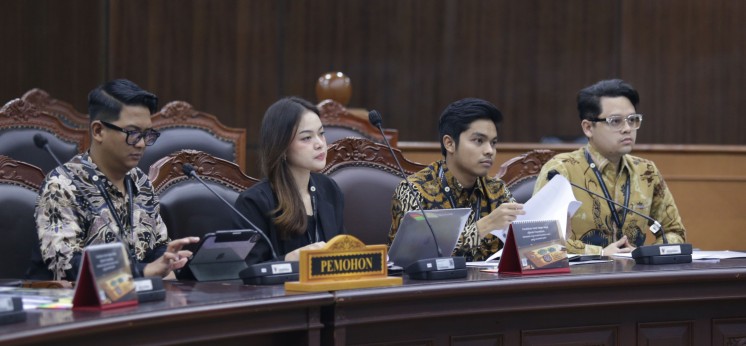
The Petitioners at the preliminary hearing for the judicial review of Law No. 1 of 2023 on the Criminal Code in Case No. 112/PUU-XXIV/2026, Tuesday (4/7/2026). Photo by MKRI/Bayu.
JAKARTA (MKRI) — The Constitutional Court held the preliminary hearing for the material judicial review of Article 466 paragraph (1) of Law No. 1 of 2023 on the Criminal Code (KUHP) and its elucidation on Tuesday, April 7, 2026. The Petition No. 112/PUU-XXIV/2026 was filed by Deddy Rizaldy Arwin Gommo and Diorama Tiffany (Petitioners I and II). The hearing was presided over by Constitutional Justices Enny Nurbaningsih, Asrul Sani, and Adies Kadir.
Article 466 paragraph (1) of the Criminal Code provides: “Any person who commits assault shall be punished with imprisonment for a maximum of 2 (two) years and 6 (six) months or a fine of up to category III.” The elucidation reads, “This provision does not define the meaning of assault, which shall be left to judicial interpretation on the case in accordance with the development of social and cultural values as well as medical science. This means that assault is not limited to physical harm, and not all physical suffering necessarily constitutes assault. The element of ‘intent’ is not explicitly included in this provision, as it is already regulated under Article 36 and Article 54 letter j for the purpose of aggravating punishment.”
Muhammad Danang Pratama, counsel for the Petitioners, argued that the formulation of Article 466 paragraph (1), particularly the phrase “commits assault,” does not provide a definitive parameter within the body of the law. As a result, the core element of the offense depends on the elucidation, which in turn delegates its meaning to judicial interpretation. He referred to the concrete experience of Petitioner I, an advocate who was a victim of assault on January 23, 2026, together with his assistant. In the subsequent legal process, Petitioner I coordinated with investigators and other parties to charge the reported perpetrator under Article 466 in conjunction with Article 467 (premeditated assault) in conjunction with Article 470 letter a.
According to R. Emirio Keefe Deballiano, another member of the Petitioners’ legal team, “Petitioner I believes the definition of ‘assault’ in the elucidation to Article 466 paragraph (1) in the Criminal Code relies on ‘judicial interpretation’ that has ever-changing references, guided by evolving social, cultural, and medical standards. Such phrasing does not provide a clear and limiting legal parameter, but instead introduces an open-ended and fluid standard that is highly dependent on interpretive context.”
This condition, the Petitioners argue, directly harms Petitioner I as a victim, as it creates legal uncertainty regarding the boundaries of the prohibited conduct, the direction of evidentiary assessment, and the proper qualification of the criminal offense in the assault case he experienced.
Petitioner II, an Indonesian citizen working as an entrepreneur, also experienced physical violence in 2022 perpetrated by a member of the Indonesian Army (TNI AD). The case was processed within the military justice system, culminating in Decision No. 169/PM II-09/AD/XI/2022.
This experience, according to the Petitioners, demonstrates that as a victim of physical violence, Petitioner II has a concrete constitutional interest in the existence of a clear, definite, and non-ambiguous formulation of the offense of assault. The ambiguity of the core element of the offense, they argue, consistently disadvantages victims, particularly when confronting perpetrators with unequal power relations. The absence of a precise definition opens the possibility of discrimination, disparity in judicial decisions, and secondary victimization.
The Petitioners contend that the norm a quo fails to meet the minimum requirements of a criminal norm in a state governed by the rule of law. It does not define the essential elements of the offense in a limiting manner, allows shifting interpretations, creates legal uncertainty for victims, weakens the protection of personal security, and risks producing disparities and discriminatory enforcement. Accordingly, they argue that the norm is contrary to Article 1 paragraph (3), Article 28D paragraph (1), Article 28G paragraph (1), and Article 28I paragraph (2) of the 1945 Constitution. In such circumstances, they assert, intervention by the Constitutional Court is necessary—not to create a new offense, but to restore the constitutional quality of an inadequately formulated criminal provision.
Based on these arguments, the Petitioners request the Court to declare Article 466 paragraph (1) of Law No. 1 of 2023 on the Criminal Code unconstitutional and not legally binding insofar as it is not interpreted to read: “Any person who unlawfully or without right commits assault shall be punished with imprisonment for a maximum of 2 (two) years and 6 (six) months or a fine of up to category III.”
They also request the Court to declare the elucidation to Article 466 paragraph (1) unconstitutional and not legally binding insofar as it is not interpreted to mean: “Assault shall be an intentional active act, carried out unlawfully or without right, which results in pain to another person’s body, injury to another person’s body, or a physical health disorder, which can be objectively proven based on medical science.”
Justices’ Advice
In response, Constitutional Justice Arsul Sani advised the Petitioners to take into account Article 12 paragraphs (2) and (3) of the new Criminal Code, as these provisions already contain elements related to the unlawfulness of criminal acts. “You should provide examples of categories of assault. If this requirement is met, many provisions in the Criminal Code indeed do not provide definitions,” he stated.
Meanwhile, Constitutional Justice Adies Kadir noted that the Petitioners should consider that the formulation of “assault” was designed to anticipate evolving forms of violence that are not limited to physical acts. “For example, bullying. It is therefore necessary to clarify the meaning of assault that is non-physical but has tangible physical effects,” he explained.
Constitutional Justice Enny Nurbaningsih also emphasized the need to clearly identify the constitutional issue at stake in the judicial review. “What exactly is being contested? You need to identify the original intent of the provision a quo and its elucidation,” she advised.
At the end of the hearing, the panel of justices gave the Petitioners 14 days to revise the petition. The revised petition must be submitted to the Registrar’s Office no later than 12:00 WIB on Tuesday, April 21, 2026, after which the Court will schedule a second hearing to examine the revisions to the petition.
Explore Case No. 112/PUU-XXIV/2026 (in Indonesian).
Author : Sri Pujianti
Editor : N. Rosi.
PR : Fauzan F.
Translator : Yuniar Widiastuti (NL)
Disclaimer: The original version of the news is in Indonesian. In case of any differences between the English and the Indonesian versions, the Indonesian version will prevail.
Tuesday, April 07, 2026 | 17:45 WIB 207