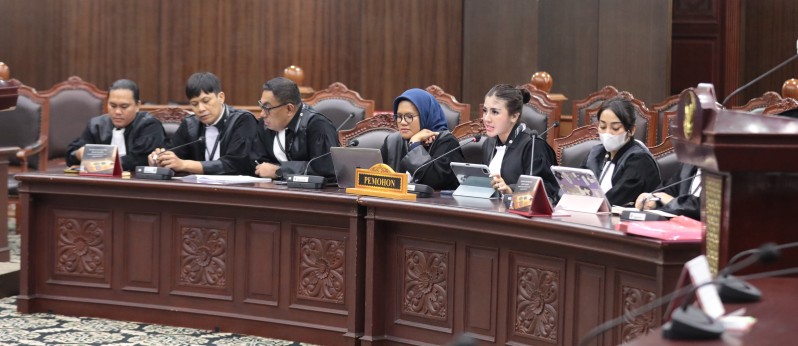
Petitioners in the judicial review of the Criminal Code reading out their petitum during the preliminary hearing, Thursday (4/2/2026). Photo by MKRI/IlhamWM.
JAKARTA (MKRI) — The Constitutional Court (MK) held a preliminary hearing for Petition No. 106/PUU-XXIV/2026 on the judicial review of Law No. 1 of 2023 on the Criminal Code (KUHP). The hearing was presided over by Constitutional Justice Enny Nurbaningsih, alongside Constitutional Justices M. Guntur Hamzah and Arsul Sani, on Thursday, April 2, 2026, at the Court’s plenary courtroom in Jakarta.
The petition was filed by several citizens, including ST Luthfiani, Syamsul Jahidin, Henoch Thomas, Popy Desiyantie, Fredy Limantara, Uswatun Hasanah, Steven Izaac Risakotta, Elyas Marulitua, and Irfan Wahyudi. The Petitioners challenge the constitutionality of Articles 218, 219, and 220 of the Criminal Code, which regulate offenses against the dignity of the President and/or Vice President.
According to the Petitioners, these provisions may give rise to legal uncertainty, as they allow overly broad interpretation between legitimate criticism and insult. They argue that such ambiguity contravenes the guarantee of fair legal certainty as stipulated in Article 28D paragraph (1) of the 1945 Constitution.
The Petitioners also referred to Constitutional Court Decision No. 013-022/PUU-IV/2006, which had previously annulled similar provisions on insulting the President. In their view, the substance of the provisions in the new Criminal Code does not significantly differ from those already declared unconstitutional.
Furthermore, the Petitioners asserted that the a quo articles could potentially be used to criminalize criticism of the President and/or Vice President, thereby constraining democratic practices. The provisions, they argued, fail to provide a clear demarcation between criticism—an integral part of freedom of expression, and personal insult.
“According to the Petitioners, offenses of insulting the President and/or Vice President should instead fall under the defamation provisions (Articles 433–442) of the new Criminal Code, which regulate verbal and written defamation, slander, and false complaints as absolute complaint offenses when the insult (beleediging) is directed at a person in their private capacity, including when directed at the President and/or Vice President as public officials (als ambtsdrager),” Syamsul Jahidin explained.
He further emphasized that the Criminal Code should better reflect democratic principles, particularly since the formulation of Articles 218, 219, and 220 reintroduces normative ambiguity that had previously been declared unconstitutional in Decision No. 013-022/PUU-IV/2006, and is substantively reminiscent of the colonial-era Criminal Code.
The Petitioners also addressed a statement by Deputy Minister of Law and Human Rights Eddy Hiariej, who described the provisions as complaint-based offenses aimed at preventing abuse. However, they contended that such a view is misguided, as it risks distorting democratic values and positioning the President as an untouchable symbol beyond criticism.
“The Deputy Minister erred in asserting that the President and/or Vice President are constitutional symbols of the state. The Petitioners believe this would shift the very meaning of democracy, whereas the provision is not intended to strike a proper balance between freedom of expression and the ethics of democratic life,” Syamsul added.
Therefore, in their petitum, the Petitioners request the Court to declare Articles 218, 219, and 220 of the Criminal Code unconstitutional and not legally binding.
Constitutional Loss
Responding to the petition, Constitutional Justice Arsul Sani stated that he had yet to see any constitutional loss resulting from the enforcement of Articles 218 and 219 of the Criminal Code. He noted that the Petitioners’ arguments remain largely analytical and do not sufficiently demonstrate actual or potential harm.
“What we have so far is merely an analysis, it has not been clearly substantiated. I am not convinced that if this were brought to the justice deliberation meeting (RPH), the Court would grant the Petitioners legal standing,” Arsul said.
He further underscored that one of the essential requirements for legal standing is a clear explanation of the constitutional loss suffered or potentially suffered by the Petitioners. In addition, applicants must meet five criteria, including valid legal standing and a well-elaborated account of the alleged constitutional harm. “It must be clear,” he stressed.
The panel granted the Petitioners 14 days to revise their petition, with the deadline set for Wednesday, April 15, 2026.
Author: Utami Argawati
Editor: N. Rosi
Public Relations: Andhini SF
Translator: Mauliza Ara Rizki/Yuanna Sisilia
Disclaimer: The original version of the news is in Indonesian. In case of any differences between the English and the Indonesian versions, the Indonesian version will prevail
Explore the case: Case No. 106/PUU-XXIV/2026 (in Bahasa Indonesia)
Thursday, April 02, 2026 | 16:27 WIB 156