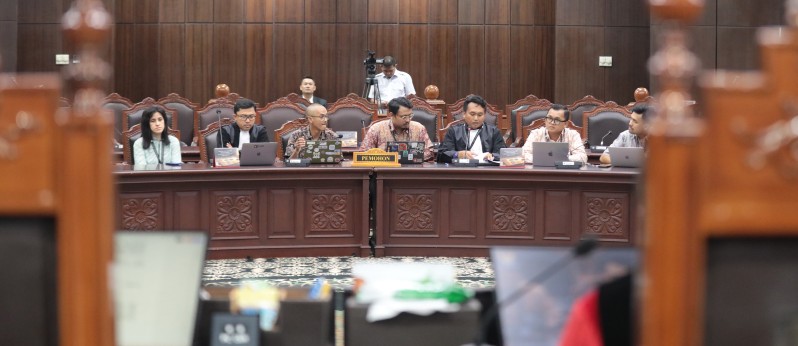
The Petitioners of Case No. 100/PUU-XXIV/2026 on the 2026 State Budget Law presenting their petition before the constitutional justices, Thursday (4/2/2026). Photo by MKRI/Ilham W. M.
JAKARTA (MKRI) — The Sajogyo Institute, the Association of Women Micro and Small Business Facilitators, the Indonesian Consumers Foundation (YLKI), along with Muhammad Busyro Muqoddas, Agus Sarwono, and Sabiq Muhammad, have filed a petition for the judicial review of Law No. 17 of 2025 on the State Budget for Fiscal Year 2026 (2026 APBN Law) to the Constitutional Court. They appointed advocates and/or legal aid assistants for civil society affiliated with MBG Watch as their legal counsel to present arguments concerning alleged constitutional violations in the management of the free nutritious meals (MBG) program.
“The Government, through the State Budget, has engaged in misuse of fiscal authority or budgetary abuse of power without going through the legislative process, which has cross-sectoral impacts,” stated Alif Fauzi Nurwidiastomo, one of the Petitioners’ counsels, during the preliminary hearing for Petition No. 100/PUU-XXIV/2026 on Thursday, April 2, 2026 in the Constitutional Court.
The Sajogyo Institute is represented by executive director Maksum Syam and board member Eko Cahyono; the Association of Women Micro and Small Business Facilitators is represented by executive director Emmy Astuti; and the Indonesian Consumers Foundation is represented by executive chair Niti Emiliana and secretary Rio Priambodo, all acting as petitioners in their capacity as public/private legal entities. Meanwhile, the other three petitioners are individual Indonesian citizens.
The Petitioners argue that Article 8 paragraph (5), Article 20 paragraph (1), Article 13 paragraph (4), and Article 29 paragraph (1) of the 2026 APBN Law provide broad discretionary powers to the Government to shift, amend, and prioritize budget allocations through presidential regulations. Through mechanisms of reallocation and prioritization, the Government effectively alters public policy without first revising the relevant sectoral laws governing those fields. No new regulation has been formally enacted, and no sectoral norms have been amended through the ordinary legislative process. Yet, through control of fiscal allocation, the substance of policy changes in practice.
This condition, according to the Petitioners, demonstrates that the President’s fiscal authority is being used as a dominant instrument to direct state policy without adequate legislative mechanisms. From a constitutional perspective, this model leads to a concentration of control over public resources within the executive—a phenomenon they characterize as fiscal authoritarianism. The inclusion of the MBG program in the structure of the state budget, they argue, reflects the Government’s deliberate use of budgeting as the primary pathway for policy formation.
Unlike sectoral legislation, which generally requires academic papers, harmonization, and public participation, the 2026 APBN Law does not mandate the preparation of an academic paper in the same sense. The Petitioners contend that this procedural gap has been exploited.
By placing large-scale national programs directly within the structure of the state budget, the Government can drive substantial budget reallocations without first conducting comprehensive academic studies subjected to open legislative scrutiny. The state budget instrument is chosen because it remains under strong executive control and provides broad discretion in its implementation, making it faster and less subject to deliberative resistance compared to enacting new sectoral legislation.
According to the Petitioners, this demonstrates that the state budget is being used not merely as an instrument for implementing policy, but as a vehicle for creating policy itself—amounting to an exploitation of legal loopholes in the budgeting mechanism. In this context, budgetary abuse of power is no longer incidental but structural, evolving into fiscal authoritarianism—a situation in which control over state finances is used to shape public policy in a dominant manner without adequate checks and balances.
The Petitioners further argue that the planning of the 2026 State Budget, as stipulated in the 2026 APBN Law, is far removed from the spirit of protecting the fundamental rights of citizens. This is reinforced by the fact that allocations for education and health remain three to six times lower than the budget for the President’s priority free meal program. Moreover, the absence of legislation at the statutory level governing the free meal program further complicates access to justice for the numerous alleged violations experienced by the public, such as cases of food poisoning, which directly infringe upon the rights to survival and child development as guaranteed under Article 28B paragraph (2) of the 1945 Constitution.
The Petitioners therefore request that the provisions being challenged be reinterpreted in accordance with their petitums. Specifically, they request the Court to declare the following norms of the 2026 APBN Law unconstitutional and not legally binding:
- Article 8 paragraph (5) if not interpreted to mean that “The detailed allocation of Central Government Expenditure by Organization, Function, and Program as referred to in paragraph (2) shall be set out in Appendix I, which constitutes an integral part of this Law in accordance with the financial memorandum, and any amendments shall be regulated by a Presidential Regulation that does not contradict sectoral laws and ensures the provision of meaningful public participation.”
- Article 9 paragraph (4) if not interpreted to mean that “Further provisions regarding the detailed allocation of regional transfer funds (TKD) as referred to in paragraph (1) shall be regulated by a Presidential Regulation that does not contradict sectoral laws and ensures the provision of meaningful public participation.”
- Article 11 paragraph (2) if not interpreted to mean that “In the event of government policies affecting the calculation of the General Allocation Fund (DAU), adjustments to the DAU as referred to in paragraph (1) may be made in accordance with the laws governing financial relations between the central and regional governments.”
- Article 13 paragraph (4) if not interpreted to mean that “The use of Special Autonomy Funds shall be prioritized to support national priority programs, which may include education, health, free nutritious meals, food security, infrastructure, and energy resilience, as regulated by law.”
- the phrase “and/or implementing central government policies” in Article 14 paragraph (1) letter b
- the phrase “determined by the Government” in Article 20 paragraph (1) unless interpreted to mean “determined by the Government by ensuring legal certainty through the processes of planning, drafting, deliberation, enactment, or stipulation, in order to guarantee meaningful public participation.”
- Article 29 paragraph (1) unless interpreted to mean that “The Government may undertake policy measures relating to State Revenue, State Expenditure, and/or Budget Financing to address threats that endanger the national economy and/or the stability of the financial system, provided that such measures do not reduce allocations for education, health, and social protection, and must obtain approval from the House of Representatives (DPR).”
The petition was heard by a panel consisting of by Constitutional Justices Enny Nurbaningsih (chair), Daniel Yusmic P. Foekh, and Arsul Sani. In his advisory remarks, Justice Foekh highlighted that the petition still lacks a clear and detailed explanation of the constitutional harm suffered by each petitioner as a result of the challenged provisions.
“In addition, the causal relationship (causal verband) between the alleged constitutional harm suffered by the Petitioners and the application of the challenged norms must also be clearly elaborated. This should be carefully addressed in relation to legal standing,” he stated.
Before adjourning the session, Justice Enny announced that the Petitioners would have 14 days to revise the petition only once. The softcopy or hardcopy of the revised the petition must have been received by the Court no later than 12:00 WIB on Wednesday, April 15, 2026.
Explore case No. 100/PUU-XXIV/2026 (in Indonesian).
Author : Mimi Kartika
Editor : Lulu Anjarsari P.
PR : Adriana A. Y.
Translator : Yuniar Widiastuti (NL)
Disclaimer: The original version of the news is in Indonesian. In case of any differences between the English and the Indonesian versions, the Indonesian version will prevail.
Thursday, April 02, 2026 | 15:11 WIB 94