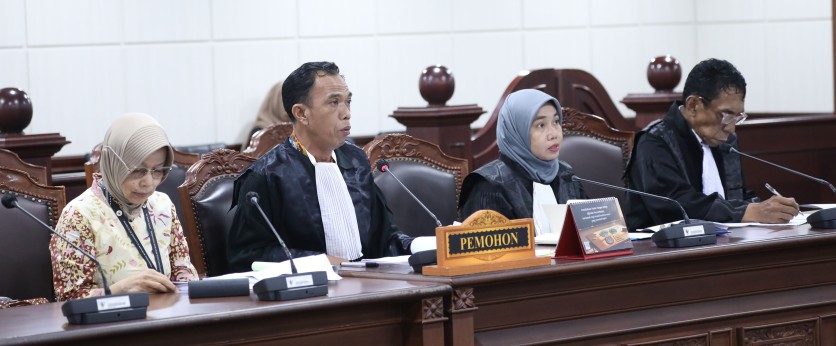
The Petitioner and her legal counsel presenting the main points of the petition at a preliminary hearing on judicial review of Law No. 1 of 1974 on Marriage, Thursday (4/2/2026).Photo by MKRI/Panji.
JAKARTA (MKRI) — A retired state civil apparatus, Sulastriningsih, has filed a petition for a material judicial review of Article 35 paragraph (1) of Law No. 1 of 1974 on Marriage (Marriage Law) with the Constitutional Court. The preliminary hearing for Case No. 108/PUU-XXIV/2026 was presided over by Deputy Chief Justice Saldi Isra in the Court’s panel courtroom on Thursday, April 2, 2026.
Article 35 paragraph (1) of the Marriage Law stipulates, “Assets acquired during marriage shall become joint marital property.”
Through her legal counsel, Yudi Anton Rikmadani, the Petitioner contended that the provision lacks clarity, particularly due to the absence of clear criteria for defining joint property; the failure to take into account the actual contributions of each party; the lack of adequate protection for the rights of women and children; and the absence of guarantees for substantive justice in its implementation.
The ambiguity of the a quo provision, she argued, has caused real and actual constitutional harm. Normatively, the provision categorizes all assets acquired during marriage as joint property without considering each party’s factual contribution. Consequently, the Petitioner asserted that she has been deprived of her right to fair and proportional treatment, as the provision places her in an unequal and unjust position. It disregards her dominant contribution to the acquisition of assets during the marriage and overlooks the husband’s failure to fulfill his obligations. As such, the enforcement of the a quo norm has allegedly violated the Petitioner’s constitutional rights to justice and equality before the law, as guaranteed by the 1945 Constitution.
Accordingly, the Petitioner requested the Court to declare Article 35 paragraph (1) of Law No. 1 of 1974 on Marriage, stating that “Assets acquired during marriage shall become joint marital property”, as contradictory to the 1945 Constitution and conditionally unconstitutional, insofar as it is not interpreted to mean: “Assets acquired during marriage shall constitute joint property insofar as they are obtained through balanced contributions between husband and wife, while taking into account who works, the source of acquisition, the fulfillment of maintenance obligations, good faith within the marriage, as well as the best interests of the child.”
“The explanation of Article 35 paragraph (1) of Law No. 1 of 1974 on Marriage, particularly the phrase ‘according to their respective laws,’ must also be declared unconstitutional and not legally binding insofar as it is not interpreted as a division of joint property that ensures legal certainty and equal protection of economic rights,” Yudi added.
Petition Grounds
During the panel’s advisory remarks, Constitutional Justice Ridwan Mansyur emphasized that, given the presence of a concrete case and dispute over the division of assets, the Petitioner must further elaborate the grounds of the petition. “As this relates to constitutional rights, the explanation remains insufficiently focused. The causal relationship must be clearly articulated, supported by references and proper analysis in the petition,” Ridwan stated.
Meanwhile, Constitutional Justice Adies Kadir questioned the object of the petition. “Does the petition concern solely the a quo article, or does it also include the explanation of the article as part of the object under review in this case?” Adies asked.
At the conclusion of the hearing, Deputy Chief Justice Saldi Isra granted the Petitioner 14 days to revise the petition. The revised petition must be submitted no later than Wednesday, April 15, 2026, at 12:00 p.m. WIB. The Court will subsequently schedule a second hearing to examine the revised petition.
Author: Sri Pujianti
Editor: N. Rosi
PR: Tiara Agustina
Translator: Yuanna Sisilia
Disclaimer: The original version of the news is in Indonesian. In case of any differences between the English and the Indonesian versions, the Indonesian version will prevail.
Explore the case: Case No. 108/PUU-XXIV/2026
Thursday, April 02, 2026 | 15:10 WIB 160