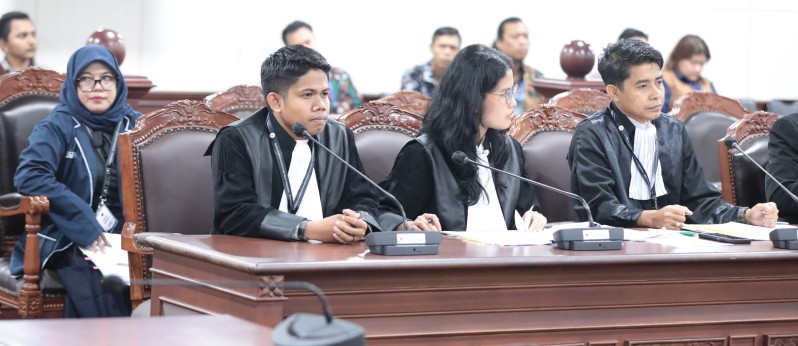
The Petitioners challenging the State Civil Apparatus Law and their legal team presenting the revisions to petition No. 84/PUU-XXIV/2026, Wednesday (4/1/2026). Photo by MKRI/Ilham W. M.
JAKARTA (MKRI) — There has been an addition of petitioner in Case No. 84/PUU-XXIV/2026. Forum Aspirasi Intelektual Nusantara (FAIN) as Petitioner I, represented by chairperson Yumnawati and first vice chair Angga Priatna, is joined by Rizalul Akram as Petitioner II, a lecturer and contract government employee (PPPK), submitted revisions to their petition for the judicial review of Article 34 paragraphs (1) and (2) and Article 52 paragraph (3) letter c of Law No. 20 of 2023 on the State Civil Apparatus (ASN Law) to the Constitutional Court.
“There is an additional (petitioner), Your Honors,” said the Petitioners’ counsel Abdul Basit at the petition revision hearing on Wednesday, April 1, 2026.
In addition, another counsel, Muhamad Arfan, highlighted the phrase “expiration of the work agreement period,” which could potentially undermine legal certainty if interpreted as an automatic termination of employment without an objective and transparent performance evaluation. He argued that, in addition to violating the principles of equality and non-discrimination, the norm a quo also contravenes the principle of legal certainty as guaranteed in Article 28D paragraph (1) of the 1945 Constitution.
The Petitioners contend that the phrase “expiration of the work agreement period” results in the continuity of PPPK employment being entirely dependent on contract renewal that is not normatively guaranteed. Consequently, the future career of PPPK employees becomes unpredictable, there is no assurance of continued service as state apparatus, and it creates uncertainty in professional life planning. Basic law professor at Airlangga University Peter Mahmud Marzuki emphasizes that legal certainty requires norms that are clear, logical, and capable of providing predictability for legal subjects—requirements which, according to the Petitioners, are not fulfilled by the norm a quo.
Furthermore, the ASN Law itself adopts the merit system, which emphasizes the management of state apparatus based on qualifications, competencies, and performance. However, the norm a quo instead places PPPK employees in an uncertain employment relationship, thereby contradicting the merit principle and creating internal inconsistency within the ASN Law.
Accordingly, the norm a quo should be interpreted as a regulation that continues to allow the possibility of sustained PPPK employment based on performance evaluation and organizational needs, so as not to create legal uncertainty. As a result of the application of the norm a quo, the Petitioners claim to have suffered constitutional harm in the form of the absence of guarantees for continued employment as state apparatus, the loss of certainty in career planning and a decent livelihood, and unequal treatment compared to civil servants (PNS) in public employment relations. These harms are specific and at least potential based on reasonable reasoning, and have a causal relationship (causal verband) with the application of the norm a quo.
Also read: Discrimination Between PNS, PPPK on Access to Positions in Civil Service Questioned
In their revised petitums, the Petitioners request the Court to declare that the phrase “be prioritized” in Article 34 paragraph (1) of the ASN LAW conditionally unconstitutional and not legally binding insofar as it is not interpreted to mean that the filling of ASN positions must remain to be merit-based—based on qualifications, competencies, and performance—without discrimination based on employment status; to declare that the phrases “may” and “certain” in Article 34 paragraph (2) of the ASN LAW conditionally unconstitutional and not legally binding insofar as they are not interpreted to mean that PPPK employees have equal opportunities in filling ASN positions based on the merit system; and to declare that the phrase “and/or the expiration of the work agreement” in Article 52 paragraph (3) letter c of the ASN LAW conditionally unconstitutional and not legally binding insofar as it is not interpreted to mean that the termination of PPPK employment must be based on an objective performance evaluation.
Specifically, Article 34 of the ASN Law provides: “(1) Managerial Positions as referred to in Article 14 and Non-Managerial Positions as referred to in Article 18 shall be prioritized to be filled by PNS. (2) Certain Managerial and Non-Managerial Positions may be filled by PPPK.” Meanwhile, Article 52 paragraph (3) letter c stipulates: “Dismissal not at one’s own request for ASN employees occurs if one: a. commits acts against Pancasila and the Constitution of the Republic of Indonesia of 1945; b. passes away; c. reaches the mandatory retirement age for the position and/or the expiration of the work agreement.”
Explore case No. 84/PUU-XXIV/2026 (in Indonesian).
Author : Mimi Kartika
Editor : Lulu Anjarsari P.
PR : Andhini S. F.
Translator : Yuniar Widiastuti (NL)
Disclaimer: The original version of the news is in Indonesian. In case of any differences between the English and the Indonesian versions, the Indonesian version will prevail.
Wednesday, April 01, 2026 | 14:29 WIB 64