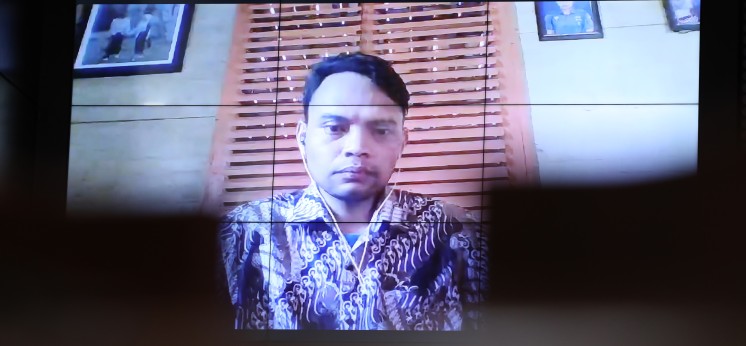
Jangkung Sido Sentosa, Petitioner of Law No. 20 of 2003 on the National Education System, at the panel preliminary hearing, Wednesday (4/1/2026). Photo by MKRI/Ifa.
JAKARTA (MKRI) — Jangkung Sido Sentosa, an organizer of equivalency education at a community learning center (PKBM), has filed a petition for the judicial review of Law No. 20 of 2003 on the National Education System (Sisdiknas Law) with the Constitutional Court. Through Petition No. 98/PUU-XXIV/2026, he challenges Article 26 paragraph (3) and Article 35 paragraph (1) of the Sisdiknas Law against the 1945 Constitution, particularly with regard to the nonformal education.
The preliminary hearing was presided over by Chief Justice Suhartoyo, accompanied by Constitutional Justices Daniel Yusmic P. Foekh and M. Guntur Hamzah. At the hearing on Wednesday, April 1, 2026, Jangkung explained that his petition aims to assess whether the Sisdiknas Law is consistent with the 1945 Constitution, especially in the implementation of nonformal education.
“I [would like] a review whether Law No. 20 of 2003 on the National Education System (Sisdiknas Law) is indeed in conformity with the 1945 Constitution. In that way, the objective of my petition can be achieved. In practice, in the nonformal education, based on my experience, children can easily say that they are not attending school at all. They can easily disengage from the education system, and adult learners, after gaining work experience and skills, face a constraint because the system requires a compulsory three-year period of study, which causes delays, as those who wish to enroll must wait for three years,” Jangkung explained.
In his petition, he argues that there is still no clear measure distinguishing formal and nonformal education, despite both having the same educational standards. He also highlights the provisions on equivalency education, which, in his view, do not explicitly obligate the State to provide proportional mechanisms for equivalency, particularly for adult learners from lower socio-economic backgrounds.
According to the Petitioner, this condition could potentially create unequal treatment and is contrary to the principle of equality before the law as well as fair protection for all citizens. Furthermore, the implementation of the national education standards as regulated in Article 35 paragraph (1) of the Sisdiknas Law has not considered the characteristics of nonformal education.
The Petitioner argues that national standards should ensure the quality of education, not become barriers to access, particularly for adult learners. The rigid application of such standards is considered a potential violation of the principles of accessibility and constitutional justice.
Moreover, the Petitioner emphasizes that nonformal education has different characteristics from formal education. In practice, equivalency education is often treated as an extension of formal education, both in terms of learning structure and process standards, even though participants in this pathway are generally already working and have life experience beyond school age.
Therefore, the Petitioner requests that nonformal education be interpreted as a flexible and adaptive system capable of recognizing work experience and the actual competencies of the community. The State, he argues, has an active and continuous constitutional obligation to ensure that access to education remains open to all citizens, including those who have left the formal education system.
In his petitums, the Petitioner requests the Constitutional Court to declare Article 26 paragraph (3) and Article 35 paragraph (1) of the Sisdiknas Law conditionally unconstitutional and not legally binding, insofar as they are not interpreted in accordance with constitutional principles. He also requests that the State be required to provide fair mechanisms for equivalency and recognition of competencies, as well as to apply educational standards adaptively within the nonformal education pathway.
Justices’ Advice
Responding to the petition, Constitutional Justice M. Guntur Hamzah advised the Petitioner to follow proper petition format. “I believe Mr. Jangkung has not yet read Constitutional Court Regulation No. 7 of 2025,” he stated. He also asked the Petitioner to download sample petitions available on the Court’s official website.
Justice Guntur further requested that the Petitioner clarify his legal standing and elaborate more systematically on the constitutional losses he has suffered. In addition, he asked the Petitioner to improve the rationale of the petition. “In terms of the posita (grounds of the petition), Mr. Jangkung still needs to explain in much greater detail why he considers the challenged norms to be contrary to the Constitution, particularly the constitutional provisions used as the basis for review. It is not sufficient merely to state that they are contrary; the point of contradiction and how such contradiction arises must be clearly explained,” he emphasized.
The panel gave the Petitioners 14 days to revise the petition. The revised petition must be received by the Court no later than Tuesday, April 14, 2026.
Explore case No. 98/PUU-XXIV/2026 (in Indonesian).
Author : Utami Argawati
Editor : Lulu Anjarsari P.
PR : Adriana A. Y.
Translator : Yuniar Widiastuti (NL)
Disclaimer: The original version of the news is in Indonesian. In case of any differences between the English and the Indonesian versions, the Indonesian version will prevail.
Wednesday, April 01, 2026 | 11:57 WIB 52