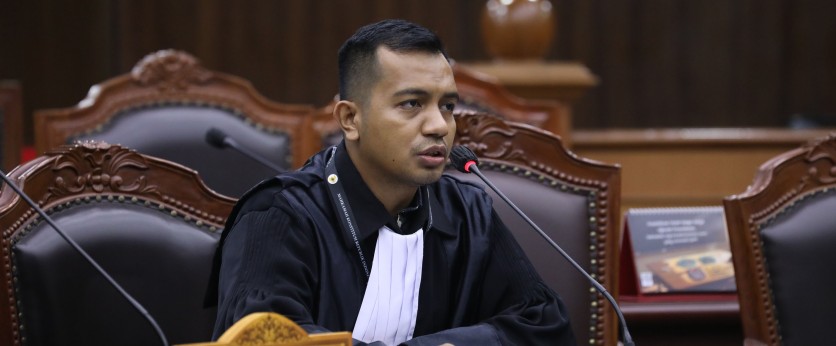
The Petitioner’s legal counsel La Ode Muhammad Faisal Akbar delivering the revised petition in the panel courtroom of the Constitutional Court, Wednesday (4/1/2026). Photo by MKRI/Panji.
JAKARTA (MKRI) — The Constitutional Court again held a hearing for the judicial review of Law No. 20 of 2025 on the Criminal Procedure Code (KUHAP) on Wednesday, April 1, 2026. The second hearing of Case No. 92/PUU-XXIV/2026, filed by Hanter Oriko Siregar challenging Article 235 paragraph (1) letter g, was presided over by Chief Justice Suhartoyo.
The Petitioner’s legal counsel, La Ode Muhammad Faisal Akbar, conveyed that the petition had been revised, particularly with regard to the Petitioner’s legal standing and the posita. He emphasized that the provision recognizing judges’ observations as evidence does not provide clear limitations, unlike the concept of petunjuk (indications) under the previous KUHAP.
“In the previous KUHAP regime, indications were understood as the conformity between legal facts derived from evidence, witness testimonies, and the defendant’s statement, which are then formulated to establish the truth of a criminal event. By contrast, under the a quo KUHAP, judges’ observations as evidence do not have clear boundaries, allowing even observations made outside the courtroom to be considered legally valid,” Faisal explained.
In the revised petitum, the Petitioner requests the Court to declare Article 235 paragraph (1) letter g of the KUHAP, particularly the phrase “evidence consists of: … letter g. ‘judges’ observations’,” as contrary to the 1945 Constitution and not legally binding, or conditionally unconstitutional and therefore not legally binding, insofar as it is not interpreted to mean that judges’ observations cannot stand alone as evidence. Instead, their use must be supported by other lawful evidence, uphold the principles of objectivity and transparency, be clearly reflected in the legal considerations of the decision, and be rationally accountable.
Also read: Advocates Question Judges’ Observations as Evidence in Criminal Procedure Code (KUHAP)
At the preliminary hearing on Wednesday, March 11, 2026, the Petitioner argued that the provision gives rise to serious concerns from the perspectives of procedural law principles, evidentiary theory, and constitutional guarantees of a fair trial. Article 4 of Law No. 20 of 2025 on the KUHAP stipulates that criminal procedure under the Law is conducted through a combination of an active judge system and balanced adversarial parties in court proceedings.
The elucidation of Article 4 defines the active judge system as one in which judges play a significant role in directing proceedings, deciding cases, actively uncovering facts, and carefully assessing evidence. Meanwhile, balanced adversarial parties refer to a system that ensures equilibrium between the rights of investigators, public prosecutors, and suspects or defendants. Thus, Indonesia’s criminal procedure reflects a combination of the Continental European system and the adversarial system.
Within this framework, the Petitioner argued that procedural law principles, within reasonable limits, require a clear boundary between the function of evaluating and the function of proving. By classifying judges’ observations as evidence, the a quo provision gives rise to legal uncertainty, as the boundary between evaluating and proving becomes blurred.
The Petitioner further argued that judges’ observations contradict the very nature of evidence in procedural law. Doctrinally and historically, evidence under the KUHAP constitutes a means of proof that lies exclusively within the domain of the litigating parties, namely the public prosecutor and the defendant, submitted to convince the judge of the truth of a legal fact. Such evidence arises from an adversarial process and has an objective character, meaning it can be presented, examined, and contested openly in court. This nature of evidence is a fundamental prerequisite for the realization of a fair trial.
Author: Sri Pujianti
Editor: Lulu Anjarsari P.
PR: Fauzan Febriyan
Translator: Yuanna Sisilia
Disclaimer: The original version of the news is in Indonesian. In case of any differences between the English and the Indonesian versions, the Indonesian version will prevail.
Explore The Case: Case No. 92/PUU-XXIV/2026 (in Bahasa Indonesia)
Wednesday, April 01, 2026 | 15:19 WIB 63