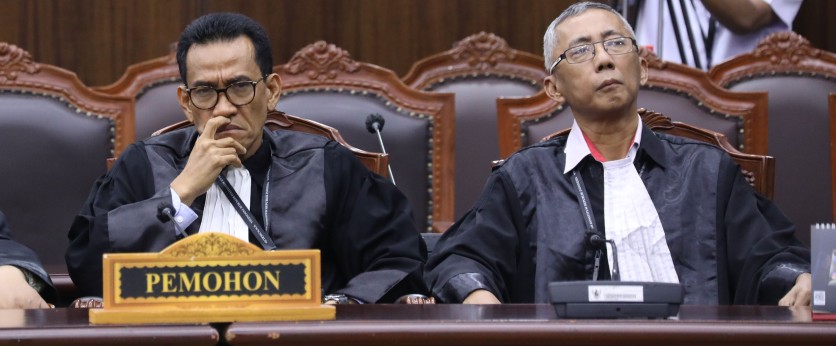
Counsel for the petitioners in the judicial review of the Criminal Code Law and the Electronic Information and Transactions Law attends the pronouncement hearing at the Constitutional Court’s plenary courtroom on Monday (March 16, 2026). Photo: Public Relations/Panji.
JAKARTA, MKRI — The Constitutional Court has declared inadmissible a petition seeking judicial review of several provisions of Law No. 1 of 2023 on the Criminal Code (KUHP) and Law No. 1 of 2024 on the Second Amendment to Law No. 11 of 2008 on Electronic Information and Transactions (ITE Law). The pronouncement hearing for Decision No. 50/PUU-XXIV/2026 was held on Monday (March 16, 2026), presided over by Chief Justice Suhartoyo together with the panel of constitutional justices in the Plenary Courtroom of Building I of the Constitutional Court.
Chief Justice Suhartoyo stated that operative clauses (petitum) numbers 2 through 6 were not supported by corresponding arguments in the posita explaining why the Petitioners sought the norms to be exempted only for academics, researchers, or activists, while remaining applicable to other subjects covered by the a quo provisions. As such, the interpretation requested in petitum numbers 2 to 6 was effectively limited to the Petitioners’ own interests. In fact, he continued, if the norms were to be interpreted as requested, such interpretation would apply generally (erga omnes).
“Furthermore, there is no constitutional argument explaining why the norms under review would be problematic only for academics, researchers, or activists,” Chief Justice Suhartoyo stated in reading the Court’s legal considerations in the petition filed by Tifauzia Tyassuma, Roy Suryo Notodiprojo, and Rismon Hasiholan.
The Court also found that petitum numbers 7 through 9, which sought to link the challenged norms with other provisions using the term juncto, were improperly formulated. The Petitioners requested that such linked provisions be declared unconstitutional and conditionally invalid.
“Such a formulation is uncommon and its intent is unclear—whether it seeks to challenge both provisions connected by juncto. If that is the case, each norm should have been formulated in a separate petitum, as in petitum numbers 2 through 6, which clearly identify a single norm in each request. Accordingly, the formulation of petitum numbers 7 through 9 creates difficulty for the Court in understanding the true intent of the Petitioners’ request,” Suhartoyo explained.
For these reasons, the Court had no hesitation in declaring the petition unclear or obscure. Although the Court acknowledged its jurisdiction over the matter, it declined to proceed further given the lack of clarity in the petition.
Also read:
Tifa, Roy, Rismon Challenge Provisions on Defamation in Criminal Code, EIT Law
Tifa, Roy, and Rismon Elaborate Constitutional Losses in Defamation Provisions Challenge
Petition No. 50/PUU-XXIV/2026 was filed by Tifauzia Tyassuma, Roy Suryo Notodiprojo, and Rismon Hasiholan, challenging the constitutionality of several provisions in the Criminal Code and the ITE Law. The provisions under review included Articles 310(1) and 311(1) of the KUHP; Articles 433(1) and 434(1) of the new Criminal Code; as well as Articles 27A, 28(2), 32(1) and (2), and 35 of the ITE Law.
Article 310(1) of the KUHP provides: “Any person who intentionally attacks the honor or reputation of another by alleging something, with the intent that it becomes publicly known, shall be punished for defamation with imprisonment of up to nine months or a fine of up to four thousand five hundred rupiah.”
Article 311(1) states: “If a person who commits defamation or written defamation is allowed to prove the truth of the allegation but fails to do so, and the allegation is made contrary to what is known, such person shall be punished for slander with imprisonment of up to four years.”
Article 433(1) of the new Criminal Code provides: “Any person who orally attacks the honor or reputation of another by alleging something, with the intent that it becomes publicly known, shall be punished for defamation with imprisonment of up to nine months or a fine up to category II.”
Article 434(1) states: “If a person as referred to in Article 433 is given the opportunity to prove the truth of the allegation but fails to do so, and the allegation is contrary to what is known, such person shall be punished for slander with imprisonment of up to three years or a fine up to category IV.”
Article 27A of the ITE Law provides: “Any person who intentionally attacks the honor or reputation of another by alleging something, with the intent that it becomes publicly known in the form of Electronic Information and/or Electronic Documents through an Electronic System.”
Article 28(2) states: “Any person who intentionally and without authority distributes and/or transmits Electronic Information and/or Electronic Documents containing incitement, persuasion, or influence that generates hatred or hostility toward individuals and/or certain groups based on race, nationality, ethnicity, skin color, religion, belief, gender, mental disability, or physical disability.”
Article 32(1) and (2) provide: “(1) Any person who intentionally and without authority or unlawfully alters, adds, reduces, transmits, damages, deletes, transfers, or conceals Electronic Information and/or Electronic Documents belonging to another person or the public. (2) Any person who intentionally and without authority or unlawfully transfers Electronic Information and/or Electronic Documents to another person’s Electronic System without authorization.”
Article 35 provides: “Any person who intentionally and without authority or unlawfully manipulates, creates, alters, deletes, or damages Electronic Information and/or Electronic Documents with the intent that such data be regarded as authentic.”
During the initial hearing on Tuesday (February 10, 2026), Refly Harun, counsel for the Petitioners, argued that these provisions violate Articles 28D(1), 28E(3), and 28F of the 1945 Constitution, particularly due to their frequent use to suppress criticism, including criticism directed at public officials or former officials.
According to the Petitioners, criticism or opinions concerning public actions, conduct, or decisions of state officials are often shifted from the public domain into the private domain, and subsequently prosecuted under Article 310 in conjunction with Article 311 of the KUHP, now replaced by Articles 433(1) and 434(1) of the new Criminal Code. Such criticism, Refly argued, is often based on research conducted in the public interest and not intended to defame.
In a concrete example, the Petitioners referred to an opinion they expressed regarding the authenticity of an academic diploma of a state official, which they framed as an exercise of transparency and public accountability in assessing the integrity and eligibility of national leaders. Such expression, they argued, should not be suppressed through criminal law under the a quo provisions.
Suspect Status
The Petitioners also challenged the constitutionality of Article 32(1) and (2) in conjunction with Article 35 of the ITE Law, arguing that these provisions had been used to designate them as suspects, thereby infringing upon their constitutional rights. They claimed that the application of these provisions has silenced their efforts to voice public concerns regarding the authenticity of the diploma of Indonesia’s 7th President, Joko Widodo.
According to the Petitioners, in a rule-of-law state that guarantees freedom of expression, such provisions should not be applied to opinions based on data analysis and lacking malicious intent. Democratic actors who express views grounded in research and public interest, and made in good faith, should not be easily subjected to criminal prosecution. This exception, they argued, is necessary to ensure the protection, advancement, enforcement, and fulfillment of human rights as mandated by Article 28I(4) of the 1945 Constitution.
Accordingly, among their requests, the Petitioners asked the Court to declare Article 311(1) of the KUHP unconstitutional and conditionally invalid, unless it is interpreted to mean: “except for criticism or opinions based on research concerning the actions, conduct, or decisions of incumbent or former public officials, which shall not be punishable so long as they are expressed in good faith.”
Full decision in Bahasa Indonesia is available here Decision of Case Number 50/PUU-XXIV/2026
Author : Sri Pujianti
Editor : N Rosi.
Public Relations: Raisa Ayuditha Marsaulina
Translator : SO
Disclaimer: The original version of the news is in Indonesian. In case of any differences between the English and the Indonesian versions, the Indonesian version will prevail.
Monday, March 16, 2026 | 10:11 WIB 96