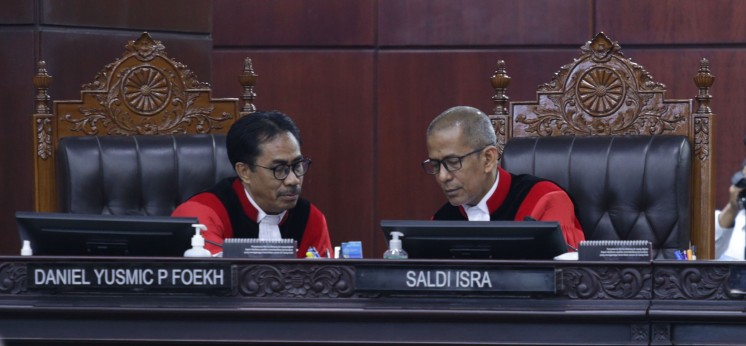
The ruling hearing for Decision No. 46/PUU-XXIV/2026 on the judicial review of Law No. 37 of 2004 on Bankruptcy and Suspension of Debt Payment, Monday (3/16/2026). Photo by MKRI/Bayu.
JAKARTA (MKRI) — The Constitutional Court rejected Petition No. 46/PUU-XXIV/2026 on the judicial review of Article 192 paragraphs (2) and (3) of Law No. 37 of 2004 on Bankruptcy and Suspension of Debt Payment Obligations (PKPU). It considered that the issue of constitutionality raised by the Petitioners, which essentially concerns the procedure for publishing the distribution list in a newspaper and the time limit for the provision of the bankruptcy asset distribution list, calculated from the date the distribution list is announced by the curator in a newspaper.
“The Petitioners’ arguments on the unconstitutionality of Article 192 paragraphs (2) and (3) of Law No. 37 of 2004 were legally groundless,” said Constitutional Justice Ridwan Mansyur, who read the Court’s legal considerations for Decision No. 46/PUU-XXIV/2026 on Monday, March 16, 2026 in the plenary courtroom.
He explained that the time limit for the provision of the distribution list as stipulated in Article 192 paragraph (2) of Law No. 37 of 2004 refers to the five-day period used to announce a summary of the bankruptcy declaration decision in the State Gazette of the Republic of Indonesia and in at least two daily newspapers designated by the supervisory judge. Furthermore, Article 192 paragraph (3) regulates the commencement of the time limit for the provision of the distribution list, namely on the day and date when the provision of the distribution list is announced in the newspaper as referred to in the preceding paragraph. This means that the regulation concerning the commencement of the five-day time limit for the provision of the distribution list differs from that stipulated in Article 1 point 10 of Law No. 37 of 2004, which must be calculated without including the day on which the time limit begins.
If creditors do not agree with the distribution of bankruptcy assets as announced in the distribution list, then pursuant to Article 193 of Law No. 37 of 2004 the creditors may submit a legal remedy in the form of an objection to the distribution list by filing a written objection with the court during the time period as referred to in Article 192 paragraph (1). If within that time period no creditor submits an objection, or if the objection has been decided by the court, the distribution list becomes binding.
“Thus, the legal facts of the case a quo show that with such an interrelated regulatory structure among the articles, the formulation of Article 192 paragraph (2) and paragraph (3) of Law No. 37 of 2004, which are being challenged in the petition a quo, constitute norms that are specific and contextual in nature and whose application must be understood in a complete and comprehensive manner,” Justice Ridwan stated.
In addition, the Petitioners requested that the provision in Article 192 paragraph (2) of Law No. 37 of 2004 concerning the provision of the distribution list and the relevant time limit be interpreted to commence from the receipt of the written provision of the distribution list from the curator to the creditors and the debtor, as well as from the time it is announced in a newspaper as referred to in Article 15 paragraph (4). With regard to this interpretation, the Court held that the mechanism for providing the bankruptcy asset distribution list with the time limit as stipulated in Article 15 paragraph (4)—calculated from the time it is announced in a newspaper by the curator as provided in Article 192 paragraph (2)—constitutes a form of mandate to fulfill the principle of publicity. In essence, this principle aims to ensure that the public and interested parties, particularly creditors, are aware of the provision of the bankruptcy asset distribution list so that creditors are deemed to have knowledge of the existence of the distribution list, which contains details of receipts and expenditures, including the curator’s fees, the names of creditors, the verified amount of each claim, and the portion to be distributed to creditors.
Therefore, if the formulation proposed in the Petitioners’ petitums were to be applied or explicitly formulated so that the calculation of the time limit for the provision of the distribution list would commence “from the receipt of the written provision of the distribution list from the curator to the creditors and the debtor as well as from its announcement in a newspaper as referred to in Article 15 paragraph (4),” it would not only constitute a shift from the implementation of the principle of publicity but would also impose an additional duty or authority on curators to directly deliver the distribution list to creditors and the debtor. According to the Court, this could in fact potentially create legal uncertainty. If the Court were to accommodate the addition of a mechanism requiring the curator to directly deliver the distribution list to creditors and the debtor as requested by the Petitioners, it could potentially create difficulties or obstacles in its implementation.
One reason for this is that in bankruptcy decisions involving a large number of creditors with different and geographically distant domiciles, such a requirement would create difficulties and potentially generate legal uncertainty regarding which legal subject must deliver the written provision of the distribution list and what form of proof could serve as evidence that the written provision of the distribution list had indeed been received by the creditors and the debtor, such that the time limit for filing an objection by creditors would be calculated from the time the written provision of the distribution list was received by the creditors and the debtor.
Justice Ridwan further explained that another potential difficulty could arise if the delivery of the written provision of the distribution list as requested by the Petitioners does not meet the creditor/their legal counsel and/or the debtor/their legal counsel directly. In such circumstances, the proof of delivery of the written provision of the distribution list would be unclear as evidence that the delivery had lawfully occurred and could therefore serve as the benchmark for the time limit for filing an objection. The requirement that the curator provide the bankruptcy asset distribution list within a certain time period, announced by the curator in a newspaper as regulated in Article 192 paragraphs (2) and (3) of Law No. 37 of 2004, cannot be regarded as a form of discriminatory treatment or as an attempt to hinder creditors—in this case the Petitioners—from obtaining their right to fair and proportionate remuneration within an employment relationship.
“The norms of the articles requested to be reviewed by the Petitioners in fact provide legal certainty regarding the mechanism that must be fulfilled by creditors as one of the formal requirements for submitting an objection in order to defend their rights through an objection to the bankruptcy asset distribution list,” Justice Ridwan stated.
Also read:
Salary, Severance Unpaid, Workers Challenge Bankruptcy Law
Challenging Bankruptcy Law, Workers Demand Priority for Payment of Unpaid Wages
The Petitioners are Sutikno, Rislani, Muchammad Solechuddin, Mochamad Farziq, Slamet Wahyudi, Alimah Hariyani, Prins Barin Agus Suryaman, Evi Sudarmini, Siti Anisah, and Saudah. They contested the said provisions for imposing a five-calendar-day time limit for the Petitioners to file objections to discrepancies in the list of claims, calculated from the announcement of the distribution list of the bankruptcy estate by the curator.
The Petitioners stated that the curator’s allocation of the bankruptcy estate did not reflect proportionality in the payment of salary for the Petitioners and approximately 4,800 other employees. They had submitted claims for salary and religious holiday allowance (THR) exceeding Rp86 billion, whereas the curator recognized only Rp51 billion, as recorded in the long term receivables. The salary, severance pay, and religious holiday allowance of the Petitioners and other employees were not paid by the company from October 2021 to February 2022.
They expressed their wish that payment of unpaid workers’/laborers’ wages is prioritized over all categories of creditors. Accordingly, they argue that the deadline for filing objections to the distribution list of the bankruptcy estate should exceed five calendar days, as currently stipulated in the provisions being challenged in this petition. They contended that imposing a five-day time limit is unreasonably short and potentially detrimental to both preferred and concurrent creditors seeking to file objections. There is a legal risk that if an objection is not submitted within five calendar days from its announcement in a newspaper, the time deadline be deemed expired and the distribution list will become binding upon all creditors.
Article 192 paragraph (2) reads: “The distribution list and the period as referred to in paragraph (1) shall be announced by the Curator in the newspapers as referred to in Article 15 paragraph (4).” Meanwhile, Article 192 paragraph (3) reads: “The display period as referred to in paragraph (1) shall start from the date on which the distributions list is advertised in the newspapers as referred to in paragraph (2).”
In their petitums, the Petitioners requested the Court to declare Article 192 paragraphs (2) and (3) of the PKPU Law unconstitutional and not legally binding if not interpreted as: “The distribution list and the period as referred to in paragraph (1) shall commence from the receipt of the written provision of the distribution list by the creditors and the debtor and from its announcement in the newspapers as referred to in Article 15 paragraph (4)” and “The period as referred to in paragraph (1) shall start from the date on which the written distributions list is received by the creditors and the debtor and since its announcement in the newspapers as referred to in paragraph (2),” respectively.
Explore case No. 46/PUU-XXIV/2026 (in Indonesian).
Author : Mimi Kartika
Editor : Lulu Anjarsari P.
PR : Raisa Ayuditha M.
Translator : Yuniar Widiastuti (NL)
Disclaimer: The original version of the news is in Indonesian. In case of any differences between the English and the Indonesian versions, the Indonesian version will prevail.
Monday, March 16, 2026 | 10:55 WIB 181