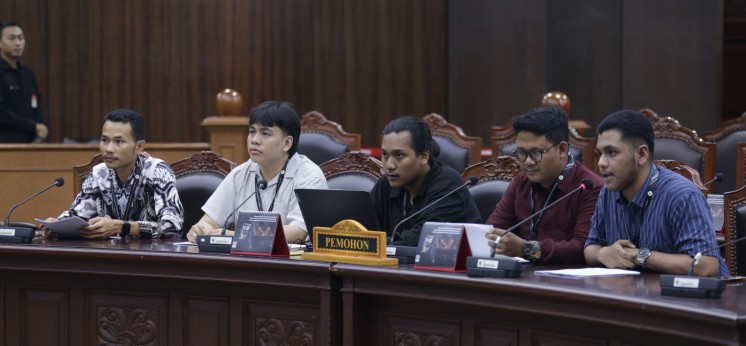
The Petitioners attending the preliminary hearing for the judicial review of Law No. 1 of 2023 on the Criminal Code for Case No. 93/PUU-XXIV/2026, Thursday (3/12/2026). Photo by MKRI/Bayu.
JAKARTA (MKRI) — Delpedro Marhaen Rismansyah and Muzaffar Salim have filed a petition for the judicial review of several provisions in Law No. 1 of 2023 on the Criminal Code (KUHP) to the Constitutional Court. The Case No. 93/PUU-XXIV/2026 concerns the constitutionality of Article 246, Article 263 paragraphs (1) and (2), and Article 263 of the Criminal Code, which concern incitement and the broadcast or spread of hoax that potentially lead to social unrest.
Before the panel chaired by Deputy Chief Justice Saldi Isra, counsel M. Fauzan Alaydrus explained that the provisions could potentially harm the Petitioners’ constitutional rights. “The articles being reviewed in the petition a quo actually obstructs and could potentially criminalize Petitioner I and Petitioner II, whose work focuses on the promotion of human rights, political education, and advocacy,” Alaydrus stated at the hearing.
The Petitioners argued that these provisions may be used as instruments to report or criminalize critics while carrying out advocacy. They believe this has already occurred when law enforcement authorities processed allegations of dissemination of hoax related to data-based information on approximately 400 protesters arrested for the August 2025 protests. The Petitioners contended that the accusation was inconsistent with facts because they had collected data on the arrested protesters in order to provide advocacy and legal assistance to members of the public who participated in the protests.
Another counsel, M. Fahrul Rhozi Lubis, explained that in judicial review proceedings there is a recognized principle of ne bis in idem, in that provisions that have been reviewed and decided upon by the Constitutional Court in final and binding decisions cannot, in principle, be reviewed again. Nevertheless, a review may be submitted again insofar as the constitutional provisions used as the basis for review or the reasons for the petition are different.
The Petitioners stated that a judicial review on the dissemination of hoax had previously been decided in Constitutional Court Decision No. 78/PUU-XXI/2023. However, the object of review in that case is different because it concerns Article 14 and Article 15 of Law No. 1 of 1946 on the Criminal Code as well as Article 27 paragraph (3) and Article 45 paragraph (3) of the Law on Electronic Information and Transactions (EIT Law). Meanwhile, the petition currently submitted challenges the provisions in Article 263 of Law No. 1 of 2023, and therefore does not contravene the principle of ne bis in idem.
Furthermore, the Petitioners argued that the formulation of the norms in the articles under review is overly broad and unclear, thereby creating legal uncertainty. Such conditions, they contended, potentially criminalize activists and human rights defenders when they convey criticism, report violations, or disseminate information related to matters of public interest.
In addition, several phrases in the provisions could allow over-criminalization. According to the Petitioners, vague criminal norms allow broad interpretation by law enforcement authorities in determining whether a particular act may be classified as a criminal offense.
The Petitioners also highlighted Article 246 of the Criminal Code, which regulates “incitement.” Although the article contains an elucidation section, they argued that it does not provide clear and objective limits regarding the meaning of incitement. As a result, calls or appeals expressed in the public sphere within the context of democratic life could potentially be interpreted as criminal acts.
Furthermore, the Petitioners believe that Article 263 paragraph (1) of Law No. 1 of 2023 does not provide a clear definition of the phrase “the news or notification is false.” This lack of clarity, according to the Petitioners, opens the possibility of subjective interpretation and thus creates legal uncertainty.
Meanwhile, Article 263 paragraph (2) and Article 264 of the Criminal Code also contain vague phrases, such as “it is reasonably suspected,” “may result in riots,” “uncertain news,” “exaggerated,” and “incomplete.” The Petitioners argued that these phrases may lead to subjective law enforcement and are inconsistent with the principle of lex certa in criminal law.
They maintained that the principle of legality as stipulated in Article 1 paragraph (1) of the Criminal Code requires that every criminal norm be formulated clearly, firmly, and without multiple interpretations. The lack of clarity in the formulation of criminal norms could violate the guarantee of legal certainty as guaranteed in Article 28D paragraph (1) of the 1945 Constitution.
In addition, the Petitioners argued that the continued applicability of these provisions may hinder freedom of expression and the freedom to convey opinions as guaranteed in Article 28E paragraphs (2) and (3), as well as Article 28F of the 1945 Constitution.
Therefore, the Petitioners requested the Constitutional Court to declare Article 246, Article 263 paragraphs (1) and (2), and Article 264 of the Criminal Code unconstitutional and not legally binding, and to order that the decision be published in the State Gazette of the Republic of Indonesia as appropriate.
Justices’ Advice
In response to the petition, Constitutional Justice Ridwan Mansyur said that in light of the large number of constitutional provisions used as the basis for review, the Petitioners must elaborate on each of them individually. “If there are too many, you may explain them starting from the fifteen that have been identified and at least determine which ones are most appropriate to serve as the constitutional basis for review, so that it is not necessary to elaborate on all fifteen,” he said while advising the Petitioners to follow the guidelines set out in the Constitutional Court Regulation.
The panel gave the Petitioners 14 days to revise the petition. The revised petition must be received by the Court no later than Wednesday, March 25, 2026.
Explore case No. 93/PUU-XXIV/2026 (in Indonesian).
Author : Utami Argawati
Editor : N. Rosi
PR : Fauzan F.
Translator : Yuniar Widiastuti (NL)
Disclaimer: The original version of the news is in Indonesian. In case of any differences between the English and the Indonesian versions, the Indonesian version will prevail.
Thursday, March 12, 2026 | 15:30 WIB 178