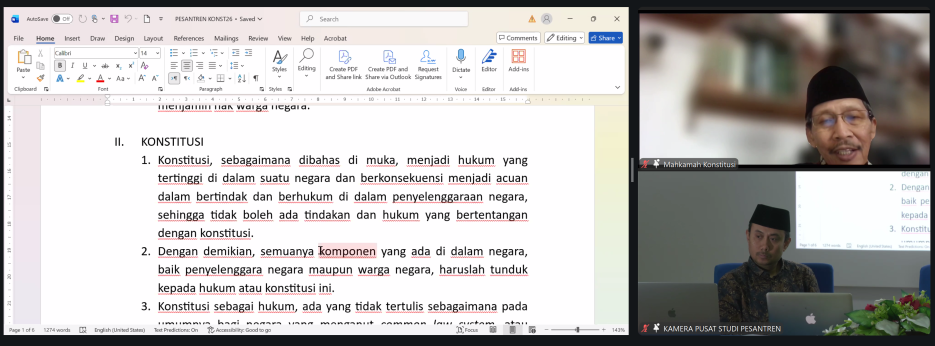
Ahmad Fadlil Sumadi, 2010-2015 Constitutional Justice, delivering material at the Constitutional Pesantren Webinar on Wednesday (3/11/2026). MKRI
JAKARTA (MKRI) – Ahmad Fadlil Sumadi, 2010-2015 Constitutional Justice, stated that santri (Islamic boarding school students) are not only students of knowledge but also the heirs of the kiai (Islamic teachers). Therefore, Islamic boarding school students play a crucial role in safeguarding, protecting, and implementing the constitutional rights of citizens in Indonesia.
"This role is rooted in the history of the independence struggle (such as the 1945 Jihad Resolution) and continues to actively participate in national life today, contributing to the realization of independence," said Fadlil in a Constitutional Pesantren Webinar entitled "Strengthening the National Sanad: Synergy of Fiqh and the Constitution for a Golden Indonesia," organized by the Constitutional Court (MK) in collaboration with the Center for Pesantren Studies and Community Empowerment, Brawijaya University, on Wednesday, March 11, 2026.
Therefore, in this discussion, santri (students) are understood as seekers of knowledge whose function is to seek knowledge within a specific educational system, namely the pesantren.
Teachers or instructors within the pesantren educational system are the kiai (Islamic teachers), whose contributions to the struggle to achieve and maintain independence have been significant to this day. The traces of this struggle are etched in the Preamble to the 1945 Constitution, Paragraph III, which states: "By the grace of Almighty God and motivated by the noble desire to live a free national life, the people of Indonesia hereby declare their independence."
Paragraph III of the Preamble to the 1945 Constitution reflects a view based on faith in God Almighty. Essentially, the achievement of independence, which led to the establishment of this nation, is due to the grace of God Almighty and the noble ideals pursued through the struggle against colonialism.
Some aspects of the role of santri include being role models in tolerance and diversity (Articles 28E & 29 of the 1945 Constitution) by prioritizing unity and moderation in religion (wasathiyah) amidst Indonesia's diversity; socio-economic empowerment (Articles 33 & 34 of the 1945 Constitution) through education and da'wah by motivating and encouraging poverty alleviation in the surrounding community; driving literacy and education (Article 31 of the 1945 Constitution), particularly on basic literacy and expanding public access to knowledge; and prioritizing good manners and civility in democracy (the fourth principle of Pancasila) and prioritizing problem solving through the tradition of deliberation and Islamic values.
This Constitutional Pesantren webinar also featured speakers Ahmad Zaki Fadlur Rohman, a lecturer in Government Studies at the Faculty of Social and Political Sciences, Brawijaya University, and Muhammad Dahlan, a lecturer in the Faculty of Law, Brawijaya University. The webinar was moderated by Wahyu Widodo, a lecturer in the Faculty of Cultural Sciences, Brawijaya University.
Author : Mimi Kartika.
Editor : N. Rosi.
Translator : N. Valentino Rahadityo
Disclaimer: The original version of the news is in Indonesian. In case of any differences between the English and the Indonesian versions, the Indonesian version will prevail.
Wednesday, March 11, 2026 | 15:33 WIB 62