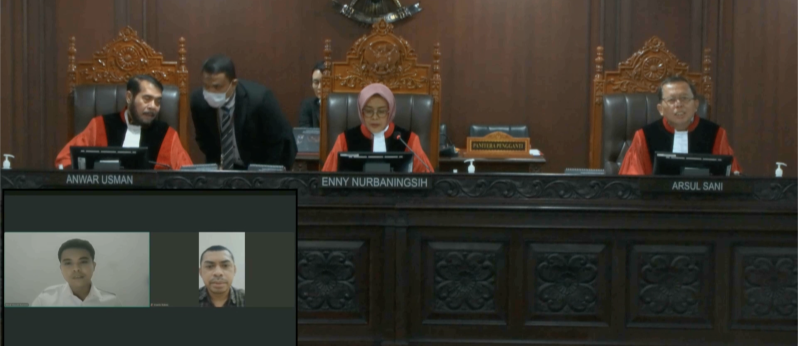
The Petitioners’ counsel for the judicial review petition of Law No. 12 of 2012 on Higher Education entering the courtroom to follow the petition revision hearing, Wednesday (3/11/2026). Photo by MKRI/Ilham W. M.
JAKARTA (MKRI) — The second hearing for the material judicial review of Article 55 paragraph (2) of Law No. 12 of 2012 on Higher Education took place on Wednesday, March 11, 2026. The Case No. 72/PUU-XXIV/2026 was filed by Wirdi Hisroh Komeni and Irianto Kabes (Petitioners I and II).
Panel chair Constitutional Justice Enny Nurbaningsih stated that the Petitioners’ had requested to withdraw their petition. Counsel Wirdi Hisroh Komeni confirmed the request, explaining that the Petitioners had sent a letter containing their request through email.
“Affirmative. What [Justice Enny] mentioned about the petition has been sent yesterday through email. The ground for this withdrawal is that after further evaluation on the petition and its revisions, we realized that many parts needed revision in terms of substance, legal arguments, and format. Despite revisions, we still think there are parts that are ineffective,” Wirdi explained.
Also read: Petitioners Claim University Accreditation An Unconstitutional Civil Service Requirement
At the preliminary hearing on Thursday, February 26, the Petitioners explained that they had completed a masters’ degree in October 2025, graduating cum laude. They believe this academic achievement reflects their hard work, intellectual capacity, and commitment to higher education. They plan on pursuing doctoral studies to develop their academic and professional competencies at reputed universities that boast competent, experienced professors, in order to increase their knowledge quality and analytical capacities optimally.
In addition to academic development, the plan is also related to career prospects, particularly participation in the civil servant candidate (CPNS) selection. “Higher educational qualifications are an important factor in enhancing competitiveness, job qualifications, and the likelihood of passing the selection,” stated counsel Wirdi Hisroh Komeni.
However, the Petitioners argued, the implementation of Article 55 paragraph (2) of Law No. 12 of 2012 on Higher Education has been interpreted and applied as the basis for imposing certain accreditation requirements—such as an A or Excellent accreditation—to pursue doctoral studies at several universities. As a result, they have been unable to apply and compete on equal footing because the accreditation status of their study programs or universities do not meet the criteria set by the destination institution.
They contended that this restriction does not take into account individual capacity, achievement, and competency, but is based solely on administrative factors beyond an individual’s control. In practice, specific accreditation requirements have effectively barred them from continuing their education at their desired universities. They further contended that accreditation, originally intended as an instrument for institutional quality assurance, has shifted into an individual requirement that restricts citizens’ rights to pursue further education.
Beyond its impact on access to education, the implementation of the norm is also considered detrimental in the field of employment. In recruitment processes, several government agencies and employers require specific accreditation statuses of applicants’ universities and study programs as a basis for recognizing the cum laude distinction.
Consequently, although they factually graduated cum laude, the Petitioners claimed they were not recognized as such in employment selection processes because they did not meet the specified accreditation requirements. They argued that this condition violates their constitutional rights to legal certainty and equal treatment before the law. They maintained that the constitutional harm they have suffered is specific, actual, and concrete, as they have directly encountered obstacles in continuing their education and obtaining employment. They also assert the existence of a causality (causal verband) between the enforcement of Article 55 paragraph (2) of the Higher Education Law and the constitutional harm experienced.
Explore case No. 72/PUU-XXIV/2026 (in Indonesian).
Author : Utami Argawati
Editor : Lulu Anjarsari P.
PR : Adriana A. Y.
Translator : Yuniar Widiastuti (NL)
Disclaimer: The original version of the news is in Indonesian. In case of any differences between the English and the Indonesian versions, the Indonesian version will prevail.
Wednesday, March 11, 2026 | 19:21 WIB 68