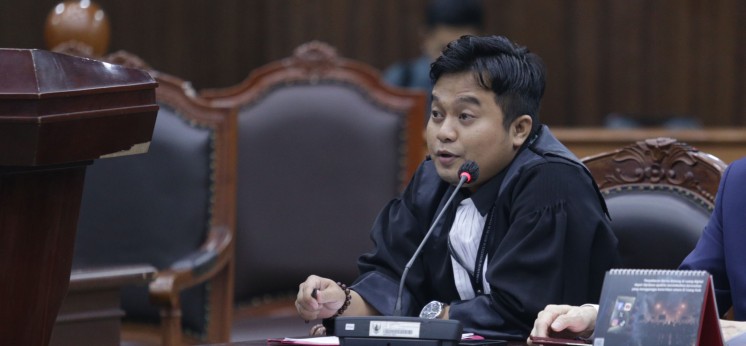
The Petitioner during the Preliminary Hearing for Case No. 88/PUU-XXIV/2026 on the judicial review of Law No. 14 of 2025 (Third Amendment to Law No. 8 of 2019 on the Organization of Hajj and Umrah), Monday (March 9, 2026). Public Relations/Bay.
JAKARTA, MKRI — PT Zidna Alfarizi International (Zai Travel) has filed a petition for judicial review of Article 9(3) of Law No. 14 of 2025 on the Organization of Hajj and Umrah (PIHU Law) with the Constitutional Court. In Petition No. 88/PUU-XXIV/2026, the Petitioner argues that the phrase “in accordance with its proportion” within the provision fails to provide clear normative standards or parameters.
“The lack of clarity creates interpretive ambiguity as to whether the term ‘proportion’ refers to the allocation scheme of the basic Hajj quota as regulated under Article 64(2) of Law No. 14 of 2025, or whether such proportion is entirely determined by the Minister based on factual needs following deliberation with the DPR, as provided under Article 9(1). This ambiguity constitutes the source of the Petitioner’s constitutional harm,” stated Moh Qusyari, counsel for the Petitioner, during the preliminary hearing on Monday (March 9, 2026).
Article 9(3) of the PIHU Law provides: “The allocation of additional Hajj quotas as referred to in paragraph (1) shall be designated for regular Hajj quotas and special Hajj quotas in accordance with their proportion and must be announced online and periodically.” Meanwhile, Article 9(1) grants the Minister authority to determine the allocation of additional Hajj quotas, including through deliberation with the DPR.
The phrase “in accordance with its proportion” lacks explicit normative reference, thereby opening the door to varying interpretations in its implementation. According to the Petitioner, this ambiguity has had serious implications in governance practice. It creates space for divergent interpretations and legal uncertainty. As a concrete example, a former Minister of Religious Affairs, Yaqut Cholil Qoumas, was named a suspect by the Corruption Eradication Commission (KPK) in connection with a policy allocating additional Hajj quotas equally—50 percent for regular Hajj and 50 percent for special Hajj.
This case, the Petitioner argues, illustrates how a norm lacking legal certainty can give rise to legal consequences, both for state administrators and affected business actors. When the a quo provision does not explicitly define the standard for proportional allocation, any policy adopted within discretionary space becomes vulnerable to legal challenge. This situation underscores how the phrase “in accordance with its proportion” generates concrete legal uncertainty in the administration of Hajj.
For the Petitioner, certainty regarding the proportion of special Hajj quotas is not merely an administrative matter, but one that directly affects business continuity, operational planning, contractual commitments with prospective pilgrims, and both existing and future investments. Without clarity as to whether additional quotas will follow the composition of the base quota or be determined entirely through annual ministerial policy, the Petitioner lacks a reliable legal basis to plan service capacity, estimate the number of pilgrims, or formulate business strategies. Consequently, the ambiguity of the phrase directly impacts the Petitioner’s constitutional right to legal certainty.
In its petition, the Petitioner requests the Court to declare the phrase “in accordance with its proportion” in Article 9(3) of Law No. 14 of 2025 unconstitutional and conditionally invalid, unless it is interpreted to mean “in accordance with the proportion determined by the Minister following deliberation with the DPR as referred to in paragraph (1).”
The case is being heard by a panel of justices chaired by Constitutional Justice Enny Nurbaningsih, alongside Constitutional Justices Ridwan Mansyur and Arsul Sani. During the advisory session, Justice Arsul Sani suggested that the Petitioner carefully review the entirety of Article 9 of the PIHU Law, as well as prior petitions challenging similar provisions.
“My suggestion, as material for your revision, is that you may also refer—if you have not already to the Government’s statement and the exchange between the constitutional justices and the Government in Petition No. 237 (237/PUU-XXIII/2025), which is available on YouTube,” Arsul remarked.
Before adjourning the hearing, Justice Enny Nurbaningsih stated that the Petitioner is granted one opportunity to revise the petition within 14 days. The revised submission must be received by the Court no later than Wednesday, March 25, 2026, at 12:00 WIB.
Explore the Case: Petition No. 88/PUU-XXIV/2026
Author : Mimi Kartika
Editor : N. Rosi
Translator : SO
Disclaimer: The original version of the news is in Indonesian. In case of any differences between the English and the Indonesian versions, the Indonesian version will prevail.
Monday, March 09, 2026 | 15:40 WIB 43