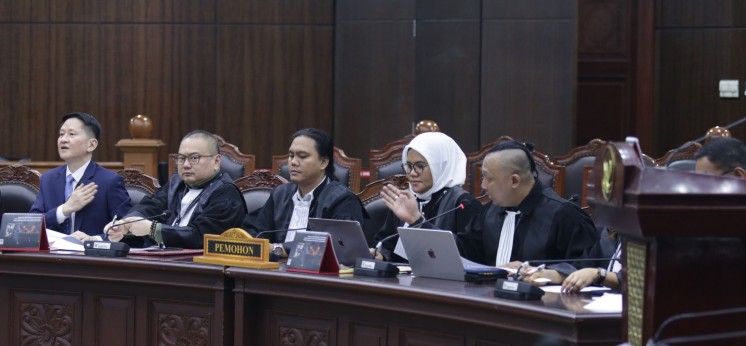
The Petitioners attending the preliminary hearing for Case No. 85/PUU-XXIV/2026 on the judicial review of Law No. 37 of 2004 on Bankruptcy and Suspension of Debt Payment Obligations, Monday (3/9/2026). Photo by MKRI/Bay.
JAKARTA (MKRI) — Eight advocates and curators have filed a petition for a constitutional review of Article 292 and Article 293 paragraph (2) of Law No. 37 of 2004 on Bankruptcy and Suspension of Debt Payment Obligations (Law 37/2004) with the Constitutional Court. The preliminary hearing for Petition No. 85/PUU-XXIV/2026 took place on Monday, March 9, 2026, in the Court’s Plenary Courtroom in Jakarta.
The Petitioners are ST Luthfiani, Syamsul Jahidin, Henoch Thomas, Popy Desiyantie, Fredy Limantara, Uswatun Hasanah, Steven Izaac Risakotta, and Elyas Marulitua. In their petition, they argue that Article 292 of Law 37/2004 creates legal uncertainty regarding the legal consequences of bankruptcy rulings, particularly those arising from the suspension of debt payment obligations (PKPU) process.
Speaking before the panel of constitutional justices chaired by Constitutional Justice Enny Nurbaningsih, Syamsul Jahidin stated that the phrase “no settlement may be offered” in the a quo provision is vague and lacks clarity. According to him, the provision is irrelevant to the context of bankruptcy rulings and generates confusion and legal uncertainty, as it opens the door to multiple interpretations due to the absence of clear limitations governing its implementation and execution.
“The provision does not explicitly clarify the legal consequences of bankruptcy rulings resulting from the PKPU process. The phrase used instead creates ambiguity and allows multiple interpretations, thereby failing to ensure fair legal certainty for all parties involved, including curators and administrators,” Syamsul told the bench.
The Petitioners further contend that such ambiguity affects the performance of curators and administrators following a bankruptcy declaration by the commercial court. Article 292, they argue, does not explicitly stipulate the relevant time limits and instead refers to another provision deemed irrelevant to the context of bankruptcy rulings.
They explained that Law 37/2004 recognizes two types of bankruptcy rulings. The first arises from bankruptcy petitions as regulated in Chapter II of the law, with the state of insolvency governed by Article 178 paragraph (1). The second arises from the PKPU process under Chapter III, in which insolvency is regulated by Article 292.
However, Article 292 contains a phrase referring to Article 286 of Law 37/2004. The Petitioners maintain that such a reference is not relevant to the substance of the norm concerning bankruptcy rulings. Article 286 itself governs settlements that have been ratified and bind all creditors, except those who reject the settlement plan as referred to in Article 281 paragraph (2).
In the Petitioners’ view, the more appropriate reference should instead be Article 289 of Law 37/2004. This article stipulates that if a settlement plan is rejected, the supervisory judge must immediately notify the court of the rejection by submitting the settlement plan along with the minutes of the creditors’ meeting. Upon receiving the notification, the court must declare the debtor bankrupt.
For this reason, the Petitioners request that the phrase “Article 286” in Article 292 be interpreted as “Article 289,” thereby making the legal framework governing bankruptcy rulings arising from the PKPU process more coherent and logically connected.
In addition, the Petitioners also challenge Article 293 paragraph (2) of Law 37/2004. They argue that the provision creates inequality and legal uncertainty by granting discretionary authority to the Attorney General to pursue legal remedies, which they believe could potentially open the door to the criminalization of the curator and administrator professions.
The Petitioners also highlighted practical issues arising from the unclear wording of Article 292 in bankruptcy proceedings. According to them, the provision may allow new creditors to emerge after a bankruptcy ruling, which could affect the composition of voting rights at creditors’ meetings.
“This condition may potentially lead to the manipulation of voting rights or interference with the independence of curators. It may even enable the emergence of new creditors who control the majority of votes and propose the replacement of curators during creditors’ meetings,” Syamsul stated.
Based on these arguments, the Petitioners request that the Court declare Article 292 and Article 293 paragraph (2) of Law 37/2004 contrary to the 1945 Constitution and therefore not legally binding, or at least provide a constitutional interpretation that ensures fair legal certainty for all parties involved in bankruptcy and PKPU practices.
Justices’ Advice
Responding to the petition, Constitutional Justice Arsul Sani offered several notes to the Petitioners during the hearing. He advised them to strengthen their legal standing by presenting evidence demonstrating actual constitutional harm.
According to Arsul, the Petitioners must more clearly explain their position and the losses they claim to have suffered, for instance, in their capacity as advocates representing parties involved in bankruptcy proceedings.
“The constitutional rights at issue must be clearly demonstrated. For example, as advocates representing a bankrupt company who feel disadvantaged, so that the harm appears actual. If such harm indeed exists, it must be substantiated, because the petition currently only states that the Petitioners are advocates and curators,” Arsul said.
He also urged the Petitioners to reexamine the section outlining the reasons for the petition to clearly distinguish between issues concerning the constitutionality of the norm and those relating to its practical implementation.
“In the section on the reasons for the petition, please reconsider whether the matter being reviewed truly concerns the constitutionality of the norm, or rather the practice or implementation of the norm. This must be carefully examined,” Arsul added.
The panel of justices subsequently granted the Petitioners time to revise their petition in accordance with the Court’s advice. The revised petition must be submitted to the Court no later than Wednesday, March 25, 2026 at 12:00 p.m. WIB.
Author: Utami Argawati
Editor: N. Rosi
PR: Andhini SF
Translator: Yuanna Sisilia
Disclaimer: The original version of the news is in Indonesian. In case of any differences between the English and the Indonesian versions, the Indonesian version will prevail.
Monday, March 09, 2026 | 15:19 WIB 103