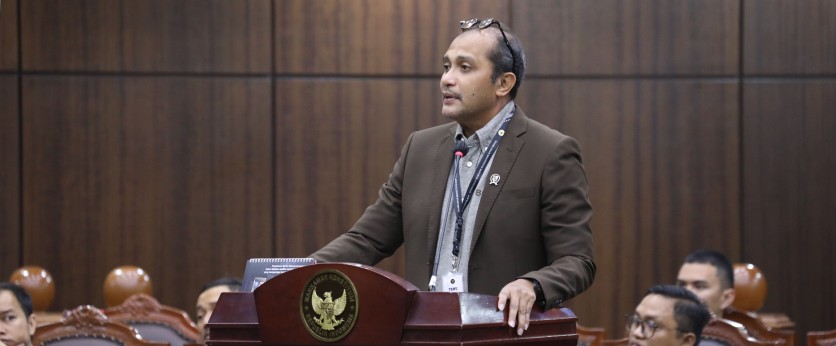
Deputy Minister of Law Eddy O. S. Hiariej testifying on behalf of the Government at the third judicial review hearing of Law No. 1 of 2023 on the Criminal Code, Monday (3/9/2026). Photo by MKRI/Panji.
JAKARTA (MKRI) — The provisions on insult against state powers or state institutions under Articles 240 and 241 of the new Criminal Code was meant to maintain the legitimacy of state institutions, so that they can perform public service functions effectively, without any damage due to baseless hate speech or slander.
This statement was delivered by the Deputy Minister of Law Eddy O. S. Hiariej at a material judicial review hearing on the judicial review of Law No. 1 of 2023 on the Criminal Code (KUHP) against the 1945 Constitution on Monday, March 9, 2026. This third hearing for Case No. 282/PUU-XXIII/2025 had been scheduled to hear the House of Representatives (DPR) and the President/Government, but the House had asked for a delay.
In response to the petition filed by Tania Iskandar, Sila Fide Novira Nggebu, Muhammad Restu, Yuni Wulan Ningsih, Ika Minawati, Putra Muhamad Fadilla, Tasya Ayu Hapsari, Mawar Prasiska Nur Rizki, and Riesa Zhafirah (Petitioners I-IX), the Government explained that those norms were not meant to suppress criticism against state administrators.
“Conversely, they serve to provide clear limits between criticism against public policies, which constitute a constitutional right of citizens, and insult in the form of verbal abuse or slander, which could harm the honor of state institutions,” Hiariej said.
Also read:
At Risk of Criminalization for Criticizing Govt, Students Challenge Criminal Code
Petitioners Expand Object of Review on Criminalization of Critics Against Govt
At the preliminary hearing on Wednesday, January 14, 2026, Priskila Octaviani, counsel for the Petitioners, argued that the enforcement of Article 240 of the Criminal Code directly places the Petitioners in a position vulnerable to restrictions and criminalization in the exercise of their constitutional rights. This is because the phrase “insulting the government or a state institution” in the provision a quo does not provide a clear definition or objective parameters, thereby opening broad and subjective interpretive space—particularly in distinguishing between criticism, academic assessment, and political expression, on the one hand, and conduct categorized as “insult,” on the other.
The Petitioners contend that the Elucidation to Article 240 fails to provide firm and measurable parameters to distinguish criticism, academic assessment, political expression, satire, and conduct that may be criminally sanctioned as “insult.” As a result, citizens, including the Petitioners, cannot reasonably predict when a lawful expression may transform into a criminal offense.
The Petitioners further argue that the enforcement of Article 241 of the Criminal Code significantly expands the scope for criminalization, as it targets any person who broadcasts, displays, affixes writings or images, plays recordings, or disseminates through information technology media any expression deemed to contain an insult against the government or a state institution, with the intent that it be publicly known.
In substance, this norm directly targets the Petitioners’ activities as law students who actively use social media, online discussion platforms, and information technology media to disseminate ideas, analyses, and critiques of public policy. The Petitioners are threatened not only when creating an expression, but also when disseminating or sharing the expressions of others, including activities commonly associated with academic and social engagement. If such conduct is deemed an insult based on subjective interpretation, the provision creates a real and disproportionate threat to the Petitioners’ freedom of expression.
Explore case No. 282/PUU-XXIII/2025 (in Indonesian).
Author : Sri Pujianti
Editor : Lulu Anjarsari P.
PR : Fauzan Febriyan
Translator : Yuniar Widiastuti (NL)
Disclaimer: The original version of the news is in Indonesian. In case of any differences between the English and the Indonesian versions, the Indonesian version will prevail.
Monday, March 09, 2026 | 11:07 WIB 188