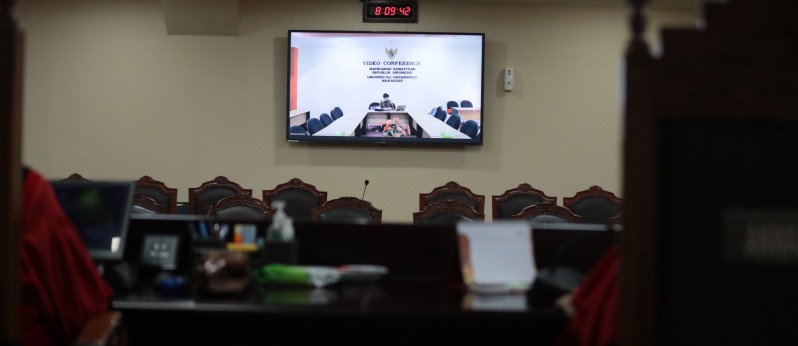
The Constitutional Court holding a preliminary hearing for the judicial review of the Traffic and Road Transportation Law on Friday (3/6/2026), examining a petition filed by Stevent Hutri Tandungan, a student of the Faculty of Law at Hasanuddin University. Photo by MKRI/IlhamWM.
JAKARTA (MKRI) — The Constitutional Court (MK) held a preliminary hearing on Friday, March 6, 2026 to examine a petition for judicial review of Article 24 paragraphs (1) and (2) as well as Article 273 paragraphs (1) and (4) of Law No. 22 of 2009 on Traffic and Road Transportation against the 1945 Constitution. The petition, registered as Case No. 82/PUU-XXIV/2026, was filed by Stevent Hutri Tandungan. The hearing was presided over by Constitutional Justice Enny Nurbaningsih, accompanied by Constitutional Justices Anwar Usman and Arsul Sani.
Attending the hearing virtually, the Petitioner argued that several provisions of the Traffic and Road Transportation Law raise constitutional issues, particularly concerning the phrase “damaged road” in Article 24, which, according to him, lacks a clear definition and measurable parameters within the statute. This ambiguity, he contended, potentially gives rise to multiple interpretations in its implementation.
“The applicability of the a quo provisions creates legal uncertainty for the Petitioner in carrying out daily activities as part of the intellectual community. My constitutional rights guaranteed under Article 28C paragraph (2) of the 1945 Constitution are impaired because Articles 24 and 273 employ the term ‘damaged road’ without providing a clear definition,” Stevent stated before the panel of constitutional justices.
The Petitioner also claimed constitutional impairment regarding the right to convenience and special treatment as stipulated in Article 28H paragraph (2) of the 1945 Constitution. In his daily activities, he frequently travels through damaged roads and therefore does not obtain adequate guarantees of safety and comfort when using public road infrastructure.
“The condition of the damaged road, as evidenced in Exhibit P-7, clearly endangers the safety of the Petitioner and other road users. Such risks may persist as long as the a quo provisions remain in force without any clear definition or measurable benchmarks,” he added.
In his petition, the Petitioner highlighted the vagueness of the norm in Article 24 of the Traffic and Road Transportation Law, which provides neither a definition nor objective criteria regarding what constitutes a “damaged road.” According to him, such ambiguity contravenes the principle of the rule of law enshrined in Article 1 paragraph (3) of the 1945 Constitution, which requires legal norms to be formulated clearly and to avoid multiple interpretations (lex certa).
“The absence of clarity in the phrase ‘damaged road’ opens broad and subjective interpretation by road administrators, thereby potentially resulting in unequal treatment for the public,” the Petitioner asserted.
Beyond the definitional issue, the Petitioner also criticized Article 273 of the same law, which requires the occurrence of an accident causing casualties as the basis for imposing criminal liability on road administrators. He argued that such a normative construction is reactive in nature, as accountability only arises after an accident has occurred. In a rule-of-law state, he maintained, the protection of citizens’ safety should be preventive rather than contingent upon the emergence of victims.
The Petitioner further referred to the theory of the positive obligation of the state, which emphasizes the duty of the state to actively safeguard its citizens, including through the establishment of clear regulations, measurable safety standards, and effective accountability mechanisms. He also invoked the principle salus populi suprema lex esto, which places the safety of the people as the supreme law. In this regard, he argued that regulations governing road maintenance as part of public infrastructure should be framed clearly and progressively to ensure public safety.
The Petitioner also contended that the absence of a definition and objective indicators for the phrase “damaged road” makes the assessment of road conditions heavily dependent on the subjective judgment of road administrators. Such circumstances may lead to misdirected prioritization in road handling, excessive technical planning (overdesign), and repeated maintenance work.
Through his petitum, the Petitioner requested that the Constitutional Court grant the petition in its entirety. He asked the Court to declare the phrase “damaged road” in Article 24 paragraphs (1) and (2) as well as Article 273 paragraphs (1) and (4) of the Traffic and Road Transportation Law unconstitutional and not legally binding insofar as it is not interpreted as referring to road conditions determined based on objective, measurable, and scientifically accountable technical indicators. He also requested that the provisions be conditionally declared unconstitutional if the imposition of obligations, criminal sanctions, or compensation is based on subjective assessments of road conditions lacking clear legal parameters.
Responding to the petition, Constitutional Justice Arsul Sani advised the Petitioner to study previous Constitutional Court decisions that granted similar petitions as references for revising his submission.
“A petition that has been granted by the Court demonstrates that the formulation of legal standing, the grounds of the petition, the posita, and the petitum have been deemed appropriate. You may examine Constitutional Court Decision No. 119 of 2025, filed by a university student concerning the Environmental Law, to gain better inspiration,” Arsul remarked.
He also asked the Petitioner to elaborate more clearly on the reasons for reviewing each of the challenged articles.
“You must explain why Article 24 and Article 273 contradict the 1945 Constitution. Such explanations should be set out in separate sub-sections, because the use of multiple constitutional grounds requires each alleged contradiction to be explained in detail,” he emphasized.
At the end of the hearing, the panel granted the Petitioner 14 days to revise the petition. The revised petition must be submitted to the Court no later than Wednesday, March 25, 2026 at 12:00 p.m. Western Indonesian Time.
Explore the Case: Case No. 82/PUU-XXIV/2026
Author : Utami Argawati
Editor : Lulu Anjarsari P.
PR : Raisa Ayuditha M.
Translator : Yuanna Sisilia
Disclaimer: The original version of the news is in Indonesian. In case of any differences between the English and the Indonesian versions, the Indonesian version will prevail.
Friday, March 06, 2026 | 09:39 WIB 47