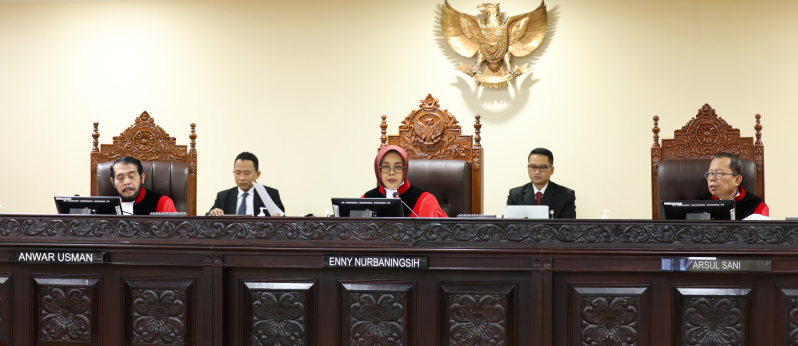
Constitutional Justice Enny Nurbaningsih presides over the Petition Revision hearing for Case Number 66/PUU-XXIV/2026, accompanied by Constitutional Justices Anwar Usman and Arsul Sani. Photo by MKRI/Fauzan.
JAKARTA, (MKRI) – The Constitutional Court again held a judicial review hearing concerning Article 16 paragraph (6), Article 20 paragraph (2), and Article 20 paragraph (4) of Law Number 30 of 2014 on Government Administration, on Thursday (03/05/2026) at the Panel Courtroom, Jakarta. The hearing agenda was to hear the revision of the petition submitted by the Petitioners.
In the Petition Revision hearing for Case Number 66/PUU-XXIV/2026, the Petitioners—represented by their legal counsel Febriansyah Ramadhan—stated that the revisions had been made in accordance with the advice of the Panel of Constitutional Justices during the previous hearing. He explained that the Petitioners consist of three qualification groups, namely law faculty lecturers, law students, and a village head.
Another legal counsel, I Gusti Agung Kidi, explained that the Petitioners had elaborated their legal standing as well as the constitutional harm they had suffered. According to him, the use of the term “state financial loss” in the government administration norm creates ambiguity that leads to conceptual uncertainty both in practice and in legal education.
“This ambiguity is reinforced in policy practices and court decisions, thereby creating conceptual uncertainty that disrupts the process of legal education. Its impact is constitutional in nature, including impairing the right to fair legal certainty as guaranteed under Article 28D paragraph (1) of the 1945 Constitution of the Republic of Indonesia (UUD 1945), and potentially hindering the development of science and participation in legal development,” said I Gusti Agung Kidi.
He added that the lack of clarity in the norm also has the potential to create disparities in treatment that contradict the principle of equality before the law as stipulated in Article 27 paragraph (1) of the 1945 Constitution of the Republic of Indonesia (UUD 1945). Therefore, according to the Petitioners, the challenged norm directly causes the violation of their constitutional rights.
Furthermore, Petitioners IV to VII, who are students of the Faculty of Law at Universitas Pendidikan Nasional (Undiknas), also claimed to be harmed by the inconsistency in the use of the phrases “state financial loss” and “state loss” in Article 16 and Article 20 of the Government Administration Law. In their learning process, the students studied that the term “state financial loss” is commonly used in the criminal law regime, particularly in corruption offenses, which require elements such as unlawfulness, abuse of authority, and proof of actual loss as regulated in corruption laws and affirmed in Constitutional Court Decision Number 25/PUU-XIV/2016.
However, according to the Petitioners, the challenged norm places the term within an administrative mechanism, thereby creating conceptual confusion in understanding the boundary between administrative law and criminal law.
Meanwhile, Petitioner VIII, who serves as a village head, stated that he is potentially directly affected by the provision. In carrying out his authority to manage village funds, make administrative decisions, and implement development programs, a village head operates within a framework of supervision and audits related to potential state losses.
In the posita section, the Petitioners also revised the object of the petition by clarifying the specific paragraphs and subparagraphs being challenged. In addition, there were updates in the wording of the petition to ensure greater legal precision.
“In the section on the object of the petition, we have narrowed down the specific paragraphs and subparagraphs and updated the phrasing in the formulation of the norm being reviewed,” said Febriansyah Ramadhan.
Read also:
Challenging the Phrase “State Financial Loss” in the Government Administration Law
Previously, eight Petitioners filed a judicial review of Article 16 paragraph (6), Article 20 paragraph (2), and Article 20 paragraph (4) of Law Number 30 of 2014 on Government Administration. The petition was registered under Number 66/PUU-XXIV/2026 and submitted by Ni Gusti Agung Ayu Mas Tri Wulandari (Petitioner I), I Putu Edi Rusmana (Petitioner II), Putu Wahyu Widiartana (Petitioner III), Putra Lorenzo (Petitioner IV), Kadek Jessica Aswanda Putri (Petitioner V), Ayu Bang Bahari Ken Widyawati (Petitioner VI), Gusti Ayu Agung Anindya P. (Petitioner VII), and I Nyoman Widhi Adnyana (Petitioner VIII).
The object of the petition concerns the use of the phrase “state financial loss” in Article 16 paragraph (6), Article 20 paragraph (2), and Article 20 paragraph (4) of Law Number 30 of 2014. The Petitioners challenge the inconsistency of terminology within the same set of norms, as Article 20 paragraphs (5) and (6) use the phrase “state loss.” As constitutional grounds, the Petitioners argue that these provisions are contrary to Article 27 paragraph (1), Article 28D paragraph (1), Article 28D paragraph (3), and Article 28I paragraph (4) of the 1945 Constitution of the Republic of Indonesia (UUD 1945).
In the hearing chaired by Constitutional Justice Enny Nurbaningsih, the Petitioners argued that there is inconsistency and conceptual incoherence in Article 20 paragraph (2) letter c and paragraph (4) of the Government Administration Law, which use the phrase “state financial loss,” while paragraphs (5) and (6) of the same article use the phrase “state loss.” According to the Petitioners, this difference in terminology creates ambiguity in the norm and results in legal uncertainty.(*)
Author : Utami Argawati
Editor : Lulu Anjarsari P.
PR : Raisa Ayuditha M.
Translator : Agusweka PS.
Disclaimer: The original version of the news is in Indonesian. In case of any differences between the English and the Indonesian versions, the Indonesian version prevails.
Explore the Case: Number 66/PUU-XXIV/2026.
Thursday, March 05, 2026 | 17:37 WIB 66