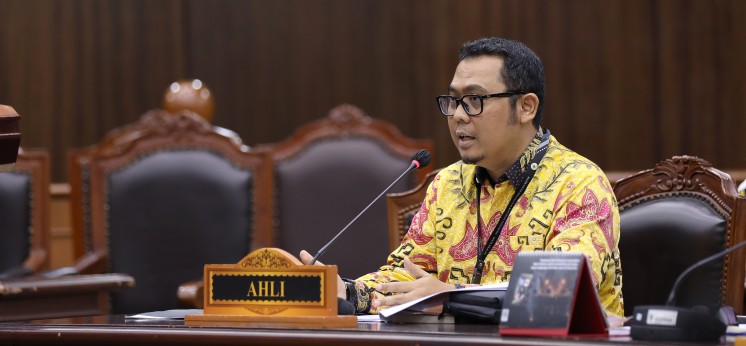
Arie Afriansyah, a government expert, delivering testimony at the hearing on the material review of Law No. 32 of 2014 on Maritime Affairs, Thursday (3/5/2026). Photo by MKRI/Ifa.
JAKARTA (MKRI) – The Maritime Security Agency (Bakamla)'s role as a coordinating hub becomes increasingly crucial when incidents involving multiple legal violations occur. In practice, a single vessel may be involved in several violations, including shipping, customs, immigration, and other criminal offenses. If each agency acts independently, there will be a tug-of-war over authority, repeated inspections, and the risk of mishandling of evidence. Therefore, in this case, Bakamla can act as an operational intermediary by ensuring early termination and securing of vessels and routing cases to the appropriate investigators.
This is the statement of Arie Afriansyah in his capacity as an Expert for the President/Government which was delivered in the hearing of the material review of Article 59 paragraph (3), Article 61, Article 62 letter c, and Article 63 paragraph (1) letter b of Law No. 32 of 2014 on Maritime Affairs (Marine Law) on Thursday, March 5, 2026. The ninth hearing of Petition No. 180/PUU-XXIII/2025 which was filed by Lukman Ladjoni was on the agenda of hearing the statements of Experts presented by the President/Government.
"So if this pattern is institutionalized, the system that is formed can be properly called a Synergized Patrol with Multidoor Legal System, namely integrated patrols in the field, but the legal handling doors remain plural according to the regime and competence of each investigator," explained Arie Afriansyah, who is also a Professor of Maritime Law at the Faculty of Law, University of Indonesia (FHUI) and Director of the Center for Sustainable Ocean Policy in the Plenary Courtroom of the Court.
Procedural Discipline
Arie further explained that from a criminal procedural law perspective, the concept of "law enforcer/investigator" essentially refers to officials authorized by law to conduct investigations, including the associated procedural actions. Therefore, Bakamla's authority to conduct stops, inspections, initial security/detention, and arrests within the context of maritime operations must be understood as technical assistance and initial security. Furthermore, Bakamla must immediately connect them with authorized investigators.
According to the expert, the key to implementing this system lies in procedural discipline. In other words, when Bakamla exercises its authority, it coordinates quickly with relevant sectoral investigators. Meanwhile, the determination of suspects based on at least two pieces of sufficient evidence remains the domain of investigators, not Bakamla. Therefore, Arie continued, Bakamla doesn’t take over the investigative function, but rather ensures that the legal process can begin and proceed on the right track.
If there is an argument that Bakamla's interdiction authority creates legal uncertainty, the Expert provides a relevant analogy with the authority of the Financial Transaction Reports and Analysis Center (PPATK). In the regime for preventing and eradicating money laundering and terrorism financing, PPATK can temporarily freeze transactions/accounts for a certain period when there is a suspected violation; after which PPATK submits the results of the analysis/findings to the authorized law enforcement officials (Police/Prosecutor's Office).
"Therefore, in terms of case handling practices, Bakamla's arrest data generally shows a pattern consistent with a "multidoor" design for cases handled at sea. These are then processed by sectoral investigators according to their authority; many result in final and binding decisions, and a small No. are terminated (SP3) due to evidentiary considerations. This pattern confirms one thing: Bakamla's authority is not a dead end, but rather a gateway to an effective maritime law enforcement system, as long as SOPs, coordination, and accountability are enforced in a disciplined manner," Arie explained.
Law Enforcement
In conclusion, the Expert explained that systematically, Article 59 paragraph (3), Article 61, Article 62 letter c, and Article 63 paragraph (1) letter b of the Maritime Law must be read as a unified, coordinated maritime law enforcement design. Simply put, Bakamla conducts security and safety patrols, takes initial interdiction measures (stopping and inspecting), and then hands the vessel over to the competent authorities for further legal proceedings. According to the Expert, this framework aligns with the multi-regime and multi-actor nature of maritime law enforcement and the need for archipelagic states to ensure state presence in their waters and jurisdiction, including through hot pursuit mechanisms in accordance with international maritime law.
"Thus, a quo norm does not eliminate the authority of other agencies, but rather regulates coordination, prevents overlap, and secures accountability through a handover mechanism. If these articles are revoked, the risks include an operational vacuum in security and safety patrols, deepening institutional fragmentation, and weakening the effectiveness of law enforcement against real threats at sea. Ultimately, this would harm legal certainty and the public interest that the rule of law aims to protect," Arie emphasized.
Also read:
Petitioner Questions Bakamla's Authority
Petitioner Changes Petitum for Judicial Review on Bakamla's Authority
DPR and President Request a Postponement of Bakamla Authority Hearing
House and Govt Explain Maritime Security Agency’s Formation, Duties, and Authorities
The Limits of Maritime Security Agency's Authority in Law Enforcement in Indonesian Waters
Ministry of Maritime Affairs and Fisheries and Ministry of Transportation Haven’t Ready to Provide Information on Bakamla's Authority on Maritime Law Review
Soleman Ponto: Bakamla Tidak Menyandang Status Penyidik atau PPNS
For information, Petition No. 180/PUU-XXIII/2025 was submitted by Lukman Ladjoni. This Petition challenges Article 59 Paragraph (3), Article 61, Article 62 Letter c, and Article 63 Paragraph (1) of the Maritime Law.
Article 59 paragraph (3) of the Maritime Law states, "In the context of law enforcement in Indonesian waters and jurisdictional areas, particularly in carrying out security and safety patrols in Indonesian waters and jurisdictional areas, a Maritime Security Agency is established."
In the first hearing at the Constitutional Court on Friday, October 10, 2025, Dusri Mulyadi as the Petitioner's Legal Counsel revealed that the provision is a direct legal basis that provides legitimacy to the actions of the Maritime Security Agency (Bakamla) which are open and unmeasured, which ultimately poses a threat to the protection of constitutional rights and legal certainty for the Petitioner.
In a concrete case, on July 31, 2024, a vessel belonging to the Petitioner's company was seized by Bakamla in "Operation Trawl Manguni IV-24". This was due to administrative findings, such as the absence of a CLC Bunker certificate and expired safety equipment, which are not classified as criminal violations, but rather administrative violations. Then, Bakamla officers in a Warrant ordered the Captain of KM. Suryani Ladjoni to depart for Bitung Port no later than August 1, 2024, for further inspection. In short, Bakamla detained the KM. Suryani Ladjoni along with the ship's documents and equipment as well as the captain and 17 crew members.
According to the Petitioner, the detention of the ship by Bakamla not only caused material and operational losses, but also the Petitioner's constitutional rights as the ship owner as a legal subject to obtain legal protection, legal certainty and justice as guaranteed in Article 28D paragraph (1) of the 1945 Constitution
"The presence of Bakamla in Law No. 32 of 2014 on Maritime Affairs creates legal uncertainty for shipping business actors because it violates the provisions of the law that clearly define the investigative authority of each institution, such as the KPLP, Customs, and others, which require inspections to be carried out at the port, not during sailing," said Dusri.
Petitioner considers Bakamla not an investigator as stated in Article 1 No. 1 of the Criminal Procedure Code and Presidential Decree No. 178 of 2014 also states that it does not have the legal authority to form an investigative agency, let alone carry out the detention and seizure of vessels without a delegation from an official investigator or a court order as required by criminal procedure law. Thus, the act of detaining and seizing vessels without reason is clearly considered to violate the principles of legality and due process of law guaranteed by the constitution and damages the national maritime law system.
Therefore, the Petitioner requested that the Court declare Article 59 Paragraph (3), Article 61, Article 62 Letter c, and Article 63 Paragraph (1) of the Maritime Affairs Law contrary to the 1945 Constitution of the Republic of Indonesia and have no binding legal force.
Petitioner also requests the Court order the legislators to draft a special law on Bakamla within a maximum of two years from the date of this decision. If the legislators fail to fulfill this obligation within two years, Bakamla will have no legal basis and all of its operational functions will be rendered inoperable.
Track case No. 180/PUU-XXIII/2025
Author : Sri Pujiati
Editor : N. Rosi.
Translator : Donny Yuniarto
Disclaimer: The original version of the news is in Indonesian. In case of any differences between the English and the Indonesian versions, the Indonesian version will prevail.
Thursday, March 05, 2026 | 11:45 WIB 187