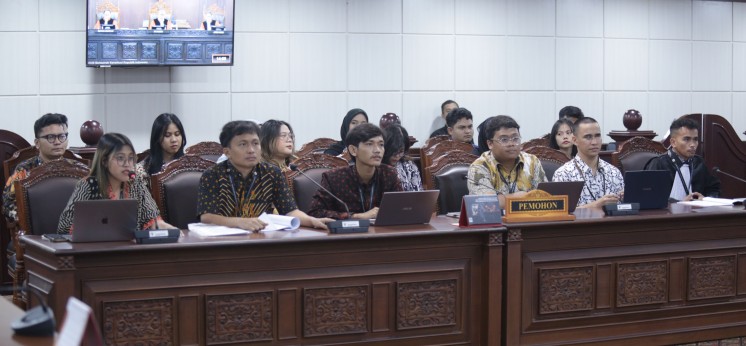
The Petitioners attending the petition revision hearing for Case No. 62/PUU-XXIV/2026 on the judicial review of Law No. 20 of 2025 on the Criminal Procedure Code (KUHAP), Wednesday (3/4/2026). Photo by MKRI/Bay.
JAKARTA (MKRI) — The Constitutional Court (MK) held a petition revision hearing for the judicial review of Law No. 20 of 2025 on the Criminal Procedure Code (KUHAP) against the 1945 Constitution on Wednesday, March 4, 2026, in the Court’s courtroom in Jakarta. The petition in Case No. 62/PUU-XXIV/2026 was filed by Nur Fauzi Ramadhan and Shafira Yasmin Noor Delila, along with eleven other petitioners, who are graduate students of the Faculty of Law of the University of Indonesia (UI).
At the hearing, the Petitioners’ legal counsel, Angelina Agung Putri Zaman, presented several revisions to the petition, particularly concerning the Court’s authority and the legal standing of the Petitioners.
“There is an additional qualification of a Petitioner. One individual has been added as an advocate, namely Budi Mangawi,” Angelina told the panel of constitutional justices.
The Petitioners also refined the description of the constitutional losses they allegedly suffered. The revision includes the addition of a matrix of constitutional losses and a stronger explanation of the causal relationship between the enforcement of the challenged provisions and the constitutional losses experienced by the Petitioners.
Also read:
UI Graduate Students Questions Supreme Court Chief Justice’s Approval to Arrest Judges
Previously, at the preliminary hearing on Thursday, February 19, 2026, the Petitioners explained that they are UI graduate students who pay close attention to the reform of the Criminal Code (KUHP) and the Criminal Procedure Code (KUHAP), both of which came into force on January 2, 2026. They argued that the enforcement of Article 98 and Article 101 of the KUHAP has caused both potential and actual constitutional losses to them, which they say are directly linked to the provisions being challenged.
The Petitioners specifically questioned the provision requiring approval from the Chief Justice of the Supreme Court (MA) before law enforcement authorities may arrest or detain a judge. Based on a proportionality test, they argued that the provision is difficult to justify.
They maintained that granting absolute authority in the form of such approval is not the only way to safeguard judicial independence in examining, adjudicating, and deciding cases. Moreover, the Petitioners argued that there is no sufficient justification for providing special protection to the office of judges through an absolute and unlimited approval mechanism, including in cases of caught-in-the-act circumstances or allegations of certain criminal offenses.
According to the Petitioners, when the interest of safeguarding judicial independence is weighed against the need for certain and fair law enforcement and the principle of equality before the law, the provision risks creating injustice. Therefore, they request that the challenged articles be declared unconstitutional and no longer legally binding.
Explore the Case : Case No. 62/PUU-XXIV/2026
Author: Utami Argawati
Editor: N. Rosi
Translator: Yuanna Sisilia
Disclaimer: The original version of the news is in Indonesian. In case of any differences between the English and the Indonesian versions, the Indonesian version will prevail.
Wednesday, March 04, 2026 | 14:43 WIB 101