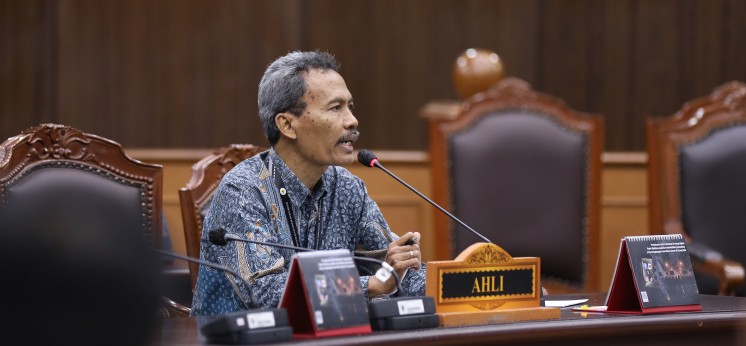
Khudori, an expert for the Petitioners in Case No. 203/PUU-XXIII/2025 on the judicial review of Law No. 6 of 2023 on Job Creation, testified before the Court, Wednesday (3/4/2026). Photo by MKRI/Ifa.
JAKARTA (MKRI) — On Wednesday, March 4, the Petitioners of Case No. 203/PUU-XXIII/2025 presented Khudori, an agricultural observer, as an expert at the material judicial review of Article 30 paragraph (1) in Article 32 point 2, Article 14 paragraph (1) letter c in Article 62 point 2, Article 31 paragraph (2), and Article 44 paragraph (2) in Article 124 point 1 of the Appendix to Law No. 6 of 2023 on the Stipulation of the Government Regulation in Lieu of Law No. 2 of 2022 on Job Creation. He stated that Indonesia is heading toward an agricultural land emergency.
“In my view, Indonesia is entering a period of agricultural land emergency,” said Khudori, who also serves as a member of the Food Security Committee of the Indonesian National Consultants Association, before the constitutional justices in the plenary courtroom.
He explained that, referring to the 2024 audit of the Ministry of Agrarian Affairs and Spatial Planning/National Land Agency (ATR/BPN), Indonesia’s permanent paddy field area stands at only 7.38 million hectares. This represents a decrease of 79 thousand hectares compared to 2019, when it reached 7.46 million hectares.
Such land area must accommodate more than a dozen food commodities, particularly rice, corn, sugarcane, and soybeans. When the planted area of one commodity increases, it is followed by a decrease in the planted area of others. Meanwhile, food demand continues to rise in line with population growth, income improvement, and shifting consumer preferences.
However, according to Khudori, the Government’s capacity to expand agricultural land, particularly wetland rice fields, is highly limited. On paper, expansion potential remains open up to 7.38 million hectares, equivalent to the current permanent paddy field area. Yet, the Government’s actual capacity to develop new rice fields only reaches 20,000-30,000 hectares per year.
In addition, agricultural land continues to be converted to non-agricultural land, such as for housing, infrastructure, industry, and public facilities. Land conversion is inevitable as long as development continues. High economic growth, structural economic transformation, and rapid population growth are the primary determinants of agricultural land conversion.
On the other hand, economic growth also increases the socio-economic value of non-agricultural land. The combination of rising demand and increasing land rents in non-agricultural sectors has driven massive and seemingly unstoppable land conversion.
Agricultural Land Conversion
According to Khudori, in the short term, land conversion may appear economically beneficial. However, in the long term, uncontrolled land conversion poses a serious threat to national food security, food sovereignty, and the country’s future. Agricultural land conversion weakens food resilience, reduces employment absorption, and decreases domestic production of various food commodities, thereby increasing reliance on food imports.
“Relying on food imports because we have converted all our land is highly disadvantageous. The global food market is oligopolistic, low in volume, and volatile,” he stated.
Agricultural land that has been converted is irreversible and cannot be restored to its original condition. Thus far, agricultural land has often been valued merely as a producer of food and fiber (tangible benefits). In reality, paddy fields also function to safeguard food security, maintain the hydrological stability of river basins, control floods, reduce erosion, absorb labor, provide uniqueness and attractiveness to rural areas, and preserve rural socio-cultural values. These functions are non-marketable and intangible, which is why they are frequently overlooked.
Khudori emphasized that fertile and productive agricultural land equipped with irrigation infrastructure, such as rice fields, must be regarded as a vital national asset for two reasons. First, the substantial investment costs involved in irrigation infrastructure and the development of new rice fields. Second, the lengthy period required from initial land development to the establishment of highly productive paddy fields.
For that reason, he argued that the provisions in Law No. 6 of 2023 equating public interest with National Strategic Projects (PSN) and facilitating the conversion of agricultural land for such projects should be annulled. According to him, these provisions do not guarantee the protection of food security, food sovereignty, and the right to food as guaranteed by the 1945 Constitution.
Also read:
Farmer Associations Challenge Provisions on Importation Agricultural and Food Products
Associations Revise Petition on Importation Agricultural and Food Products
House Pushes Increase of Food Needs Fulfillment Ratio through Domestic Products
Govt Responds to Wish for Imports Only When Domestic Production Is Exhausted
The Petitioners of this case are Indonesian farmer associations Serikat Petani Indonesia (SPI), Perkumpulan Jaringan Masyarakat Tani Indonesia (JAMTANI), Aliansi Petani Indonesia (API), and Aliansi Organis Indonesia; village development foundation Bina Desa; Indonesians coalitions for food sovereignty Koalisi Rakyat untuk Kedaulatan Pangan and for fisheries justice Koalisi Rakyat Untuk Keadilan Perikanan (KIARA); palm oil farmers union Serikat Petani Kelapa Sawit (SPKS); palm oil watchdog Sawit Watch; and CSO for the right to food and nutrition FIAN Indonesia. They go by the Advocacy Team Against Omnibus Law.
The regulation of consumption needs and/or government food reserves sourced from domestic production is no longer prioritized, resulting in the absence of protection and legal certainty guarantees for farmers. The Petitioners argued that the challenged provisions place the importation of agricultural and food commodities as one of the priority sources of food supply, thereby failing to prioritize domestic production that optimally utilizes local resources and wisdom.
They believe that making agricultural and food imports a priority equivalent to domestic production and national food reserves effectively replaces the state’s control over food sources with free trade instruments. In their view, as part of the sectors of production affecting the livelihood of the people and as part of the land, water, and natural resources contained therein, food should remain under state control to serve the objective of the greatest prosperity of the people.
In addition, the Petitioners have also revised their petitums. They now request the Court to declare Article 19 paragraph (2) insofar as the phrase “and/or national strategic projects” in Article 31 point 1 of the Appendix to the Job Creation Law unconstitutional and not legally binding if it is not interpreted to mean “In the case of public interest, Agricultural Cultivation Land as referred to in paragraph (1) may be converted and implemented in accordance with the provisions of legislation;” to declare Article 30 paragraph (1) insofar as the phrase “Importation of Agricultural Commodities” in Paragraph 3 Article 32 point 2 of the Appendix to the Job Creation Law unconstitutional and not legally binding if it is not interpreted to mean “Importation of Agricultural Commodities may only be carried out when domestic agricultural production and government food reserves are insufficient;” to declare Article 14 paragraph (1) letter c of Paragraph 11 Article 62 point 2 of the Appendix to the Job Creation Law unconstitutional and not legally binding; to declare Article 36 in Article 64 point 4 of the Appendix to the Job Creation Law unconstitutional and not legally binding if it is not interpreted to mean “Importation of Food may only be carried out when Domestic Food Production and National Food Reserves are insufficient;” and to declare Article 44 paragraph (2) insofar as the phrase “and/or national strategic projects” in Article 124 point 1 of the Appendix to the Job Creation Law unconstitutional and not legally binding unless interpreted to mean “In the public interest, Sustainable Agricultural Cultivation Land as referred to in paragraph (1) may be converted and implemented in accordance with the provisions of legislation.”
Explore Case No. 203/PUU-XXIII/2025 (in Indonesian).
Author : Mimi Kartika Sari
Editor : Lulu Anjarsari P.
PR : Raisa Ayuditha M.
Translator : Yuniar Widiastuti (NL)
Disclaimer: The original version of the news is in Indonesian. In case of any differences between the English and the Indonesian versions, the Indonesian version will prevail.
Wednesday, March 04, 2026 | 14:22 WIB 532