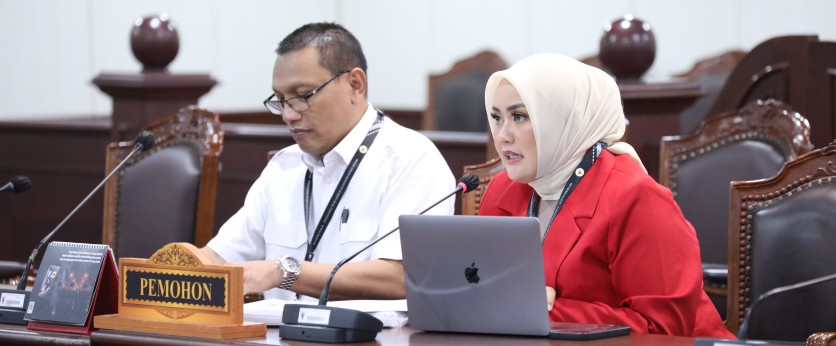
Couple Dian Amalia and Raden Nuh presenting their petition against Law No. 7 of 2017 on General Elections, Tuesday (3/3/2026). Photo by MKRI/Panji.
JAKARTA (MKRI) — Raden Nuh and Dian Amalia question the constitutionality of Article 169 of Law No. 7 of 2017 on General Elections. The preliminary hearing for Case No. 81/PUU-XXIV/2026 was chaired by Deputy Chief Justice Saldi Isra on Tuesday, March 3, 2026.
Article 169 of the Election Law provides: “Requirements that must be fulfilled by a Presidential and Vice-Presidential candidate are as follows: a. pious in service to the Lord Almighty; b. an Indonesian citizen since birth and has never, based on their own free will, received the citizenship of other country; … s. not an ex-member of banner organizations such as the Indonesian Communist Party, including any of its derivative organizations, and not an active participant of the G30S/PKI; and, t. having a statement of vision, mission, and policy program to govern the Republic of Indonesia.”
According to the Petitioners, the norm stipulating the requirements to become a candidate for president and vice president is contrary to Article 1 paragraph (3), Article 9, Article 22E paragraph (1), and Article 28D paragraph (1) of the 1945 Constitution because the norm a quo does not mention any prohibition against nepotism or conflicts of interest in the requirements.
“The essence of this petition is not to prohibit someone from running for office. The core issue is whether the Constitution permits a normative design for presidential and vice-presidential candidacy that provides absolutely no safeguards against structural conflicts of interest and nepotistic practices,” Dian explained, appearing in person in one of the Court’s panel courtrooms.
With the enactment of Article 169 of the Election Law without any requirement against nepotism, the Petitioners argue that their right to have presidential and vice-presidential candidates emerging from a fair and healthy competitive process has been diminished. The absence of such a requirement allegedly results in systemic injustice, thereby rendering the Petitioners’ voting rights substantively meaningless. Moreover, it may give rise to structural conflicts of interest that undermine the integrity of elections.
Accordingly, the Petitioners requested that the Court declare Article 169 of the Election Law unconstitutional and not legally binding insofar as it is not interpreted to mean that the requirements for presidential and/or vice-presidential candidacy must be free from conflicts of interest arising from blood or marital relationships with an incumbent president and/or vice president within the same term of office.
Grounds for Review
In his advice during the panel hearing, Constitutional Justice Ridwan Mansyur stated that the nine constitutional provisions invoked as grounds for review were excessive in number and should be narrowed down to those genuinely relevant. “There have already been 34 decisions related to the article being challenged by the Petitioners. Therefore, there is an obligation to elaborate clearly so that this petition does not fall within the category of ne bis in idem, ensuring that it is not identical to previous petitions,” he explained.
Subsequently, Constitutional Justice Adies Kadir noted that the challenged provision has been amended by Law No. 7 of 2023 and therefore must be aligned with its amendments. He further observed that the constitutional harm described by the Petitioners remains general. “The Petitioners must convince the Court by elaborating on concrete constitutional harm that they may actually suffer. They must also precisely argue whether the challenged norm potentially restricts citizens’ constitutional rights solely on the basis of blood or marital relationships,” he stated.
Meanwhile, Deputy Chief Justice Saldi Isra asked the Petitioners to clarify their legal standing as advocates. “Is it appropriate to base legal standing as an advocate on the alleged loss of constitutional rights due to the enactment of this norm, or should it instead be based on your status as voters? Are your voting rights obstructed by this norm? This must be carefully considered so that the petition is not declared inadmissible,” he explained.
Before adjourning the session, Deputy Chief Justice Saldi Isra announced that the Petitioners would have 14 days to revise the petition. The revised petition must have been received by the Court’s Registrar’s Office no later than 12:00 WIB on Monday, March 16, 2026. The Court will then schedule a second hearing to examine the revised petition.
Explore case No. 81/PUU-XXIV/2026 (in Indonesian).
Author : Sri Pujianti
Editor : N. Rosi
PR : Raisa Ayuditha Marsaulina
Translator : Yuniar Widiastuti (NL)
Disclaimer: The original version of the news is in Indonesian. In case of any differences between the English and the Indonesian versions, the Indonesian version will prevail.
Tuesday, March 03, 2026 | 15:19 WIB 81