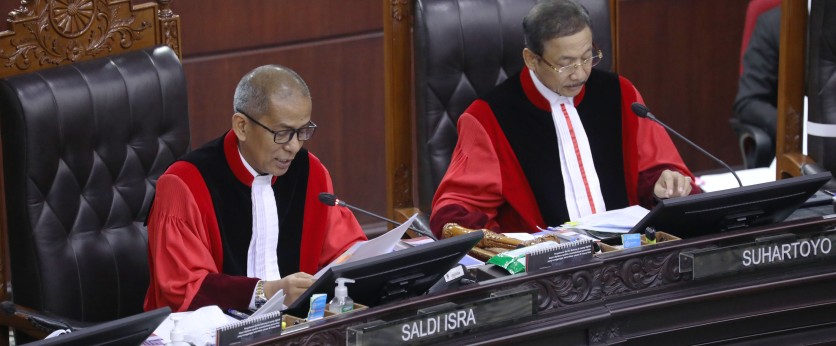
Deputy Chief Justice Saldi Isra during the ruling hearing on the judicial review of Law No. 1 of 2023 on Criminal Code (KUHP) in plenary courtroom. Photo by MKRI/Panji.
JAKARTA (MKRI) – The Constitutional Court (MK) has ruled that the petition for judicial review of Article 406 of Law No. 1 of 2023 on Criminal Code (KUHP) is inadmissible. The reason is that the evidence submitted by the Petitioners was not stamped with sufficient legal force, as required by statutory provisions.
"Therefore, the evidence for each of these Petitions cannot be validated in the hearing," said Deputy Chief Justice Saldi Isra, reading out the legal considerations for Decision No. 41/PUU-XXIV/2026 on Monday, March 2nd, 2026, in the Plenary Courtroom of the Court, Jakarta.
He explained that the Petitioners submitted evidence P1-P9, which lacked sufficient stamps, as valid evidence under statutory provisions. Meanwhile, according to procedural law, submitting evidence affixed with sufficient stamps is a crucial element in assessing whether a petition meets the formal requirements.
"There is no doubt for the Court to declare that Petition No. 41/PUU-XXIV/2026 does not meet the formal requirements for submitting a Petition," said Deputy Chief Justice Saldi.
Also read:
Reviewing Moral Offenses in Criminal Code
Petitioner Revises Petition on Review for Moral Offenses in Criminal Code
For your information, this petition was filed by Lodovikus Ignasius Lamury, Chris Melda Bani, and Melianus Alopada. In a previous preliminary hearing, the Petitioners argued that the articles being challenged in the new Criminal Code open up excessive normative misconduct, shifting the principle of "no crime without fault," without proof of personal fault in the form of intent or negligence on the part of the perpetrator.
The Petitioners argue that the petition of Article 406 of Criminal Code relies on an assessment of propriety or impropriety according to local social values, potentially using moral judgment as the basis for criminalization. In practice, such norms can lead to criminalization based on majority morality and create inconsistent law enforcement across regions and time periods.
According to the Petitioners, the norm being challenged in this petition is contrary to Article 28D paragraph (1) of the 1945 Constitution of the Republic of Indonesia because it does not guarantee fair legal certainty and is contrary to Article 1 paragraph (3) of the 1945 Constitution of the Republic of Indonesia because it opens up opportunities for uncontrolled law enforcement in a state based on the rule of law. The Petitioners view that the norm of Article 406 of the Criminal Code can only be declared constitutional if it is interpreted strictly, namely by requiring the existence of personal error in the form of intent or negligence and not solely based on subjective moral or social value assessments.
For your information, Article 406 of the Criminal Code states, "Any person who: a. violates morality in public; or b. violates morality in front of other people who are present without the will of the people present shall be punished with imprisonment for a maximum of 1 (one) year or a maximum fine of category II." Furthermore, in the Elucidation of Article 406 letter a of the Criminal Code, it states, "What is meant by "violating morality" is committing an act of displaying nudity, genitals, and sexual activity that is contrary to the values that exist in society at the place and time the act is committed.
Meanwhile, in their petitum, the Petitioners requested the Court to declare the phrase "violating morality" and the phrase "values that exist in society" in Article 406 of the Criminal Code contrary to the 1945 Constitution of the Republic of Indonesia (UUD NRI), specifically Article 1 paragraph (3) and Article 28D paragraph (1), and not legally binding as long as it is not interpreted that the determination of "violating morality" must be based on clear, objective, and predictable legal norms.
Explore case No. 41/PUU-XXIV/2026 (in Indonesian).
Read more decision No. 41/PUU-XXIV/2026 (in Indonesian)
Author : Mimi Kartika
Editor : N. Rosi.
Translators : Donny Yuniarto
Disclaimer: The original version of the news is in Indonesian. In case of any differences between the English and the Indonesian versions, the Indonesian version will prevail.
Monday, March 02, 2026 | 10:43 WIB 57