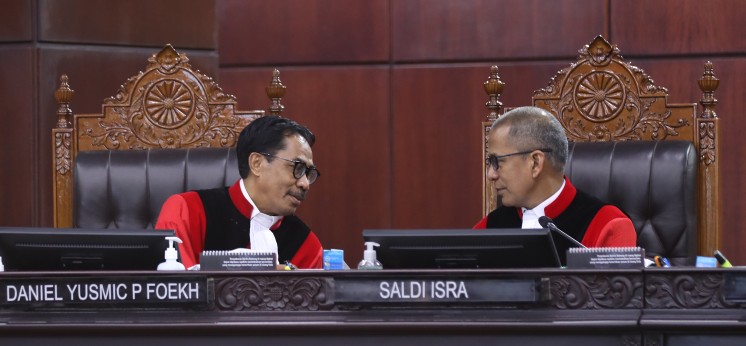
Deputy Chief Justice Saldi Isra with Constitutional Justice Daniel Yusmic during the ruling hearing for judicial review of Law No. 24 of 2009 on State Flag, Language, and Emblem, as well as National Anthem, Monday (3/2/2026). Photo by MKRI/Ifa.
JAKARTA (MKRI) – The Constitutional Court (MK) rejected in its entirety the judicial review of Law No. 24 of 2009 on National Flag, Language, and Symbol, and National Anthem (UU BBLNLK) on Monday, March 2, 2026. In the ruling hearing of Case No. 173/PUU-XXIII/2025 from the petition filed by Feri Kurniawan (Petitioner I) and Fatchurozak (Petitioner II), Constitutional Justice Daniel Yusmic P. Foekh read out the Court's legal considerations.
That regarding the issue of the constitutionality of the norms argued by the Petitioners in this petition, Court has issued Constitutional Court Decision No. 188/PUU-XXIII/2025. It is stated that in the practice of forming legislation, the selection of certain words or diction has normative consequences that cannot be viewed as merely editorial issues, including the use of the word "obligatory" in the norm of Article 31 paragraph (1) of Law No. 24 of 2009 which is the main problem that the Petitioners are requesting.
If we look at it comprehensively, besides the norm of Article 31 paragraph (1) of Law No. 24 of 2009, there are also several article norms that use the word "obligatory" to use Indonesian in Law No. 24 of 2009, for example Articles 26 to 28, Article 29 paragraph (1), and Article 39 paragraph (1) Law No. 24 of 2009. All of these norms are not followed by the regulation of sanctions but do not immediately remove the imperative nature of these norms.
This demonstrates the unique nature of the normative provisions in Law No. 24 of 2009, which conform to the legal policy desired by the legislators. This then shapes the meaning and scope of the word "obligatory," which is unique and distinct from provisions in other laws. Therefore, it cannot be included in the definition of the word "obligatory" as outlined in the normative guidelines in No. 268 of Attachment II of Law No. 12 of 2011.
However, in this regard, it is important for the Court to be more selective and wise in determining the word "mandatory" in determining the word "mandatory" to ensure that its use is appropriate to the context. If the use of the word "mandatory" is required without sanctions, then for the sake of educating the lawmakers and the public, the inclusion of the word "mandatory" in the statutory norm without sanctions should be explained, namely in the general explanation or explanation of the article within the law.
Mutatis Mutandis
Based on the legal considerations cited in Decision No. 188/PUU-XXIII/2025, insofar as it relates to the constitutionality review of Article 31 paragraph (1) of Law No. 24 of 2009, it also applies mutatis mutandis to the arguments in the a quo petition. Therefore, because the Court has not yet found a compelling reason to change its position on this matter, the arguments in the a quo petition must also be declared legally unreasonable.
Based on these legal considerations, the Court believes that the provisions of Article 31 paragraph (1) of Law No. 24 of 2009 do not conflict with the principles of the rule of law and do not violate the principle of equality of citizens before the law and government as guaranteed in Article 1 paragraph (3) and Article 27 paragraph (1) of the 1945 Constitution of the Republic of Indonesia. Therefore, the Petitioners' arguments are legally groundless in their entirety.
"Rejecting the Petitioners' petition in its entirety," said Chief Justice Suhartoyo, reading out the ruling on the a quo petition.
In the Preliminary Hearing for Petition No. 173/PUU-XXIII/2025 on Thursday, October 9, 2025, as a prospective advocate, Petitioner I was prepared to carry out the functions of an advocate professionally, which includes work to prepare and/or review legal documents, such as agreements and memoranda of understanding. However, the existence of Article 31 paragraph (1) of Law No. 24 of 2009 has the potential to cause constitutional harm to the Petitioner in preparing memoranda of understanding and/or agreements for clients who are subjects of Indonesian law. Petitioner I believes that he will be overshadowed by legal risks in the form of the validity of an agreement if the memorandum of understanding and/or agreement only uses a foreign language.(*)
Track case No. 173/PUU-XXIII/2025
Read more Decision No. 173/PUU-XXIII/2025
Author : Sri Pujiati
Editor : Lulu Anjarsari P.
PR : Fauzan Febriyan
Translator : Donny Yuniarto
Disclaimer: The original version of the news is in Indonesian. In case of any differences between the English and the Indonesian versions, the Indonesian version will prevail.
Monday, March 02, 2026 | 17:36 WIB 140