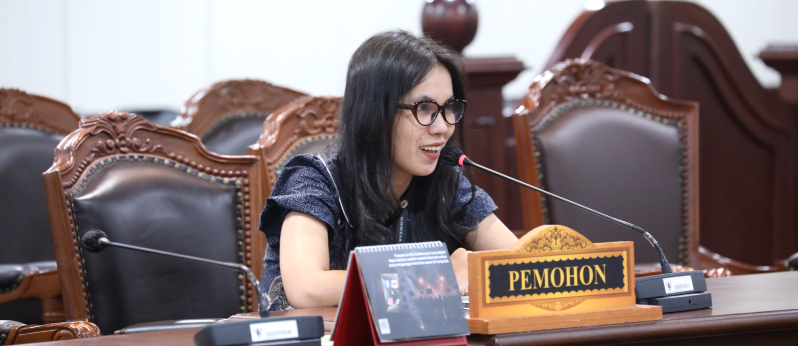
The Petitioner presenting her petition during the Preliminary Hearing (I) for Case No. 78/PUU-XXIV/2026. Photo: Public Relations/Fauzan.
JAKARTA, MKRI— Bernita Matondang has filed a judicial review petition challenging Article 72(g) and Article 234(3)(j) of Law No. 17 of 2014 on the People’s Consultative Assembly (MPR), the House of Representatives (DPR), the Regional Representative Council (DPD), and Regional Legislative Councils (DPRD) (the MD3 Law). The Petitioner argues that her alleged constitutional injury arises from the construction of Article 72(g), which contains the phrase “to follow up on public aspirations and complaints” without providing normative parameters regarding the form, stages, or traceability of such follow-up. This, she contends, is compounded by Article 234(3)(j), which merely regulates the receipt and distribution of public aspirations without mandating a transparent and trackable follow-up mechanism.
The Preliminary Examination Hearing (I) for Petition No. 78/PUU-XXIV/2026 was held on Monday (March 2, 2026). During the hearing, presided over by Deputy Chief Justice Saldi Isra, the Petitioner argued that these provisions are inconsistent with citizens’ constitutional rights in the exercise of popular sovereignty and public participation in the legislative process.
Appearing without legal counsel, the Petitioner maintained that Article 1(2) of the 1945 Constitution affirms that sovereignty resides in the people and is exercised in accordance with the Constitution. In her view, the exercise of popular sovereignty does not end with electoral mechanisms such as general elections, but must continue through meaningful public participation in the lawmaking process.
“The Petitioner does not request the Court to regulate the DPR’s rules of procedure in technical detail, but merely seeks an affirmation of constitutional limits—that the function of ‘following up on public aspirations’ cannot be interpreted as mere administrative receipt without any form of constitutional accountability to the public,” Bernita stated during the hearing.
She further emphasized that public participation must not end at the stage of submitting aspirations, but must be accompanied by clarity regarding how such aspirations are processed within the legislative process.
Deemed Merely Administrative in Nature
The Petitioner argued that while Article 72(g) of the MD3 Law formally assigns the DPR the function “to follow up on public aspirations and complaints,” it lacks parameters concerning the form, stages, time limits, and traceability of such follow-up. Meanwhile, Article 234(3)(j) regulates only the receipt and distribution of aspirations within the DPR’s internal rules of procedure, without integrating an obligation for transparent follow-up.
According to the Petitioner, this creates a normative gap between the recognition of popular sovereignty and the mechanisms for its implementation. Public aspirations, she argued, risk being reduced to an administrative formality without clarity regarding their progression in the legislative process.
She also drew comparisons with public service regimes, which require clear deadlines, accountability, and complaint mechanisms. In contrast, similar parameters have not been established in the context of public participation in lawmaking, despite its constitutional significance.
In her petition, the Petitioner elaborated that the phrase “to follow up” in Article 72(g) is not integrated into the procedural framework referenced in Article 234(3)(j). As a result, internal rules may stop at the stage of receiving and distributing aspirations without guaranteeing clarity of subsequent steps. This condition, she argued, undermines procedural certainty and violates the right to legal certainty as guaranteed under Article 28D(1) of the 1945 Constitution.
Additionally, the Petitioner alleged violations of the right to advance collective interests (Article 28C(2) of the Constitution), as well as the right to communicate and obtain information (Article 28F). In a constitutional democracy, she argued, communication between the public and legislative institutions must be two-way and ensure transparency in public decision-making processes.
The Petitioner cited her experience in submitting aspirations through the SIMAS PUU system and in delivering a policy brief to Commission III of the DPR, which, she claimed, remained at the stage of receipt without any clarity regarding timelines or deliberation status.
Based on these arguments, the Petitioner requested the Constitutional Court to declare the phrase “to follow up on public aspirations and complaints” in Article 72(g) of the MD3 Law unconstitutional and conditionally invalid, unless it is interpreted to mean that such follow-up must not be limited to administrative receipt but must enable the public to obtain information regarding the status of their submissions within the legislative process.
She also requested that Article 234(3)(j) of the MD3 Law be declared unconstitutional and conditionally invalid, unless it is interpreted to require that DPR rules of procedure governing the receipt and distribution of public aspirations ensure clear and accessible information regarding their follow-up.
During the judicial advisory session, Constitutional Justice Ridwan Mansyur raised concerns regarding the Petitioner’s legal standing. While acknowledging that the Petitioner had identified herself as an individual Indonesian citizen, he noted that the argument concerning the alleged violation of her constitutional rights had not been clearly demonstrated.
“Di permohonan ini belum tampak. Menurut Saudara, menggunakan hak konstitusional, hak berpartisipasi. Cuma ini belum tampak walaupun saudara menguraikan itu di dalam uraian tentang partisipasi yang saudara lakukan melalui kegiatan itu,” ujar Ridwan dalam persidangan.
He further observed that the Petitioner had not sufficiently elaborated on the form of participation claimed, nor provided supporting evidence of the activities cited as manifestations of her constitutional rights.
At the conclusion of the hearing, the panel of justices granted the Petitioner 14 days to revise her submission. The revised petition must be submitted to the Court no later than Monday, March 16, 2026, at 12:00 WIB. (*)
Explore the Case: Petition No. 78/PUU-XXIV/2026
Author : Utami Argawati
Editor : Lulu Anjarsari P.
Public Relations: Fauzan Febriyan
Translator : SO
Disclaimer: The original version of the news is in Indonesian. In case of any differences between the English and the Indonesian versions, the Indonesian version will prevail.
Monday, March 02, 2026 | 17:08 WIB 83