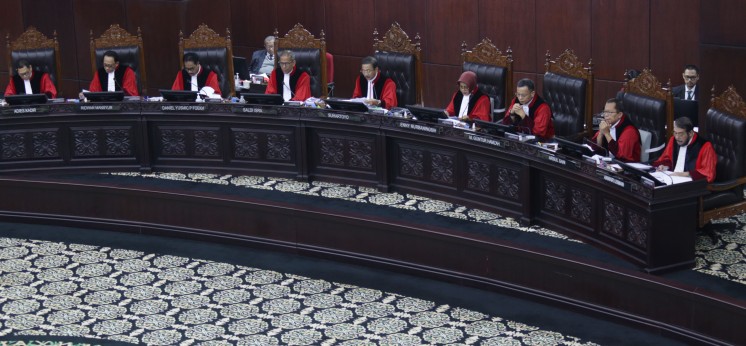
Decision Pronouncement Hearing of Case No. 8/PUU-XXIV/2026 on the material judicial review of Law No. 22 of 2009 on Road Traffic and Transportation, Monday (2/3/2026). Photo by MKRI/Bay.
Jakarta (MKRI) – The Constitutional Court has ruled that the material judicial review of Article 106 paragraph (1) of Law No. 22 of 2009 on Road Traffic and Transportation (Traffic Law) petitioned by Muhammad Reihan Alfariziq is inadmissible. The Court found that the Petitioner had not sufficiently elaborated the reasons for such a petition, which implies a norm contradiction in the article being reviewed against the 1945 Constitution of the Republic of Indonesia.
“Yet those explanations are essential to clarify the conflict between the norm being challenged and the constitutional benchmarks in the 1945 Constitution,” said Deputy Chief Justice Saldi Isra as he read out the Court’s legal considerations in Decision No. 8/PUU-XXIV/2026 on Monday, March 2, 2026, in the Constitutional Court’s plenary courtroom in Jakarta.
Chief Justice Saldi went on to say that the wording of petitum point 2 could be seen as unusual. On the one hand, the Petitioner asks the Court to declare Article 106paragraph (1) of Law No. 22 of 2009 unconstitutional and without binding legal force, while on the other hand, the Petitioner also requests that the Court add a new interpretation to that provision. The new interpretation proposed in petitum point 2 uses the standard conditional formula that the article is contrary to the 1945 Constitution, “insofar as it is not interpreted to mean” a particular construction.
Also read:
Traffic Accident Victim From Cigarette Butt Tests Traffic Law
Victim of Accident Caused by Cigarette Butt Revises Petition to Review Traffic Law
The petition specifically questioned the phrase “full concentration” in Article 106 paragraph (1) of the Traffic Law. The article reads, ““Every person driving a motor vehicle on the road must operate their vehicle reasonably and with full concentration.”
According to Reihan, the phrase “full concentration” is broad and multi-interpretable, and it lacks clear normative limits or parameters, which he believes can lead to legal uncertainty in law enforcement and suboptimal protection of road users’ safety. He argues that this norm has harmed him as someone who directly experienced a traffic accident.
He recounted that he was involved in a serious accident while riding on March 23, 2025. The accident, he said, occurred after a cigarette butt discarded by another driver struck him, disrupting his concentration, balance, and focus in controlling his vehicle.
As his concentration was disrupted, he was then hit from behind by a Colt diesel truck and nearly run over. The drivers responsible for the accident fled the scene, leaving him in shock and traumatized.
He further argued that the harm is potentially recurring because Article 106, paragraph (1) of the Traffic Law remains in force without improvement and may again trigger similar incidents for him or the wider public as road users. For this reason, he believes Article 106 paragraph (1) violates Article 28D paragraph (1), Article 28G paragraph (1), Article 28H paragraph (1), and Article 28I paragraph (4) of the 1945 Constitution of the Republic of Indonesia.
The Petitioner, in his petitum, requests the Court to declare that the phrase “full concentration” in Article 106 paragraph (1) of the Traffic Law is contrary to the 1945 Constitution and has no binding legal force, on a conditionally unconstitutional basis, insofar as it is not understood as the driver’s obligation to refrain from any act that clearly and objectively reduces reasonable control over the vehicle and lowers the level of alertness while driving, which at a minimum includes: (a) manually using a mobile phone, namely by holding, typing on, or staring at the mobile phone screen; and/or (b) engaging in active smoking, namely lighting, inhaling, or holding a cigarette or electronic cigarette (vape) in a way that reduces control of the vehicle or creates a potential danger to traffic safety; and/or (c) committing other similar acts, insofar as, based on objective assessment and evidence, they cause the loss of reasonable control over the vehicle and/or a significant reduction in the driver’s level of alertness, thereby potentially endangering traffic safety.
The Petitioner also asks the Court to declare Article 106 paragraph (1) of the Traffic Law constitutional and binding, insofar as it is interpreted to mean: “Every person driving a motor vehicle on the road must operate their vehicle reasonably and with full concentration, namely by refraining from any act that clearly and objectively reduces reasonable control over the vehicle and/or lowers the level of alertness while driving, including the manual use of a mobile phone and active smoking while driving, as well as other similar acts which, based on objective assessment, cause the loss of reasonable control or a significant reduction in the driver’s attention.”
Case tracking: Petition No. 8/PUU-XIV/2026
Author: Mimi Kartika.
Editor: N. Rosi.
PR: Raisa Ayuditha Marsaulina.
Translator: Rizky Kurnia Chaesario
Disclaimer: The original version of the news is in Indonesian. In case of any differences between the English and the Indonesian versions, the Indonesian version prevails.
Monday, March 02, 2026 | 12:14 WIB 64