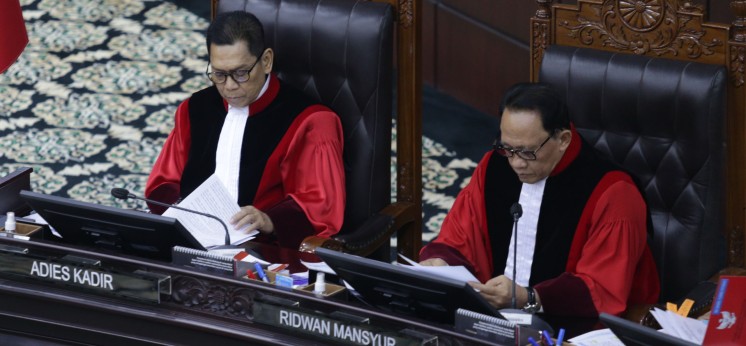
The Constitutional Court held a hearing to pronounce the decision in Case Number 17/PUU-XXIV/2026 concerning the judicial review of Law Number 6 of 1983 on General Provisions and Tax Procedures, as amended several times, most recently by Law Number 7 of 2021 on the Harmonization of Tax Regulations, on Monday (03/02/2026). Photo by MKRI/Bay.
JAKARTA, (MKRI) – The Constitutional Court declared inadmissible a petition for judicial review of Law Number 6 of 1983 on General Provisions and Tax Procedures (KUP Law), as amended several times, most recently by Law Number 6 of 2023 on the Stipulation of Government Regulation in Lieu of Law Number 2 of 2022 on Job Creation. The pronouncement of Decision Number 17/PUU-XXIV/2026 was held on Monday (03/02/2026) in the Court’s plenary courtroom.
In its legal considerations, the Court found a fundamental inconsistency between the petition’s posita and petitum. In the posita, the Petitioner based its argument on a provision referred to as Article 36 paragraph (2) of the KUP Law; however, the quoted norm substantively corresponds to Article 10A of Law Number 19 of 2000 on Amendments to Law Number 19 of 1997 on Tax Collection by Distress Warrant.
Meanwhile, in petitum point 3, the Petitioner requested the Court to declare conditionally unconstitutional Article 36 paragraph (2) of Law Number 28 of 2007. Thus, there is a discrepancy in the cited provisions, which, from a legal standpoint, cannot be equated.
Read also:
PT SIMAC Indonesia Seeks Declaration of Incorrect Tax Assessment Letter Phrase as Unconstitutional
Previously, during the initial hearing at the Court on Thursday (01/22/2026), PT SIMAC Indonesia (In Liquidation)—represented by its legal counsel Cuaca—argued that there is legal uncertainty in tax law enforcement due to what it considered a very limited legal basis, particularly regarding applications for the annulment of Tax Underpayment Assessment Letters (SKPKB). According to the Petitioner, SKPKB issued under the KUP Law and the Income Tax/Value Added Tax laws should be subject to applications for annulment of incorrect tax assessment letters, whether on formal or substantive grounds.
“The Petitioner submitted an administrative remedy against the Tax Underpayment Assessment Letter on the grounds that the issuance of the SKPKB contradicts the KUP Law,” he explained.
He further elaborated that formal grounds relate to the issuance of SKPKB that does not comply with the provisions of the KUP Law, while substantive grounds concern the substance of tax calculations. Such annulment applications should remain permissible as long as the grounds have not been examined through the objection mechanism as regulated in Article 25 of the KUP Law, or do not violate the principle of ne bis in idem.
In addition, the Petitioner asserted that applications for the annulment of tax assessment letters should not be precluded even if the taxpayer has submitted a request for the reduction of administrative sanctions as referred to in Article 36 paragraph (1) letter a of the KUP Law, or if three months have passed since the decision on such objection or sanction reduction was issued.
The Petitioner requested the Court to grant the petition in its entirety, to declare the phrase “incorrect tax assessment letter” in Article 36 paragraph (1) letter b of the KUP Law contrary to the 1945 Constitution of the Republic of Indonesia (UUD 1945) insofar as it is not interpreted in a limited manner as requested, and to declare Article 36 paragraph (2) of the KUP Law contrary to the 1945 Constitution of the Republic of Indonesia (UUD 1945) and without binding legal force.
Explore the Case: Number 17/PUU-XXIV/2026
Author : Utami Argawati
Editor : N. Rosi
PR : Andhini SF.
Translator : Agusweka PS.
Disclaimer: The original version of the news is in Indonesian. In case of any differences between the English and the Indonesian versions, the Indonesian version prevails.
Read the full decision at the following link: Decision Number 17/PUU-XXIV/2026
Monday, March 02, 2026 | 14:39 WIB 45