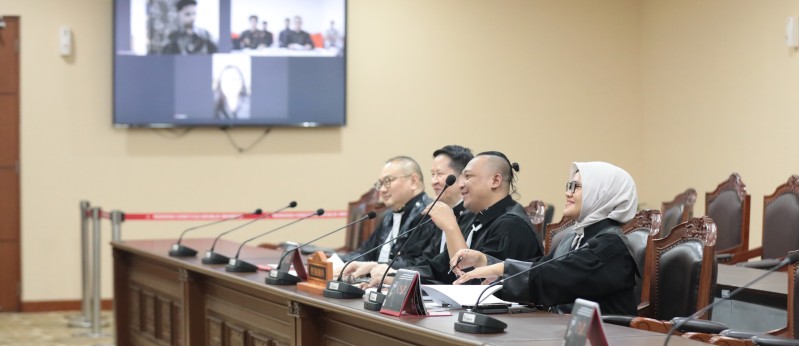
Petitioners’ legal counsels presenting their arguments before the panel of constitutional justices during the preliminary hearing, 3/2/2026. Photo by MKRI/IlhamWM.
JAKARTA (MKRI) — Approximately five advocates have filed a petition for a judicial review of Article 3 paragraph (1) letter d of Law No. 18 of 2003 on Advocates (Advocates Law) with the Constitutional Court (MK). The Petitioners argue that the provision only stipulates a minimum age requirement and does not set a maximum age limit for prospective advocates. As a result, retirees from the police, prosecution service, the Indonesian National Armed Forces (TNI), and the judiciary may register as advocates, which they consider prone to corruption, collusion, and nepotism.
“This provision does not impose a maximum age limit for prospective advocates. Consequently, retired police officers, prosecutors, TNI personnel, and judges are able to register as advocates,” said Syamsul Jahidin, one of the Petitioners in Case No. 79/PUU-XXIV/2026, during a hearing at the Constitutional Court courtroom in Jakarta on Monday, March 2, 2026.
Other Petitioners in this case include St Luthfiani, Henoch Thomas, Popy Desiyantie, and Fredy Limantara. They contend that retirees from law enforcement institutions may still retain institutional ties, which could undermine the independence of legal representation provided to clients.
The Petitioners further argue that the provision is discriminatory and contrary to Article 27 paragraph (1) and Article 28D paragraph (1) of the 1945 Constitution. They note that retirement age limits under the Police Law, the Prosecution Law, the TNI Law, and the Supreme Court Law reflect the legislator’s assessment of an individual’s physical and psychological capacity to work.
“Therefore, after retiring from the police, prosecution service, TNI, or the judiciary, individuals should no longer serve as advocates,” Syamsul stated.
They also highlight that the existence of maximum age limits for professions such as police officers, prosecutors, TNI personnel, and judges indicates a disharmony in statutory regulations. According to the Petitioners, provisions on both minimum and maximum age requirements should likewise apply to the advocate profession.
In their view, an individual’s optimal maturity ranges from 25 to 45 years, and ideally the maximum age limit for prospective advocates should be 50 years. This is comparable to the retirement age of 58 years applicable to certain functional positions within the state civil apparatus (ASN).
Article 3 paragraph (1) letter d of the Advocates Law states that an advocate candidate must be “at least 25 (twenty-five) years of age.” The Petitioners argue that the absence of a maximum age limit creates ambiguity and imbalance within the profession, which they claim risks reducing the advocate profession, traditionally regarded as an officium nobile, to a “catch-all” occupation.
They further assert that advocates operate across the entire jurisdiction of Indonesia, requiring not only intellectual competence but also physical capability. According to them, elderly or physically unfit advocates may face difficulties in handling cases, particularly those requiring travel outside their domicile.
The Petitioners question why the Advocates Law sets a minimum age requirement but fails to regulate a maximum age limit for appointment as an advocate. They argue that this omission results in a lack of legal protection and legal certainty.
In their petitum, the Petitioners request the Court to declare Article 3 paragraph (1) letter d conditionally unconstitutional and not legally binding unless interpreted as “at least 25 (twenty-five) years of age and at most 50 (fifty) years of age” or alternatively “at least 25 (twenty-five) years of age and at most 55 (fifty-five) years of age.”
The hearing was conducted by a panel of constitutional justices chaired by Constitutional Justice Enny Nurbaningsih, with Constitutional Justice Anwar Usman and Constitutional Justice Arsul Sani serving as panel members. During the advisory session, Justice Sani stated that the Petitioners must present new arguments capable of persuading the Court to reconsider its stance that age requirements fall within the scope of an open legal policy.
“The Petitioners must provide new arguments that can convince the Court to depart from its previous position. Please examine whether the issue of age falls within the domain of open legal policy,” Justice Sani said.
Before adjourning the hearing, Justice Nurbaningsih stated that the Petitioners were given 14 days to revise their petition. The revised submission, both in softcopy and hardcopy, must be received by Court no later than Monday, March 16, 2026, at 12:00 Western Indonesia Time (WIB). (*)
Author : Mimi Kartika
Editor : Lulu Anjarsari P.
PR : Andhini S.F.
Translator : Siti Rosmalina Nurhayati (SRN)
Explore Further: Petition No. 79/PUU-XXIV/2026
Disclaimer : The original version of the news is in Indonesian. In case of any difference between the English and the Indonesian versions, the Indonesian version will prevail.
Monday, March 02, 2026 | 19:31 WIB 54