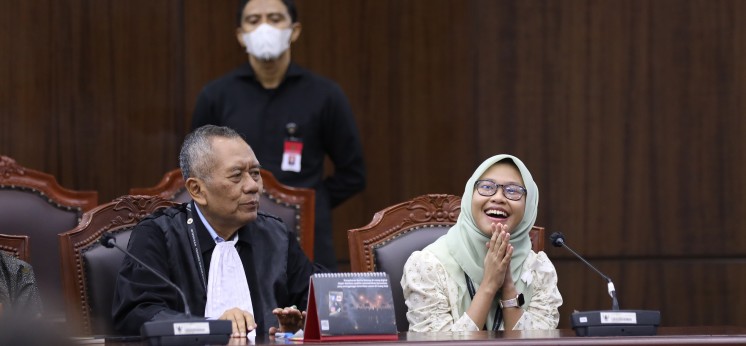
Principal Petitioner Raissa Fatikha (right) reacting after listening to the ruling hearing for the judicial review of Law No. 8 of 2016 on Persons with Disabilities, Monday (3/2/2026). Photo by MKRI/Ifa.
JAKARTA (MKRI) — The Constitutional Court granted in part a petition for the judicial review of Law No. 8 of 2016 on Persons with Disabilities, announced on Monday (March 2, 2026) in the Court’s plenary courtroom. The petition was filed by two individuals with chronic illnesses, Raissa Fatikha and Deanda Dewindaru, who argued that their constitutional rights had been impaired due to the absence of explicit recognition of chronic illnesses as a form of disability under the law.
“On the petition’s subject matter, [the Court] grants the Petitioners’ petition in part,” said Chief Justice Suhartoyo while delivering the verdict for Case No. 130/PUU-XXIII/2025.
In its ruling, the Court declared that the Explanation of Article 4 paragraph (1) letter a of the Persons with Disabilities Law is contrary to the 1945 Constitution and conditionally unconstitutional insofar as it is not interpreted as follows:
“Physical disability refers to impaired mobility functions, including but not limited to amputation, flaccid or spastic paralysis, paraplegia, cerebral palsy (CP), conditions resulting from stroke, leprosy, dwarfism, as well as individuals suffering from other chronic illnesses after undergoing an assessment by medical professionals, which is undertaken voluntarily by the individual concerned.”
Legal Considerations
In its legal considerations, the Court emphasized that determining whether a chronic illness qualifies as a disability must refer to the normative framework stipulated in Article 4 paragraphs (1) and (2) of the Persons with Disabilities Law. These provisions outline various categories of disability while affirming that the designation of an individual as a person with a disability must be based on an assessment conducted by medical professionals and/or other competent experts.
The Court further underscored that the law does not confine disability solely to conditions that are visibly manifested as mobility impairments. Instead, it allows the recognition of diverse health conditions that objectively cause long-term limitations in bodily functions. In practice, many illnesses initially perceived as ordinary health issues may develop into conditions that significantly affect a person’s ability to work, move independently, carry out daily activities, or participate fully in social life.
Consequently, a fair legal approach must not foreclose the possibility that such conditions, at a certain stage, fulfill the elements of physical functional limitation as referred to in the Persons with Disabilities Law, particularly when they create tangible barriers to performing everyday activities.
The Court also noted that the medical assessment mechanism under Article 4 paragraph (2) of the law serves as an essential instrument to maintain a balance between the protection of rights and legal certainty. This mechanism ensures that the recognition of disability status is grounded in objective professional evaluation regarding the degree of functional limitation experienced by an individual, rather than merely on subjective claims.
Furthermore, the assessment mechanism is not intended to restrict access to legal protection. Rather, it aims to evaluate the extent of a person’s functional limitations, identify the support required, and assess the impact of the condition on the individual’s capacity to carry out daily activities.
Ensuring Fair Protection
According to the Court, professional verification of medical conditions is necessary to prevent the misuse of disability status, which could otherwise create injustice for individuals who genuinely require state protection and support. Such verification must be conducted fairly and should not generate negative perceptions within society toward persons with disabilities.
Through this mechanism, the determination of disability status may effectively serve its principal purpose, ensuring the fulfillment of the rights of the individuals concerned.
The Court further observed that the medical assessment mechanism reflects the state’s commitment to protecting individuals who experience long-term functional limitations while simultaneously preventing the potential abuse of disability status that could undermine the objectives of such protection. This approach is consistent with the state’s constitutional obligation to guarantee access to healthcare services and rehabilitation for citizens as mandated under Article 28H paragraph (1) of the 1945 Constitution.
Accordingly, illnesses that persist over an extended period and affect an individual’s social rights may legally fall within the category of physical disability, provided that they have undergone professional assessment in accordance with statutory regulations. Interpreting physical disability narrowly, limited only to observable mobility impairments, would risk constricting the legal meaning in a manner inconsistent with national policies aimed at protecting the rights of persons with disabilities.
Such policies seek to move beyond the traditional perspective that viewed disability merely as an individual medical condition. Instead, they adopt a human rights–based approach that recognizes persons with disabilities as legal subjects entitled to full participation in social life.
A Right, Not an Obligation
Nevertheless, the Court stressed that although chronic illnesses may meet the criteria for disability through medical assessment, such recognition serves a specific purpose: ensuring substantive equality. In this context, substantive equality refers to providing appropriate access and support so that individuals facing certain barriers can participate fully and effectively in society.
Therefore, disability status must not be imposed as an obligation upon every individual who satisfies medical criteria. Objectively, a person may qualify for the protections afforded to persons with disabilities; however, subjectively, that individual retains the right to determine how they identify themselves within the social and legal sphere.
In other words, such status must be understood as a right to claim, rather than a duty to accept.
Thus, the Court emphasized that the issue extends beyond merely providing facilities for individuals with illnesses. The state must also preserve the individual’s freedom of choice regarding whether to affirm such status. Consequently, all legal consequences arising from the acceptance or refusal of disability status in the context of chronic illness must ultimately rest with the individual concerned as a legal subject.
Within this framework, the state provides an objective medical assessment mechanism, ensures access to rights, and protects individuals from discrimination. Beyond these guarantees, the decision to identify oneself as a person with a disability remains an expression of free will safeguarded by the principle of human dignity. The law, therefore, does not position individuals with chronic illnesses as objects of policy, but rather as rights holders who retain the autonomy to determine their identity and life choices.
Explore the case: Case No. 130/PUU-XXIII/2025
The Complete Decision: Decision No. 130/PUU-XXIII/2025
Author: Utami Argawati
Editor: Nur R.
PR: Andhini SF.
Translator: Yuanna Sisilia
Disclaimer: The original version of the news is in Indonesian. In case of any differences between the English and the Indonesian versions, the Indonesian version will prevail.
Monday, March 02, 2026 | 14:13 WIB 59