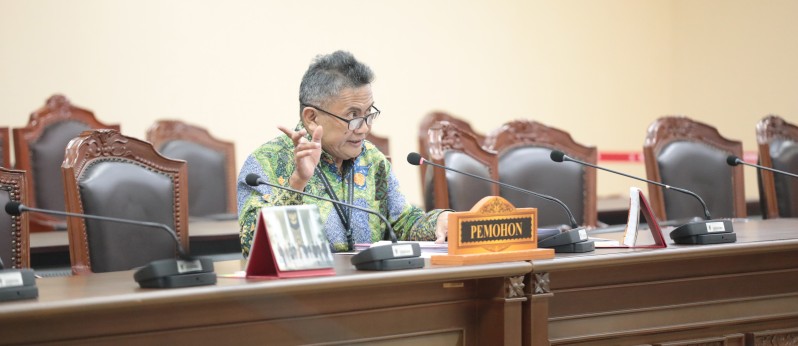
Petitioner of the judicial review of the State Administrative Court (PTUN) Law, Nico Indra Sakti, explaining the revisions to his petition before the panel of constitutional justices at the petition revision hearing, Thursday (2/26/2026). Photo by MKRI/IlhamWM.
JAKARTA (MKRI) — The Constitutional Court (MK) held a petition revision hearing for the judicial review of Article 2 letter e of Law No. 5 of 1986 on the State Administrative Court (PTUN Law) against the 1945 Constitution on Thursday, February 26, 2026. The hearing for Case No. 59/PUU-XXIV/2026 was presided over by Deputy Chief Justice Saldi Isra, and the Petitioner, Nico Indra Sakti, present the improvements to his petition.
During the hearing, Nico affirmed that he had accommodated all advice given by the panel of constitutional justices at the previous session.
“The revisions are on page two. On page six, I have shortened the legal standing section and clarified the constitutional loss I have suffered,” Nico said.
He further explained that he had supplemented the section on the Court’s authority by incorporating the substance of Article 2 and reaffirmed the principal arguments of his petition on page 16. According to him, the disputed object does not fall within the scope of judicial power as stipulated in Article 24 paragraphs (1) and (2) of the 1945 Constitution, but rather within functions related to judicial power as referred to in Article 24 paragraph (3) of the 1945 Constitution.
In the posita of his petition, Nico elaborated on provisions of the Law on Judicial Power, particularly Article 38 paragraph (2), which regulates five functions related to judicial authority.
The petition was registered with the Court under Case No. 59/PUU-XXIV/2026. Nico, a retired employee of a state-owned bank, challenges the constitutionality of Article 2 letter e of the PTUN Law, which excludes “state administrative decisions issued based on court examination results” from being objects of dispute before the State Administrative Court.
According to the Petitioner, the provision is open to multiple interpretations because it does not explicitly require that the excluded state administrative decision must truly correspond to the outcome of a court examination.
Also read: Petitioner Challenges Exclusion of Court-Based Administrative Decisions
At the preliminary hearing on Friday, February 13, 2026, Nico argued that the provision had prevented him from resolving his legal dispute with administrative officials of a district court, including the Chief Judge of the South Jakarta District Court in his capacity as head of the registrar’s office and bailiffs.
He contended that a state administrative decision had been issued without any clear statutory basis and had effectively annulled, disregarded, or contradicted the results of a court examination. In his view, such action constitutes interference with the independence of judicial power as guaranteed by Article 24 paragraph (1) of the 1945 Constitution.
The Petitioner also claimed that he had to defend the permanent legal force of two civil judgments against what he described as abuse of authority and arbitrary acts. He further stated that the Chief Judge of the South Jakarta District Court had prohibited him from filing a cassation against a non-executable stipulation (beschikking) that had been issued.
Moreover, he asserted that the allegedly unlawful state administrative decision had been used as a reference by other state administrative officials, including those within the Ministry of Agrarian Affairs and Spatial Planning/National Land Agency (ATR/BPN), the Police, the Judicial Commission (KY), and the National Commission on Human Rights (Komnas HAM).
Author : Utami Argawati
Editor : Lulu Anjarsari P.
PR : Fauzan Febriyan
Translator : Yuanna Sisilia
Disclaimer: The original version of the news is in Indonesian. In case of any differences between the English and the Indonesian versions, the Indonesian version will prevail.
Thursday, February 26, 2026 | 15:39 WIB 77