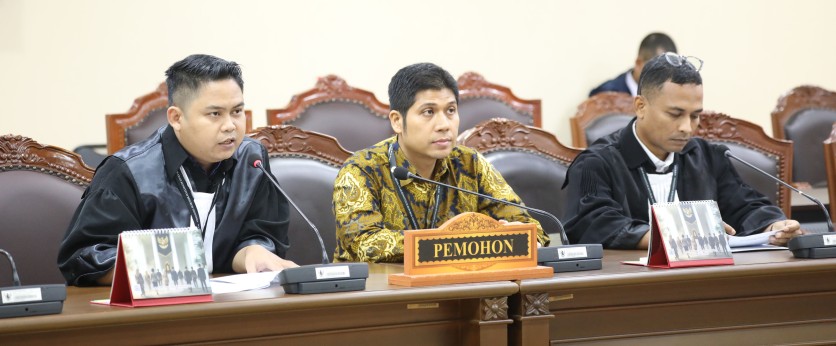
The Petitioners accompanied by their legal counsels conveying the main points of the judicial review. Wednesday (25/2/2026). Photo by MKRI/Panji.
JAKARTA (MKRI) — Achmad Safi’ (Petitioner I), an online motorcycle taxi driver, together with the Deconstitute Democracy Research Institute (Petitioner II), have brought a petition for judicial review of Article 18 paragraph (1) letter f of Law No. 8 of 1999 on Consumer Protection and Article 71 point 2 of Law No. 6 of 2023 on the Stipulation of Government Regulation in Lieu of Law No. 2 of 2022 on Job Creation into Law, which amends Article 28 paragraph (1) of Law No. 36 of 1999 on Telecommunications, alleging that these provisions are inconsistent with the 1945 Constitution of the Republic of Indonesia. The preliminary hearing for Case No. 68/PUU-XXIV/2026 was held on Wednesday, February 25, 2026 before a panel of justices chaired by Deputy Chief Justice Saldi Isra.
The core of the Petitioners’ challenge concerns the legal ambiguity surrounding the validity period imposed on prepaid internet data quotas and the absence of clear protections against the unilateral forfeiture of remaining quota that has already been fully paid for. They argue that the tested norms fail to explicitly and limitatively prohibit business actors from including standard contractual clauses that confer the right to “terminate or erase” consumers’ rights to the entirety or residual benefits of goods and/or services, particularly those of public importance such as internet data. This situation, they contend, grants undue latitude to providers to impose expiry periods on prepaid quota without proportionate compensation or legal safeguards, thereby undermining consumer rights.
In their petition, the Petitioners further contend that the omission of the term “goods” in Article 18 paragraph (1) letter f of the Consumer Protection Law blurs the distinction between goods and services in the modern digital economy, given that many products, including prepaid internet quota, exhibit hybrid characteristics of both. While prepaid internet quota may constitute a telecommunications service because it confers access to network services, it also possesses attributes of a good, such as quantifiable volume (in GB) that is “held” in a consumer’s account and “consumed” over time. According to the Petitioners, this definitional uncertainty enables business actors to oscillate between classifications to evade applicable consumer protections.
Moreover, they argue that the use of the term “reduce” in Article 18 paragraph (1) letter f itself introduces normative ambiguity. Whereas “reduce” denotes partial diminution, the total forfeiture of unused quota upon expiry may not fall neatly within this semantic scope, leaving an interpretive gap regarding whether such forfeiture constitutes unlawful diminution of consumer benefit.
Accordingly, in their petitum the Petitioners request the Constitutional Court to declare the challenged provisions conditionally unconstitutional and lacking legal force unless interpreted to mean that business actors may not reduce, limit the validity period, or erase the benefits of goods and/or services that have been paid for, including prepaid internet quota while the prepaid card remains active; and that any limitation on tariff determination must not be applied to such goods/services without clear legal protection for consumers.
Constitutional Losses
During the hearing, Constitutional Justice Ridwan Mansyur advised the Petitioners to refer carefully to precedent, such as Decision No. 23/PUU-XX/2022 on the review of Article 18 paragraph (1) of the Consumer Protection Law, to avoid issues of nebis in idem, and to elucidate the specific constitutional losses they claim. Justice Adies Kadir underscored the need to clarify the constitutional bases and the direct link to alleged impairments. Deputy Chief Justice Saldi Isra also requested further elaboration on Petitioner II’s legal standing as a private legal entity and concrete evidence of disruption to its programmatic activities.
Before adjourning the session, Saldi Isra granted the Petitioners 14 days to perfect their petition, with the revised submission due by Tuesday, March 10, 2026 at 12:00 p.m. Western Indonesian Time, after which the Court will schedule the next hearing.
Explore the Case No. 68/PUU-XXIV/2026
Author : Sri Pujianti
Editor : Lulu Anjarsari P.
PR : Adriana A.Y.
Translator : Yuanna Sisilia
Disclaimer: The original version of the news is in Indonesian. In case of any differences between the English and the Indonesian versions, the Indonesian version will prevail.
Wednesday, February 25, 2026 | 14:49 WIB 81