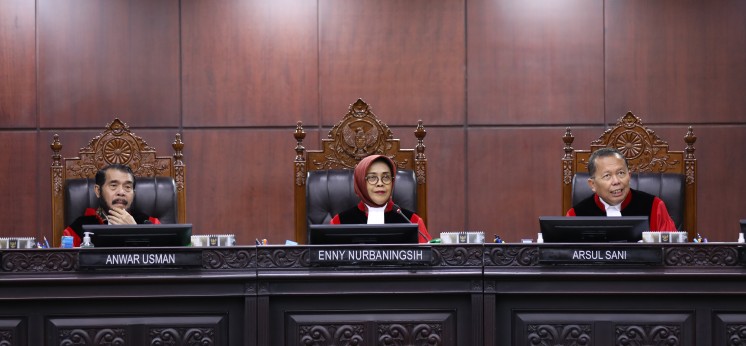
Presiding over the petition revision hearing for Case No. 54/PUU-XXIV/2026 on Law No. 20 of 2025 on the Criminal Procedure Code (KUHAP), Wednesday (2/24/2026) at the Constitutional Court courtroom. Photo by MKRI/Ifa.
JAKARTA (MKRI) — The Petitioners of Case No. 54/PUU-XXIV/2026 presented revisions to their petition for a judicial review of Article 5 paragraph (1) letters b and e as well as Article 79 paragraph (8) letter a of Law No. 20 of 2025 on the Criminal Procedure Code (KUHAP) before the Constitutional Court of the Republic of Indonesia on Tuesday, February 24, 2026. The revised petition narrows the scope of review from the initial 14 challenged provisions to only three articles.
“We have amended the substance of our petition in this review by limiting it to three provisions, namely Article 5 paragraph (1) letters b and e and Article 79 paragraph (8) letter a,” said Mayang Anggi Pradita, legal counsel for the Petitioners, during the petition revision hearing conducted virtually.
She explained that Article 5 paragraph (1) letter b of the KUHAP is being tested against Article 28D and Article 1 paragraph (3) of the 1945 Constitution, while Article 5 paragraph (1) letter e is challenged for allegedly contravening Article 28D paragraph (1) of the 1945 Constitution. Meanwhile, Article 79 paragraph (8) letter a is examined in light of Article 28I paragraph (5) of the 1945 Constitution.
The Petitioners remain unchanged in number, totaling 12 individuals, comprising eleven students from various universities across Indonesia and one legal staff member and consultant from HGM Law Office.
Mayang further conveyed that the section outlining the constitutional arguments has been adjusted to reflect the modified provisions under review. In their petitum, the Petitioners request the Court to declare Article 5 paragraph (1) letter b of the KUHAP contrary to the 1945 Constitution and unconstitutional insofar as it is not interpreted as “seeking and collecting information and evidence.” They also ask the Court to declare Article 5 paragraph (1) letter e unconstitutional and not legally binding unless construed as “undertaking other lawful actions that are accountable and regulated by law.” Furthermore, they seek a ruling that Article 79 paragraph (8) letter a of the KUHAP is unconstitutional and not legally binding.
Also read:
May Day Suspects Challenge New Criminal Procedure Code
For context, two of the 12 Petitioners claim to have been subjected to criminalization after being named suspects in connection with the May Day demonstration on May 1, 2025. Petitioner I, Cho Yong Gi, is an active student of the Faculty of Humanities, majoring in Philosophy at the Universitas Indonesia. Petitioner II, Jorgiana Augustine, is a graduate student in Law at the Faculty of Law of Universitas Gadjah Mada.
Their designation as suspects, they argue, places them directly under the coercive authority of the state, exposing them to potential detention, case file transfer, and prosecution. As such, their personal liberty, sense of security, and legal certainty have been, and continue to be, under palpable threat. With the investigation still ongoing and the possibility of prosecution remaining open, they assert that they are directly and actually subjected to the norms of the new KUHAP throughout the subsequent stages of investigation, detention, indictment, evidentiary proceedings, and trial.
Both Petitioners identify themselves as activists advocating civil liberties and the effective implementation of human rights principles, expressed through public discussions, written works, and media interviews.
During the recent May Day rally, they served as paramedics. However, they allege that they were subjected to torture, searches, forcible seizure, harassment, physical assault, and collective violence on the pretext of disobeying orders from authorized officials. They were formally named suspects on May 23, 2025 under Article 216 in conjunction with Article 218 of the Criminal Code.
In addition to Petitioner I and Petitioner II, the other Petitioners are Hafizhah Nur Oktawiyana (Petitioner III), Muhammad Shiddiq (Petitioner IV), Rangga Putra Valeriant (Petitioner V), Dyzta Mutiara Salim (Petitioner VI), Muhammad Nouval Ar-Rahman (Petitioner VII), Satria Dzaky Suhendar (Petitioner VIII), Noval Ferdiansyah (Petitioner IX), Julianus (Petitioner X), Ahmad Zabidi Hikam (Petitioner XI), and Mathias Eikel Bremana Sembiring (Petitioner XII).
Explore the case: Petition No. 54/PUU-XXIV/2026 (in Bahasa Indonesia)
Author: Mimi Kartika
Editor: N. Rosi
Translator: Yuanna Sisilia
Disclaimer: The original version of the news is in Indonesian. In case of any differences between the English and the Indonesian versions, the Indonesian version will prevail.
Tuesday, February 24, 2026 | 15:48 WIB 92