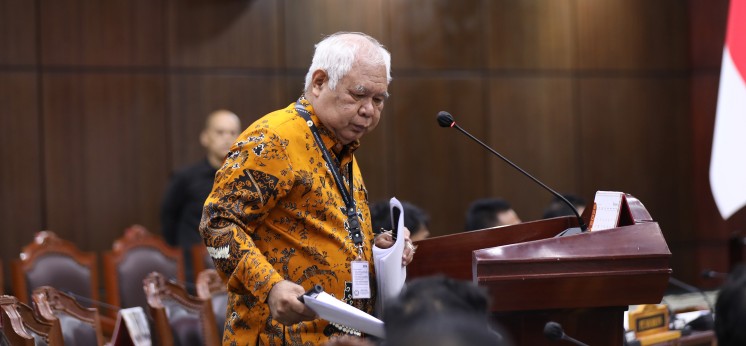
Soleman B Ponto, Petitioner's Expert, after providing testimony at the hearing of the judicial review of Law No. 32 of 2014 on Maritime Affairs, Monday (2/23/2026). Photo by MKRI/Ifa.
JAKARTA (MKRI) – The effort to bring the Maritime Security Agency (Bakamla) into the law enforcement system through a narrative of coordination between nine institutions, namely the Indonesian Navy, the Indonesian National Police, the Ministry of Transportation, the Ministry of Maritime Affairs and Fisheries, Customs and Excise, Immigration, the National Narcotics Agency, the Ministry of Environment and Forestry, and Bakamla contains flawed logic in criminal procedural law and is contrary to Article 24 paragraph 3 of Law No. 6 of 1996 on Indonesian Waters.
This is the statement delivered by Soleman B Ponto as the Petitioner's Expert in the hearing for judicial review of Article 59 Paragraph (3), Article 61, Article 62 Letter c, and Article 63 Paragraph (1) of Law No. 32 of 2014 on Maritime Affairs (Maritime Law) on Monday, February 23, 2026. The eighth hearing for Petition No. 180/PUU-XXIII/2025 filed by Lukman Ladjoni was on the agenda of hearing the Expert's statement presented by the Petitioner.
In addition, this Maritime Law and Constitutional Law Expert stated that Law No. 6 of 1996 on Indonesian Waters has regulated the coordination mechanism for law enforcement at sea, so that the argument for the need for a new institution based on coordination is not reasonable. This is reflected in Article 24 paragraph (3) of Law No. 6 of 1996 which states, "In implementing law enforcement as referred to in paragraph (1), the authorized agency shall coordinate in accordance with applicable laws and regulations." This means that since 1996 the Indonesian legal system has recognized cross-agency coordination in law enforcement and sovereignty at sea, without changing the distribution of sectoral authority or creating parallel investigators outside the national criminal procedural law system.
Meanwhile, Article 59 paragraph (3), Article 61, Article 62 letter c, and Article 63 paragraph (1) letter b of Law No. 32 of 2014 together state the establishment of a law enforcement agency at sea that has the function of patrolling, taking action, and the authority to “stop, examine, arrest, and carry”. In fact, in the doctrine of criminal procedure law, the act of “arresting and carrying” is a form of restriction on physical freedom.
"Bakamla is not explicitly granted the status of investigator or civil servant (PPNS) in the a quo law. Consequently, this norm creates the risk of a disconnect between factual authority and judicial oversight," Soleman concluded.
Not a Legal Vacuum
The eight maritime threats often cited as the basis for legitimizing the expansion of authority, Soleman explained, actually have a material legal basis and legitimate investigators, so there is no legal vacuum. For example, illegal fishing is regulated under the Fisheries Law, with investigators from the Fisheries Civil Servant Officers (PPNS); smuggling is regulated under the Customs Law, with investigators from the Customs Office; narcotics issues are regulated under the Narcotics Law, with investigators from the National Narcotics Agency (BNN)/National Police (Polri); and people smuggling is also regulated under the Immigration/TPPO Law, with investigators from the National Police/Immigration Civil Servant Officers (PPNS).
Furthermore, marine pollution is regulated in the Environmental Law and the Shipping Law with relevant PPNS investigators; maritime terrorism is also regulated in the Terrorism Eradication Law with National Police investigators; piracy cases are regulated in the Criminal Code and the Shipping Law with National Police/Navy investigators; and territorial violations are regulated in the TNI Law and the National Defense Law with Indonesian Navy investigators. Therefore, security must not be built by obscuring established law enforcement procedures.
Obscuring Responsible Parties
The expert also explained that coordination is not a basis for attributing coercive measures, as the Criminal Procedure Code (KUHAP) does not recognize a mechanism related to the administrative coordination function, which grants "arrest" authority to institutions that do not hold investigator or civil servant status. Furthermore, the lack of a "Arrest-hand over" mechanism, where an arrest is made by a non-investigating institution and then "handed over," has created an illegal pre-investigation phase. This has the effect of depriving liberty without a valid warrant under the Criminal Procedure Code. Therefore, within the framework of fragmented accountability, this coordination obscures who/what party is procedurally responsible. This renders pretrial access ineffective due to the positioning of coercive measures as "administrative-preventive," Soleman added.
Therefore, the configuration of the norms of Article 59 paragraph (3), Article 61, Article 62 letter c, and Article 63 paragraph (1) letter b of the Maritime Law clearly contradicts constitutional principles. This is because in the Indonesian criminal law system, coercive measures are not ordinary administrative powers.
Arrest, detention, confiscation, and restrictions on freedom of movement are the most serious forms of state intervention in human rights. The Criminal Procedure Code explicitly stipulates that these actions may only be carried out by investigators authorized by law.
Thus, coercive measures are a monopoly of legitimate investigators within the national criminal justice system. This is because the state does not recognize a parallel regime that allows administrative officials to conduct actions resembling investigations without being subject to criminal procedural law. If a norm grants the authority to "arrest and transport" to an institution not expressly positioned within the investigative structure of the Criminal Procedure Code (KUHAP), then such a norm is inherently constitutionally flawed.
"Based on the description above, in the opinion of the Expert, Article 59 paragraph (3), Article 61, Article 62 letter c, and Article 63 paragraph (1) letter b of the a quo Law have the potential to conflict with Article 1 paragraph (3) and Article 28D paragraph (1) of the 1945 Constitution insofar as they are interpreted as providing the authority to investigate and arrest outside the national criminal procedural law system," stressed Soleman in the Plenary Session led by Chief Justice of the Constitutional Court Suhartoyo together with Deputy Chief Justice of the Constitutional Court Saldi Isra and seven other constitutional justices from the Plenary Session Room, Building 1 of the Court.
Also read:
Petitioner Questions Bakamla's Authority
Petitioner Changes Petitum for Judicial Review on Bakamla's Authority
DPR and President Request a Postponement of Bakamla Authority Hearing
House and Govt Explain Maritime Security Agency’s Formation, Duties, and Authorities
The Limits of Maritime Security Agency's Authority in Law Enforcement in Indonesian Waters
Ministry of Maritime Affairs and Fisheries and Ministry of Transportation Haven’t Ready to Provide Information on Bakamla's Authority on Maritime Law Review
For your information, Petition No. 180/PUU-XXIII/2025 was filed by Lukman Ladjoni (Petitioner). This Petition challenges Article 59 Paragraph (3), Article 61, Article 62 Letter c, and Article 63 Paragraph (1) of the Maritime Affairs Law.
Article 59 Paragraph (3) of the Maritime Affairs Law states, "To enforce the law in Indonesian waters and jurisdictional areas, specifically to carry out security and safety patrols in Indonesian waters and jurisdictional areas, a Maritime Security Agency shall be established."
In the first hearing at the Constitutional Court on Friday, October 10, 2025, Dusri Mulyadi as the Petitioner's Legal Counsel revealed that the provision is a direct legal basis that provides legitimacy to the actions of the Maritime Security Agency (Bakamla) which are open and unmeasured, which ultimately poses a threat to the protection of constitutional rights and legal certainty for the Petitioner.
In a concrete case, on July 31, 2024, a vessel belonging to the Petitioner's company was seized by Bakamla in "Operation Trawl Manguni IV-24". This was due to administrative findings, such as the absence of a CLC Bunker certificate and expired safety equipment, which are not classified as criminal violations, but rather administrative violations. Then, Bakamla officers in a Warrant ordered the Captain of KM. Suryani Ladjoni to depart for Bitung Port no later than August 1, 2024, for further inspection. In short, Bakamla detained the KM. Suryani Ladjoni along with the ship's documents and equipment as well as the captain and 17 crew members.
According to the Petitioner, the detention of the ship by Bakamla not only caused material and operational losses, but also the Petitioner's constitutional rights as the ship owner as a legal subject to obtain legal protection, legal certainty and justice as guaranteed in Article 28D paragraph (1) of the 1945 Constitution.
"The presence of Bakamla in Law No. 32 of 2014 on Maritime Affairs creates legal uncertainty for shipping business actors because it violates the provisions of the law that clearly define the investigative authority of each institution, such as the KPLP, Customs, and others, which require inspections to be carried out at the port, not during sailing," said Dusri.
Petitioner considers Bakamla not an investigator as stated in Article 1 No. 1 of the Criminal Procedure Code and Presidential Decree No. 178 of 2014 also states that it does not have the legal authority to form an investigative agency, let alone carry out the detention and seizure of vessels without a delegation from an official investigator or a court order as required by criminal procedure law. Thus, the act of detaining and seizing vessels without reason is clearly considered to violate the principles of legality and due process of law guaranteed by the constitution and damages the national maritime law system.
Therefore, Petitioner requested that Court declare Article 59 Paragraph (3), Article 61, Article 62 Letter c, and Article 63 Paragraph (1) of the Maritime Affairs Law contrary to the 1945 Constitution of the Republic of Indonesia and have no binding legal force.
Petitioner also requests that Court order the legislators to draft a special law on Bakamla within a maximum of two years from the date of this decision. If the legislators fail to fulfill this obligation within two years, Bakamla will have no legal basis and all of its operational functions will be rendered inoperable.
Track case No. 180/PUU-XXIII/2025
Author : Sri Pujiati
Editor : N. Rosi.
Translator : Donny Yuniarto
Disclaimer: The original version of the news is in Indonesian. In case of any differences between the English and the Indonesian versions, the Indonesian version will prevail.
Monday, February 23, 2026 | 12:33 WIB 150