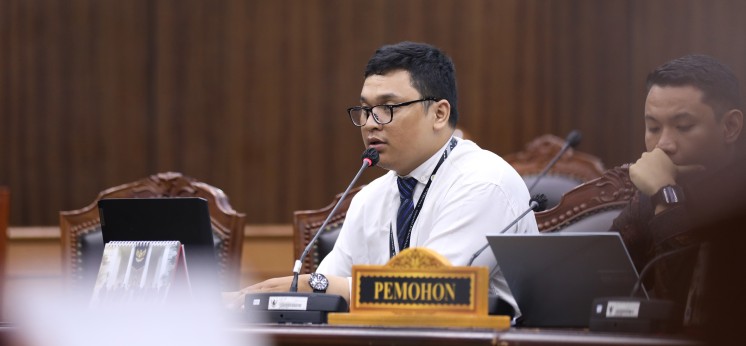
Martin Maurer, the Petitioner’s legal counsel, conveying revisions to the petition at a petition revision hearing for Case No. 51/PUU-XXIV/2026 on the judicial review of Law No. 13 of 2003 on Manpower, Monday (2/23/2026) in the Constitutional Court courtroom. Photo by MKRI/Ifa.
JAKARTA (MKRI) — The Constitutional Court (MK) once again held a petition revision hearing for the judicial review of Article 62 of Law No. 13 of 2003 on Manpower on Monday, February 23, 2026. The hearing for Case No. 51/PUU-XXIV/2026 was presided over by Constitutional Justice Enny Nurbaningsih, alongside Constitutional Justices Anwar Usman and Arsul Sani.
At the hearing, which examined the principal revisions to the petition, the Petitioner’s legal counsel Martin Maurer informed the panel that several aspects had been refined. These included clarifications regarding the Court’s authority to review the a quo provision and elaboration on the Petitioner’s legal standing. The revised petition specifies that the Petitioner is a private-sector employee under a fixed-term employment agreement (PKWT), thereby establishing a direct causal relationship between his constitutional impairment and the enforcement of the contested article.
Maurer asserted that the potential loss faced by the Petitioner is not speculative. In current labor practices, he argued, companies may create uncomfortable or adverse working conditions that effectively pressure employees into resigning. Such measures may include assigning duties unrelated to the worker’s expertise, imposing workloads beyond reasonable capacity, or transferring the employee without clear justification.
“This condition may place workers in a difficult position, causing them to lose focus and preventing them from delivering optimal performance. As a result, the Petitioner may feel compelled to resign. However, if he resigns, he must pay compensation equal to the wages stipulated under the a quo Law. This leads to a loss for the Petitioner because he is essentially forced to resign in a subtle manner,” Maurer stated before the panel.
Also read:
Resigning Before Contract Ends Requires Compensation, Manpower Law Challenged
The Case No. 51/PUU-XXIV/2026 was filed by Leonardo Olefins Hamonangan to challenge the constitutionality of Article 62 of Law No. 13 of 2003 on Manpower.
Article 62 stipulates that if either party terminates an employment relationship prior to the expiry of a fixed-term employment agreement, or if the termination does not fall under the exceptions provided in Article 61 paragraph (1), the terminating party must pay compensation to the other party in the amount of the worker’s wages until the end of the contractual period.
At the preliminary hearing on Tuesday, February 10, 2026, Maurer argued that the provision is inconsistent with the principle of constitutional protection because it imposes a legal consequence, namely, an obligation to pay compensation, upon workers who terminate their employment. The norm, he asserted, provides no room to assess whether the termination was triggered by the employer’s fault or improper conduct.
Furthermore, the Petitioner maintains that the article merely emphasizes which party formally ends the employment relationship without considering the factual background and underlying causes of such termination. Consequently, workers who experience unfair treatment and are compelled to resign may lose legal protection while simultaneously bearing financial liability.
According to the Petitioner, this condition demonstrates that the provision disregards the protective function inherent in Article 28D paragraph (1) of the 1945 Constitution, which guarantees fair legal certainty and equal treatment before the law. Instead of safeguarding workers, the norm allegedly places them in an increasingly vulnerable legal and economic position.
Author: Sri Pujianti
Editor: N. Rosi
Translator: Yuanna Sisilia
Disclaimer: The original version of the news is in Indonesian. In case of any differences between the English and the Indonesian versions, the Indonesian version will prevail.
Monday, February 23, 2026 | 15:16 WIB 96