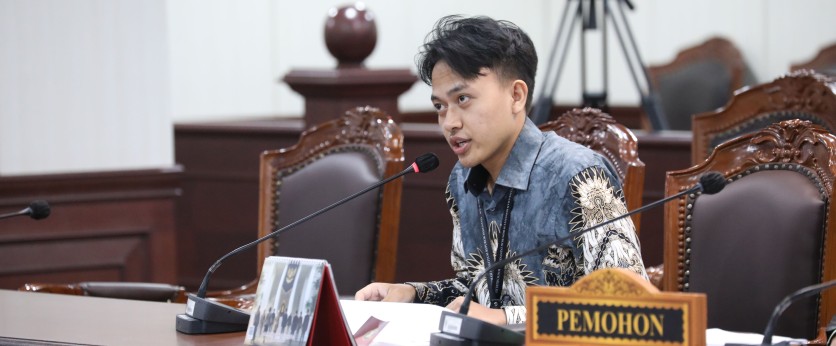
The Petitioner of Case No. 49/PUU-XXIV/2026, Moh Abqori Hisan, presenting the revisions to his judicial review petition of the Child Protection Law, Monday (2/23/2026). Photo by MKRI/Panji.
JAKARTA (MKRI) — The Constitutional Court held the petition revision hearing for the material judicial review of Article 8 of Law No. 23 of 2002 on Child Protection, as amended by Law No. 35 of 2014, on Monday, February 23, 2026 in one of the panel courtrooms. This hearing for Case No. 49/PUU-XXIV/2026, filed by Moh. Abqori Hisan, was presided over by Chief Justice Suhartoyo alongside Constitutional Justices Daniel Yusmic P. Foekh and M. Guntur Hamzah.
The Petitioner, who appeared without legal counsel, stated that he had revised his petition. “There were indeed many errors in the earlier petition. The section concerning the Court’s authority has now been revised,” he stated.
In the section on legal standing, the Petitioner elaborated on his active involvement in voluntary educational activities in Suka Raja Village, Warunggunung District, Lebak Regency, Banten Province. In addition, he is currently undertaking an internship at the National Commission for Child Protection.
“[I have] been genuinely and continuously involved in educational volunteer activities in Suka Raja Village, Warunggunung Subdistrict, Lebak Regency, which reflect the real conditions of children’s limited access to rights to social security services and guarantees, including supporting facilities for education and basic welfare. [I am] also currently participating in an internship program at the National Commission for Child Protection, demonstrating [my] direct involvement in observing and evaluating the implementation of legal norms related to child protection,” the Petitioner explained.
He further stated that revisions had also been made in the section setting out the grounds of the petition. He argued that Article 8 of the Child Protection Law contains a vague norm, thereby creating the potential for legal uncertainty. In his view, the phrases “health services” and “social security” in that provision are formulated without establishing minimum standards of protection and without accountability principles that could serve as parameters for evaluation.
Also read: Fulfillment of Children’s Rights to Health and Nutrition Questioned
Case No. 49/PUU-XXIV/2026 on the material judicial review of Article 8 of Law No. 23 of 2002 on Child Protection, as amended by Law No. 35 of 2014, was filed by Moh. Abqori Hisan. Article 8 of the Child Protection Law provides: “Every child is entitled to obtain health services and social security in accordance with their physical, mental, spiritual, and social needs.”
At the preliminary hearing on Tuesday, February 10, 2026, The Petitioner, who appeared without legal counsel, stated that the provision a quo does not provide adequate guarantees for the State to actively prevent, address, and remedy children from the impacts of violence and/or discriminatory treatment. As a result, children’s rights—constitutionally imperative and non-derogable—are reduced to merely declaratory norms without effective protection mechanisms, thereby contravening the State’s constitutional obligation to ensure the best interests of the child.
Furthermore, the Petitioner argued that Article 8 of the Child Protection Law constitutes a declaratory and relatively norm, as it does not stipulate concrete obligations of the State and Government that can be measured, supervised, and held legally accountable. Consequently, the fulfillment of children’s rights to health and nutrition depends entirely on government policies that are sectoral, programmatic, and inconsistent across regions. The absence of a binding normative guarantee in Article 8 has resulted in a substantive oversight vacuum in the implementation of children’s rights to health and nutrition. This condition has prevented the establishment of a system capable of reaching all Indonesian children (for all), particularly those in remote, underdeveloped areas and vulnerable groups.
The Petitioner emphasized that the weakness of Article 8 in practice has contributed to the persistence of malnutrition, undernutrition, and stunting among children, which poses the risk of a lost generation. This situation reflects the State’s failure to guarantee children’s right to optimal growth and development as enshrined in Article 28B paragraph (2) of the 1945 Constitution.
In his petitums, the Petitioner requests, inter alia, that the Court declare Article 8 of the Child Protection Law conditionally unconstitutional and not legally binding insofar as it is not interpreted to mean: “The fulfillment of children’s rights to health and nutrition must be implemented with safe protection standards, based on the individual conditions of each child, accompanied by mechanisms for the prevention of health risks, supervision, and state accountability for every policy concerning the fulfillment of children’s nutrition, including policies implemented through government programs.”
Explore case No. 49/PUU-XXIV/2026 (in Indonesian).
Author : Utami Argawati
Editor : N. Rosi
Translator : Yuniar Widiastuti (NL)
Disclaimer: The original version of the news is in Indonesian. In case of any differences between the English and the Indonesian versions, the Indonesian version will prevail.
Monday, February 23, 2026 | 15:47 WIB 143