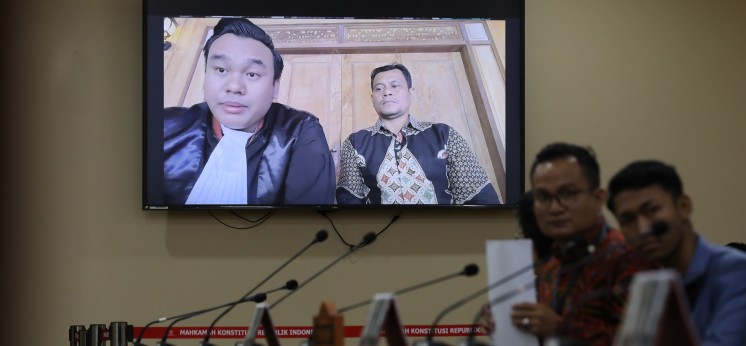
The Petitione and his’ counsels presenting the petition at the preliminary hearing for the judicial review of the Criminal Code remotely, Friday (2/20/2026). Photo by MKRI/Ifa.
JAKARTA (MKRI) — Agus Rianto, an individual citizen and chairman of Komite Juang Reforma Agraria (KJRA) or the Committee for Agrarian Reforms, has filed a judicial review petition of Law No. 1 of 2023 on Criminal Code (KUHP) to the Constitutional Court. The preliminary hearing for Case No. 64/PUU-XXIV/2026 on Friday, February 20, 2026 was presided over by panel chair Chief Justice Suhartoyo alongside Constitutional Justices Daniel Yusmic P. Foekh and M. Guntur Hamzah.
The Petitioner challenges Article 257 paragraph (1) of the Criminal Code, which reads: “Any Person who unlawfully forces Entry into a house, closed room, or closed yard that is used by other persons or those who are already in it unlawfully, and do not immediately leave the place at the request of the persons entitled to it or their messengers, shall be sentenced with imprisonment for a maximum of 1 (one) year or a maximum criminal fine of category II.”
Mohammad Ababililmujaddidyn, counsel for the Petitioner, stated that the Petitioner serves as chair of KJRA, representing the interests of small farmers and land cultivators organized in Community Groups (Pokmas) located on former plantation lands. For instance, the Community Group of Ngepoh Village, Tanggunggunung District, Tulungagung Regency, East Java Province, manages and cultivates land formerly subject to a right of cultivation (HGU) held by PT Margasari Jaya, which expired in 2008. Since the expiration of that HGU, the land has become abandoned/state land, open and no longer subject to active plantation activities.
Similarly, Community Groups in Nyawangan Village and Picisan Village, Sendang District, Tulungagung Regency, manage and cultivate land formerly under the HGU of PT NV Perkongsian Dagang Indoco, which expired in 2022. The land is used for farming and for gathering grass as a source of livelihood and in support of the national food security program.
However, the provision a quo is claimed to have harmed the constitutional rights of the Petitioner and KJRA members guaranteed under Article 28D paragraph (1) and Article 28I paragraph (2) of the 1945 Constitution. In the Petitioner’s view, the rigid application of Article 257 paragraph (1) of Law No. 1 of 2023 to abandoned/open land creates legal uncertainty. Corporations whose HGUs expired, for example as early as 2008, may rely on this article to evict farmers. In fact, according to Ababililmujaddidyn, abandoned land should revert to the State to be redistributed through the Agrarian Reform Object Land (TORA) scheme.
Moreover, the provision a quo has allegedly been used for criminalization by PT Indoco Surabaya, which claimed former plantation land in Nyawangan and Picisan Villages. As a result, two KJRA members were imprisoned for one month and fifteen days, and the decision has become final and binding. In addition, twelve KJRA members in Ngepoh Village have been reported following land ownership claims by PT Sang Lestari Abadi under the same article. In fact, the land cultivated by the Community Groups is based on a redistribution order of former HGU land of PT Margasari Jaya issued by the East Java Regional Land Office to the Tulungagung Land Office dated May 19, 2008, as well as a Recommendation for the Acceleration of TORA Land Redistribution from the Presidential Staff Office dated September 25, 2024. Consequently, the norm a quo is considered to provide no clear limitation regarding the meaning of “enclosed yard” in relation to abandoned (former HGU) land. The Petitioner therefore argue that the rights of small farmers managing TORA have been effectively expropriated.
In their petitums, as read online by Burhanuddin Jabbar, the Petitioner request the Court to: “Declare Article 257 paragraph (1) of Law No. 1 of 2023 on the Criminal Code unconstitutional and not legally binding insofar as it is interpreted not to apply to: a. Plantations whose HGU has expired, have been declared abandoned, and where no actual management activity is carried out by the former right holder; b. Land managed by small planters and farmers for cultivation in support of the National Food Security Program.”
Legal Standing
In his advice at the panel hearing, Constitutional Justice M. Guntur Hamzah stated that as KJRA is the applicant, it should attach its articles of association granting authority to represent the organization both in and out of court. “This relates to the Petitioner’s legal standing, which remains unclear. Furthermore, the grounds have not yet explained the contradiction between the challenged norm and the constitutional provisions serving as the review benchmark,” he explained.
Meanwhile, Constitutional Justice Daniel Yusmic P. Foekh advised the Petitioner to adjust the structure of the petition in accordance with Constitutional Court Regulation (PMK) No. 7 of 2025. “The grounds of the petition are still too brief and need to be strengthened with philosophical reasoning, principles, and doctrine. The requested interpretation must also be clarified and aligned—what would be the impact if the norm were interpreted as the Petitioner requests?” he asked.
Before adjourning the session, Chief Justice Suhartoyo announced that the Petitioner would have 14 days to revise the petition. The revised petition must have been received by the Court’s Registrar’s Office no later than 12:00 WIB on Thursday, March 5, 2026. The Court will the schedule the second session to hear the revisions to the petition.
Author : Sri Pujianti
Editor : N. Rosi
Translator : Yuniar Widiastuti (NL)
Disclaimer: The original version of the news is in Indonesian. In case of any differences between the English and the Indonesian versions, the Indonesian version will prevail.
Friday, February 20, 2026 | 10:58 WIB 77