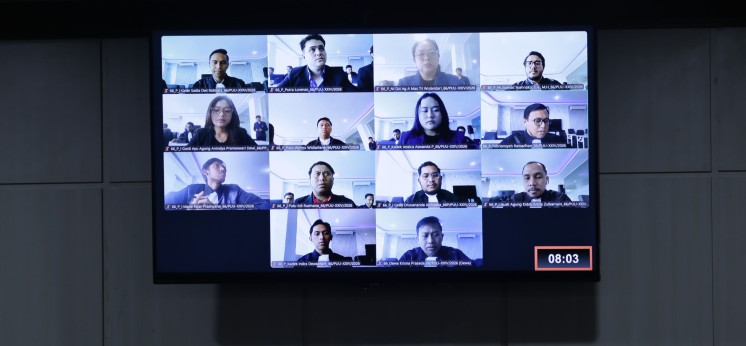
The Petitioners during the Preliminary Examination hearing of Case Number 66/PUU-XXIV/2026 concerning the judicial review of Law Number 30 of 2014 on Government Administration, Friday (02/20/2026). Photo by MKRI/Bay.
JAKARTA, (MKRI) – Eight Petitioners have filed a material judicial review of Article 16 paragraph (6), Article 20 paragraph (2), and Article 20 paragraph (4) of Law Number 30 of 2014 on Government Administration to the Constitutional Court. Petition Number 66/PUU-XXIV/2026 was submitted by Ni Gusti Agung Ayu Mas Tri Wulandari (Petitioner I), I Putu Edi Rusmana (Petitioner II), Putu Wahyu Widiartana (Petitioner III), Putra Lorenzo (Petitioner IV), Kadek Jessica Aswanda Putri (Petitioner V), Ayu Bang Bahari Ken Widyawati (Petitioner VI), Gusti Ayu Agung Anindya P. (Petitioner VII), and I Nyoman Widhi Adnyana (Petitioner VIII).
The object of the petition concerns the use of the phrase “state financial loss” in Article 16 paragraph (6), Article 20 paragraph (2), and Article 20 paragraph (4) of the Government Administration Law. The Petitioners question the inconsistency of terminology within the same set of provisions, as Article 20 paragraphs (5) and (6) use the phrase “state loss.” As the constitutional benchmark, the Petitioners argue that these provisions are contrary to Article 27 paragraph (1), Article 28D paragraph (1), Article 28D paragraph (3), and Article 28I paragraph (4) of the 1945 Constitution of the Republic of Indonesia (UUD 1945).
During the hearing chaired by Constitutional Justice Enny Nurbaningsih, the Petitioners—represented by Dewa Krisna Prasada—argued that there is a lack of synchronization and conceptual inconsistency in Article 20 paragraph (2) letter c and paragraph (4) of the Government Administration Law, which use the phrase “state financial loss,” while paragraphs (5) and (6) of the same article use “state loss.”
According to the Petitioners, this difference in terminology creates ambiguity in the norm and legal uncertainty. “The a quo norm has harmed the Petitioners’ constitutional rights because it complicates the process of teaching and learning law in a systematic and consistent manner, while also creating problems in law enforcement practice by blurring the boundary between administrative error and criminal offense,” Dewa stated before the Panel of Constitutional Justices.
The Petitioners explained that, normatively, the term “state loss” falls within the administrative law regime, which is oriented toward recovery and governance improvement rather than punishment. This, they argued, is affirmed in Article 1 point 22 of Law Number 1 of 2004 on State Treasury, which defines state/regional loss as a real and definite shortage of money, securities, or goods resulting from unlawful acts, whether intentional or due to negligence.
Meanwhile, another counsel, Febriansyah Ramadhan, emphasized the conceptual distinction between “state loss” and “state financial loss.” He noted that the term “state loss” is recognized in several regulations, including Law Number 15 of 2006 on the Audit Board of Indonesia and Law Number 1 of 2004 on State Treasury, which place it within the administrative law regime oriented toward recovery.
In contrast, the phrase “state financial loss,” according to him, is commonly used within the criminal law regime, particularly in corruption offenses, which are oriented toward punishment and require the presence of specific elements of fault.
“The regime of state financial loss is a criminal law regime, particularly corruption offenses, which use the phrase ‘causing loss to state finances,’ where the orientation is punishment and involves the element of mens rea. This reflects the conceptual difference between ‘state financial loss’ and ‘state loss’ that has been conflated within the Government Administration Law,” he stated.
According to the Petitioners, this condition is detrimental to them, including lecturers, students, and village heads as officials who are subject to and bound by the Government Administration Law.
In their petitum, the Petitioners request the Court to grant the petition in its entirety and declare the phrase “financial” in Article 16 paragraph (6), Article 20 paragraph (2), and Article 20 paragraph (4) of the Government Administration Law contrary to the 1945 Constitution of the Republic of Indonesia (UUD 1945) and without binding legal force. They also request the Court to order the publication of the decision in the State Gazette of the Republic of Indonesia.
Responding to the petition, Constitutional Justice Arsul Sani suggested that the constitutional basis of the review be clarified and aligned. He observed discrepancies between the constitutional grounds stated in the title of the petition, the section on legal standing or constitutional impairment, and the arguments presented in the posita.
“From what I observe, there are differences between the constitutional basis stated in the title, in the legal standing or constitutional impairment, and in the posita. These must all be aligned,” Arsul stated during the hearing.
According to him, the more constitutional provisions cited as the basis for review in the 1945 Constitution of the Republic of Indonesia, the broader the scope of argumentation available to explain the alleged contradiction. However, he emphasized the importance of consistency and coherence across all parts of the petition.
“You have essentially elaborated the principles. The more constitutional provisions you refer to in the 1945 Constitution, the more arguments you can develop regarding their contradiction. You have done this, but it would be more convincing if it were further expanded or, most importantly, aligned,” he added.
At the end of the hearing, the Panel of Constitutional Justices granted the Petitioners 14 days to revise their petition. The revised petition must be submitted to the Court no later than Thursday, March 5, 2026 at 12:00 p.m. WIB.
Author : Utami Argawati
Editor : Lulu Anjarsari P.
PR : Raisa Ayuditha M.
Translator : Agusweka PS.
Disclaimer: The original version of the news is in Indonesian. In case of any differences between the English and the Indonesian versions, the Indonesian version prevails.
Explore the Case: Number 66/PUU-XXIV/2026.
Friday, February 20, 2026 | 09:50 WIB 70