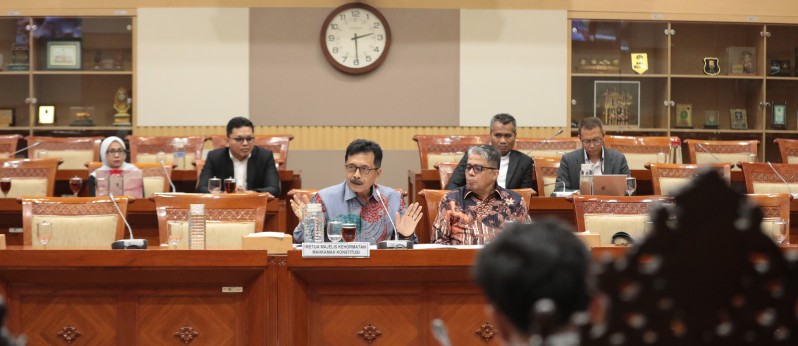
Constitutional Court Ethics Council chairman I Dewa Gde Palguna and member Yuliandri explaining the Council’s duties, functions, and independence at a hearing meeting with House Commission III, Wednesday (2/18/2026). Photo by MKRI/Ilham W. M.
JAKARTA (MKRI) — In exercising its authority, the Ethics Council of the Constitutional Court (MKMK) may not be intervened. The Council’s chairman I Dewa Gde Palguna emphasized this statement when accepting an invitation by the House of Representatives (DPR) Commission III on Wednesday noon, February 18, 2026 alongside Council member Yuliandri.
“This is not merely my personal stance, but the position of the Ethics Council of the Constitutional Court: insofar as it concerns our authority, no institution may intervene, including the constitutional justices who appointed us,” Palguna said in person at the Commission III meeting room, Nusantara II Building, within the MPR/DPR/DPD complex.
The law professor at Udayana University further stated that the Ethics Council respects the House’s authority in selecting constitutional justices. “We fully respect that the authority to propose constitutional justices lies within the three branches of state power, one of which is the House. That is an absolute competence which we cannot and will not interfere with,” Palguna said.
Responding to a statement by House Commission III member M. Nasir Djamil urging the Council not to exceed its ethical mandate, Palguna explained that the Council’s function is to safeguard the honor of constitutional justices. He stressed that rather than focusing on punishment, it prioritizes prevention and guidance.
“Our approach, Mr. Nasir, is that it is better to safeguard than to punish. Perhaps that is not popular, because punishment attracts attention and media coverage, but that is not how we work. In fact, we often become less visible because we more frequently issue reminders. That is why you may not know how many justices we have cautioned. Are you aware of this? Those matters are resolved before escalating to violations that require us to issue an annual report,” Palguna explained.
He also stated that the Ethics Council cannot disclose the substance of reports or findings currently under examination, including reports concerning newly-appointed Constitutional Justice Adies Kadir. Doing so, he said, would violate their oath and the procedural law governing the Council’s proceedings.
“Please do not assume that we have already made a decision, because we only had a preliminary examination hearing. There are two possible outcomes at this stage: either it proceeds to a full hearing, or it may be decided at this stage,” he stressed.
Palguna explained that the following day would only be a preliminary examination of the reported justice. “At present, we are still at the preliminary examination stage; we have not yet examined the substance. Tomorrow we will provide the reported justice the opportunity to present his explanation,” he elaborated.
Regarding requests from members of Commission III to dismiss reports or findings before entering the preliminary examination stage, Palguna stated that such a request cannot be granted, as it would violate the Council’s procedural law. “We cannot dismiss it at the outset as suggested, because the procedural law requires otherwise,” he asserted.
Addressing questions as to why the Ethics Council does not simply reject incoming reports or findings, Palguna clarified that a report may be deemed inadmissible only if it lacks clarity. Otherwise, the Council is bound by procedural rules and cannot refuse to register it.
“That is what is provided in our procedural law. If the report clearly identifies the complainant, the reported justice, and the supporting evidence, we have no grounds not to register it. According to our procedural rules—PMK No. 11 of 2024—once a report is registered, we are obliged to conduct a preliminary examination hearing,” he explained.
Furthermore, Palguna emphasized that the Ethics Council had never issued decisions beyond its authority, whether concerning reports or findings initiated by the Council itself. In response to findings derived from media reports, the Council employs a press conference mechanism as a form of accountability to demonstrate that it is carrying out its duties.
Author : Ilham W. M./L. A. P.
Editor : Lulu Anjarsari P.
Translator : Yuniar Widiastuti (NL)
Disclaimer: The original version of the news is in Indonesian. In case of any differences between the English and the Indonesian versions, the Indonesian version will prevail.
Wednesday, February 18, 2026 | 20:57 WIB 91