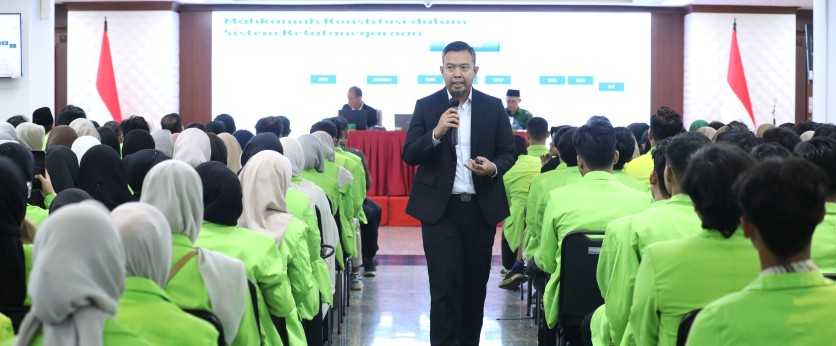
Muhamad Doni Ramdani, a Junior Legal Analyst of the Constitutional Court, delivered a presentation during a visit by students of UIN Walisongo Semarang at the hall of Building I of the Constitutional Court, on Thursday (02/12/2026). Photo by MKRI/Panji.
JAKARTA, (MKRI) – Students from the Faculty of Sharia and Law of Universitas Islam Negeri (UIN) Walisongo Semarang conducted an academic visit to the Constitutional Court on Thursday (02/12/2026). The visit aimed to provide a closer understanding of the role and function of the Court as the guardian of the constitution in Indonesia.
The session featured Muhamad Doni Ramdani, a Junior Legal Analyst of the Court, as the speaker. In his presentation, Doni explained the background of the establishment of the Court within Indonesia’s constitutional system. He noted that prior to the establishment of the Court, many problematic laws existed without an available mechanism for constitutional review. In addition, issues such as the impeachment of the President—often influenced by political interests—disputes over authority among state institutions, and electoral result disputes lacked a clear forum for resolution.
Doni also highlighted the distinction between the Court and the Supreme Court. “The key difference between the Constitutional Court and the Supreme Court lies in their respective authorities. One of the authorities of the Constitutional Court is to review laws against the Constitution, whereas regulations below the level of laws fall under the authority of the Supreme Court,” Doni explained during his presentation.
The discussion session was highly interactive. Students actively raised questions ranging from the mechanism of judicial review of laws, the requirements to become a Constitutional Justice, to examples of landmark decisions of the Court. Doni also elaborated on the constitutional rights of citizens as guaranteed under the 1945 Constitution of the Republic of Indonesia (UUD 1945), including the principle of equality before the law and the right to life and to defend one’s life.
Students were also introduced to several landmark rulings of the Court, including decisions on the open proportional electoral system, the prohibition of campaigning in places of worship, and rulings related to the separation of national and regional elections. These explanations further enriched the students’ understanding of the dynamic role of the Court in constitutional practice.
Following the presentation and discussion session, the activity continued with a visit to the Constitutional History Center. At this venue, students gained historical insights into the development of Indonesia’s constitutions, from the 1945 Constitution, the RIS Constitution, the 1950 Provisional Constitution, to the return to the 1945 Constitution and the post-reform amendment process.
Author : Adriana Airlia Yusrin
Editor : N. Rosi.
Translator : N. Valentino Rahadityo/Agusweka PS
Disclaimer: The original version of the news is in Indonesian. In case of any differences between the English and the Indonesian versions, the Indonesian version prevails.
Thursday, February 12, 2026 | 16:33 WIB 40