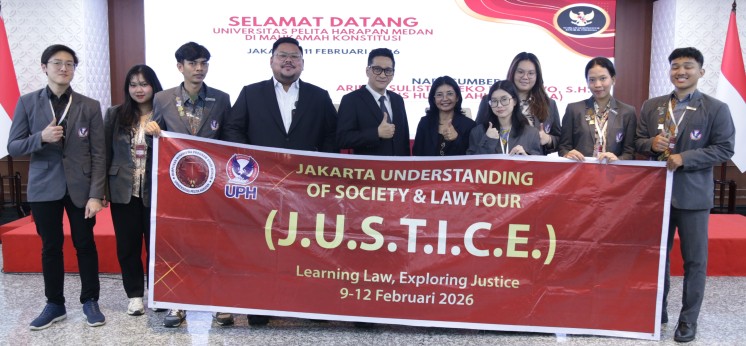
The Constitutional Court receiving a visit from the Law Student Association of Pelita Harapan University, Medan Campus, on Wednesday (2/11/2026). MKRI/Bay
JAKARTA (MKRI) – The Constitutional Court (MK) is a product of the reform era. The urgency of establishing the Constitutional Court at that time was due to the notorious legal violations committed by state organs during the New Order regime.
This was conveyed by Arinta Sulistiyo, Junior Legal Analyst at the Constitutional Court, to students from Pelita Harapan University (UPH) Medan Campus who visited the Court on Wednesday, February 11, 2026. Arinta Sulistiyo explained that one of the mandates of the reform era was to improve law enforcement, one of which was the establishment of the Constitutional Court.
The man, familiarly known as Tyo, interactively engaged the participants with questions related to the background, authority, functions, and duties of the Constitutional Court. Tyo explained that the Court's current authority includes reviewing laws against the Constitution, deciding disputes over the authority of state institutions whose authority is stipulated in the Constitution, deciding disputes over general election results, deciding on the dissolution of political parties, and deciding on the opinion of the House of Representatives (DPR) that the President and/or Vice President have violated the law, which were previously resolved politically according to current political interests.
Tyo then explained the differences in resolving disputes regarding the results of presidential and vice presidential elections, elections for members of the House of Representatives (DPR), Regional Representative Council (DPRD), Regional People's Representative Council (DPRD), and elections for Governors, Regents, and Mayors, which are time-limited. Meanwhile, the handling of judicial reviews of laws is not time-limited.
He explained that the Court's decisions are binding on all citizens (erga omnes), even if the petition is filed by only one person. Tyo gave an example of the judicial review of the Marriage Law on the civil relationship between an illegitimate child and their biological father. Although filed by only one person, the Court's decision is binding on all citizens.
Next, the visit participants received an explanation of the composition of the nine Constitutional Justices: three appointed by the House of Representatives (DPR), three by the President, and three by the Supreme Court, representing the three branches of state power. However, these nine Constitutional Justices are not affiliated with the institutions that proposed them.
Regarding the transparency and enforcement of the Constitutional Justices' code of ethics, Tyo explained the Constitutional Court's transparent handling of cases. Because of this transparency, a Constitutional Justice was reported to the Court's Ethics Council (MKMK) for discrepancies between what was said and what was written in the minutes. This demonstrates the Court's openness to public concerns and reports. The key is public oversight to safeguard the Constitutional Court.
Author : Ilham Wiryadi Muhammad.
Editor : N. Rosi.
Translator : N. Valentino Rahadityo
Disclaimer: The original version of the news is in Indonesian. In case of any differences between the English and the Indonesian versions, the Indonesian version will prevail.
Wednesday, February 11, 2026 | 19:44 WIB 77