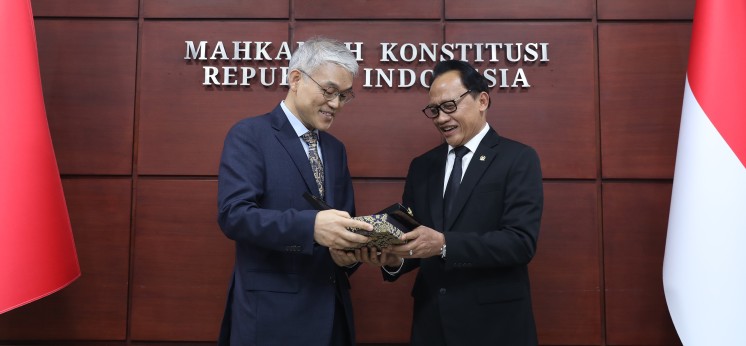
Constitutional Justice Ridwan Mansyur receiving the delegation of the Supreme Court of South Korea, Wednesday (2/11/2026). Photo by MKRI/Ifa.
JAKARTA (MKRI) — Constitutional Justice Ridwan Mansyur, accompanied by Head of the Public Relations and Protocol Bureau Pan Mohamad Faiz Kusuma Wijaya, welcomed the delegation of the Supreme Court of the Republic of Korea in a visit to the Constitutional Court of the Republic of Indonesia (MKRI) on Wednesday, February 11, 2026. The Korean Supreme Court delegation, represented by Supreme Court Justice Chun Dae-Yup and four other representatives, aimed to strengthen institutional relations and discuss the duties and functions of judicial institutions in Indonesia, particularly the Supreme Court and the Constitutional Court.
Constitutional Justice Ridwan Mansyur warmly welcomed the state guests and shared his experiences prior to joining the nine constitutional justices. As a justice who has served on the Supreme Court, Justice Ridwan expressed his hope that this meeting with one of the supreme justices of South Korea and his delegation would broaden the knowledge of the Constitutional Court of Indonesia regarding the authority and performance of the Supreme Court of South Korea.
“We are very pleased with this meeting. I previously served in the Supreme Court and was recently elected as a constitutional justice. We hope to exchange experiences and knowledge regarding the Supreme Court of South Korea, including its institutional framework and the structure of its justices,” he said.
Justice Ridwan stated that, based on Article 24 of the 1945 Constitution of the Republic of Indonesia, the Constitutional Court and the Supreme Court are part of the judicial power in Indonesia, exercising their judicial functions independently. Both have distinct roles and authorities in handling various cases. The Constitutional Court handles cases concerning citizens’ constitutional rights, while the Supreme Court oversees four courts: general, religious, military, and state administrative courts.
Differences Between Supreme Court, Constitutional Court Justices in Korea
Supreme Justice Chun Dae-Yup further explained the Korean Supreme Court’s desire to foster cooperation between judicial institutions and strengthen relations between the two countries. The Korean Supreme Court has fourteen justices, including one who serves as chief justice, who serves for a six-year term and cannot be re-elected, alongside thirteen other justices. Meanwhile, the South Korean Constitutional Court, similar to that of Indonesia, consist of nine justices appointed through a representative mechanism between the president, parliament, and the Supreme Court. However, they only serve for six years.
“In the Supreme Court of Korea, the retirement age is the same as in Indonesia, 70 years old, but the term of office is only six years. This shows that the Constitutional Court of Indonesia is more advanced and superior than the Supreme Court of Korea. Indeed, it takes considerable experience to be able to provide various legal considerations in its decisions,” explained Supreme Court Justice Chun Dae-Yup.
He further stated that the Supreme Court’s presence in South Korea is crucial, and the institution is currently striving to gain public trust. He specifically discussed judicial independence and the significant support of human resources in carrying out the Court’s judicial duties.
He explained that any shortage of assistants to assist the justices in the Supreme Court of South Korea is overcome in two ways. First, through direct recruitment. Second, through a rotation system every 2-3 years to ensure that employees working at the Supreme Court can continue working at the Constitutional Court.
“In Korea, the challenge is that we lack assistants to assist justices at the Constitutional Court, so we announce open recruitments. Secondly, we implement a rotation system (of Supreme Court justices) at district courts, who then serve at the Constitutional Court. This way, we can help meet the needs of the Constitutional Court and interpret its decisions,” explained Supreme Court Justice Chun Dae-Yup.
Responding to this, Constitutional Justice Ridwan Mansyur stated that there are several similarities between the Supreme Court of Korea, the Supreme Court of Indonesia, and the Constitutional Court of Indonesia in upholding judicial decisions. However, there are also several fundamental differences between the Supreme Court and the Constitutional Court, ranging from budgets to human resource requirements in carrying out their judicial duties.
“In Indonesia, there are only nine constitutional justices, while the Supreme Court justices are under the supervision of the Judicial Commission (KY). Meanwhile, the Indonesian Constitutional Court has the Constitutional Court Ethics Council (MKMK) that internally oversees the ethics of its justices,” Justice Ridwan explained.
He also explained that the need for justices at both the Supreme Court and the Constitutional Court in Indonesia is determined by each institution, using criteria tailored to their respective needs. At the Supreme Court of Indonesia, Supreme Court justices are selected through a selection process by the Judicial Commission, which then produces several candidates. These names are then submitted to the House of Representatives (DPR) for approval or rejection. Similarly, the human resource needs of the four lower courts are handled directly by the relevant institutions.
Before concluding the discussion, both Constitutional Justice Ridwan Mansyur and Supreme Court Justice Chun Dae-Yup expressed their hope that in the future, the two state institutions could visit and discuss further, particularly regarding the efforts undertaken by each country’s judiciary to meet and address the public’s need for justice.
During this visit, the South Korean Supreme Court delegation not only discussed with representatives of the constitutional justices was but also taken for a tour of the Court. The state guests were introduced to the Constitution History Center (Puskon), which features a diorama of the history of the Indonesian constitution, chronicling the history and development of the constitution in Indonesia. Next, the guests were also invited to see the Constitutional Court courtrooms, namely the panel courtroom and the plenary courtroom.
Author : Sri Pujianti
Editor : N. Rosi.
Translator : N. Valentino Rahadityo/YW
Disclaimer: The original version of the news is in Indonesian. In case of any differences between the English and the Indonesian versions, the Indonesian version will prevail.
Wednesday, February 11, 2026 | 17:38 WIB 282