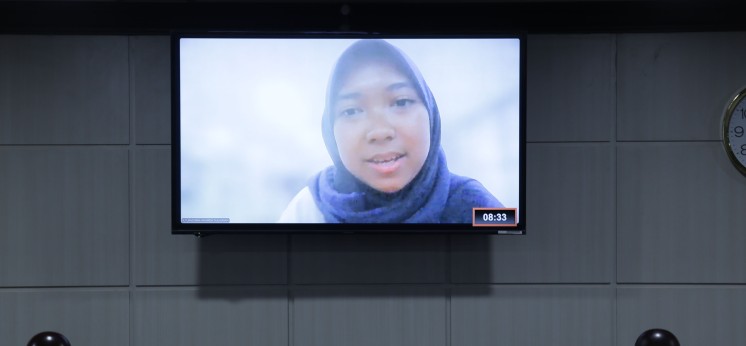
The Petitioner during the Hearing on the Revision of Petition in Case Number 9/PUU-XXIV/2026 concerning the judicial review of Law Number 23 of 2006 on Population Administration, Friday (6/2). Public Relations/Bay
JAKARTA, MKRI – The Constitutional Court (MK) convened a continuation hearing on the petition filed by E. Ramos Petege challenging Article 35 letter a of Law Number 23 of 2006 on Population Administration (Population Administration Law) against the 1945 Constitution of the Republic of Indonesia (UUD 1945).
The hearing for Petition Number 9/PUU-XXIV/2026, presided over by Constitutional Justice Enny Nurbaningsih, was held to hear the principal revisions to the Petitioner’s application.
Appearing virtually on Friday (6/2/2026), the Petitioner’s counsel, Rachma Ananda Sulaiman, stated that the application had been refined and supplemented with additional constitutional review benchmarks, namely Article 27 paragraph (1), Article 28B paragraph (1), Article 28D paragraph (2), Article 28J paragraph (1), and Article 28I paragraphs (1) and (2) of the 1945 Constitution.
The Petitioner also elaborated on the alleged constitutional harm suffered and further clarified the grounds of the petition. The Petitioner emphasized that the constitutional issue does not arise solely from the a quo provision itself, but also from the Elucidation of the article, which provides a restrictive interpretation of interfaith marriages.
“Furthermore, in the petitum of the petition, the Petitioner requests that the Court declare Article 35 letter a of the Population Administration Law contrary to the 1945 Constitution and without binding legal force insofar as it is not interpreted to mean ‘marriages between Indonesian citizens of different religions and/or adherents of indigenous beliefs.’ The Petitioner also requests that the Elucidation of Article 35 letter a of the Population Administration Law be declared contrary to the 1945 Constitution and without binding legal force insofar as it is not interpreted to mean ‘the registration of marriages between Indonesian citizens of different religions and/or adherents of indigenous beliefs is not a form of state recognition of interfaith marriages and/or belief-based marriages, but merely a matter of administrative order. Therefore, the state is obliged to register such marriages without requiring a court determination,’” stated Priskila Oktaviani, also counsel for the Petitioner, while reading the petitum.
Administrative Barriers to Marriage Registration
During the Preliminary Examination Hearing held on Thursday (22/1/2026), the Petitioner explained that the Elucidation of Article 35 letter a of the a quo Law interprets “marriage determined by a court” as referring to marriages conducted between individuals of different religions. This normative construction makes the registration of interfaith marriages entirely dependent upon a prior court determination.
In practice, the Petitioner argued, this requirement effectively closes administrative access and creates legal uncertainty for interfaith couples seeking marriage registration.
The mechanism mandated under Article 35 letter a and its Elucidation is further complicated by Supreme Court Circular Letter (SEMA) Number 2 of 2023, which prohibits judges from granting applications for interfaith marriages. The application of the a quo SEMA has, in effect, closed the only administrative avenue for registering interfaith marriages.
This situation, the Petitioner contends, logically results in violations of children’s constitutional rights as guaranteed under Article 28B paragraph (2) of the 1945 Constitution, due to legal discrimination.
Impact on Children’s Constitutional Rights
According to the Petitioner, discrimination also affects children born to interfaith couples whose marriages are not registered, thereby depriving them of full legal protection.
The consequences extend to the obstruction of children’s fundamental rights, including the right to a lawful identity, certainty of citizenship status, and clarity of legal and familial relationships with both parents. Such conditions do not arise from the child’s choice or actions but are the direct result of administrative barriers created by the legal norms governing interfaith marriage registration.
Furthermore, the Petitioner argues that the absence of marriage registration results in unclear family relationships, particularly the lack of a civil law relationship between the child and the father. Consequently, the child is deemed to have a civil relationship only with the mother.
This condition, the Petitioner asserts, has serious legal implications: it effectively eliminates the father’s legal obligations toward the child and deprives the child of the right to claim civil entitlements from the father. These include recognition of filial status, inheritance rights, legal protection within family relations, and access to social security and other legal benefits arising from the civil relationship between parent and child. (*)
Explore the Case: Petition Number 9/PUU-XXIV/2026
Author : Sri Pujianti
Editor : Lulu Anjarsari P.
Public Relations: Adriana A.Y.
Translator : SO
Disclaimer: The original version of the news is in Indonesian. In case of any differences between the English and the Indonesian versions, the Indonesian version will prevail.
Friday, February 06, 2026 | 10:10 WIB 98