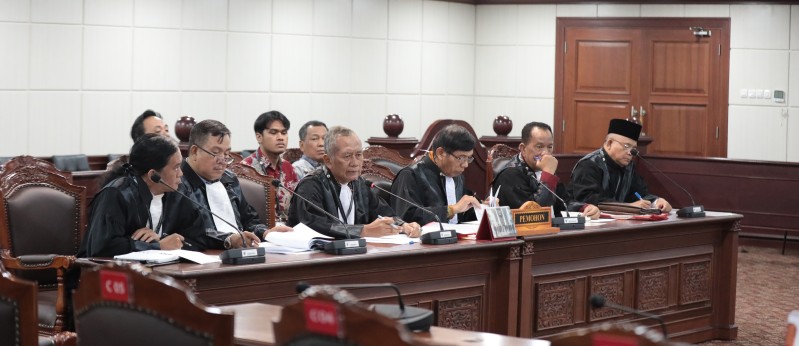
Petitioner’s legal counsel team for the judicial review of Regional Government Law presenting their petition arguments to the Panel of Constitutional Justices on Thursday, (2/5/2026). Photo by MKRI/IlhamWM.
JAKARTA (MKRI) – Major General TNI (Ret.) Eko Budi Soepriyanto (Petitioner I), Brigadier General TNI (Ret.) Purwadi (Petitioner II), and Bennyta Suryo Septanto (Petitioner III) filed a petition for judicial review of Law No. 23 of 2014 on Regional Government (UU Pemda) to the Constitutional Court (MK). The Preliminary Examination Hearing for Petition No. 45/PUU-XXIV/2026 was conducted by a Panel Hearing presided over by Constitutional Justice Enny Nurbaningsih together with Constitutional Justice Anwar Usman and Constitutional Justice Arsul Sani on Thursday, February 5, 2026.
In the petition, the Petitioners challenged the constitutionality of Article 63 and Article 64 of the Regional Government Law. Article 63 of the Regional Government Law states, “(1) The regional head as referred to in Article 59 paragraph (1) may be assisted by a deputy regional head. (2) The deputy regional head as referred to in paragraph (1) for a provincial region is called a deputy governor, for a district region is called a deputy regent and for a city region is called a deputy mayor.”
Article 64 of the Regional Government Law states, "(1) Regional deputies are appointed before assuming office by taking an oath/promise guided by the official who is appointing them. (2) The oath/promise of the deputy regional head as intended in paragraph (1) is as follows: "By Allah/God, I swear/promise that I will fulfill my obligations as deputy regional head as best and fairly as possible, uphold the 1945 Constitution and implement all laws and regulations as straight as possible and serve the people, homeland and nation."
The Petitioners, through Widodo Sigit Pudjianto, their legal counsel, stated that from a political perspective, the regional head and deputy regional head are supposed to be directly elected as a single package. However, this policy has sparked conflict, particularly since the enactment of the Regional Government Law, as nearly 97% of the time the relationship between the two is strained and even results in a fractious partnership. This is because both are directly elected by the people and supported by political parties, yet the deputy regional head fails to fulfill his or her duties as expected.
Based on an evaluation by the Director General of Regional Autonomy at the Ministry of Home Affairs since 2015, 75% of regional head pairs have had disharmonious relationships. Furthermore, LIPI research indicates that between 2005 to 2013, 95% of regional heads and deputy heads elected directly experienced political rifts.
From a social perspective, Widodo continued, conflicts or disputes between regional heads and deputy regional heads impact public services, resulting in less than optimal performance. Furthermore, such situations violate the general principles of good governance (AUPB) as stipulated in Article 10 of Law No. 30 of 2014 on Government Administration.
"Therefore, we request that the Court declare Article 63 and Article 64 of Law No. 23 of 2014 on Regional Government contrary to the 1945 Constitution of the Republic of Indonesia; declare that Article 63 and Article 64 of Law No. 23 of 2014 on Regional Government do not have binding legal force," said Widodo reading the petition of the Petitioners.
Systematics of the Petition
Constitutional Justice Arsul, in his advice of the Panel, advised the Petitioners to carefully study Constitutional Court Regulation No. 7 of 2025 on Procedures in Judicial Review Cases (PMK No. 7 of 2025) regarding the systematics of petitions submitted to the Constitutional Court. "After the Petitioner's identity, there is only the Court's authority, the reasons for the petition, and the petitum. Furthermore, in the argumentation section, the provisions of Articles 63 and 64 have not yet been identified as contradictory, so each article contradicts existing articles in the 1945 Constitution of the Republic of Indonesia. The more arguments the basis for the petition, the more detailed the explanation," Justice Arsul explained.
Constitutional Justice Anwar then questioned the Petitioners about the existence of deputy regional heads, which is not regulated in the constitution. "Is that automatically considered unconstitutional, and therefore requires further elaboration? Should regional heads be abolished? Meanwhile, the role of deputy regional heads must be regulated accordingly, so it's not simply not regulated in the constitution," Justice Anwar explained.
Meanwhile, Constitutional Justice Enny asked the Petitioners to review the Constitutional Court's decisions, which could serve as references when drafting their petition. "The Court's authority section is also quite important, covering only its legal authority. After that, we move on to the legal standing section, which must explain the Petitioners' qualifications as individual citizens," Justice Enny explained.
At the conclusion of the hearing, Constitutional Justice Enny stated that the Petitioners were given 14 days to refine their petition. The revised petition must be submitted to the Constitutional Court's Registrar's Office no later than Wednesday, February 18, 2026. The Court will then hold a second hearing to hear the Petitioners' points of revision.
Explore case No. 45/PUU-XXIV/2026 (in Indonesian).
Author : Sri Pujianti
Editor : N. Rosi
Translators : Donny Yuniarto
Disclaimer: The original version of the news is in Indonesian. In case of any differences between the English and the Indonesian versions, the Indonesian version will prevail.
Thursday, February 05, 2026 | 17:48 WIB 105