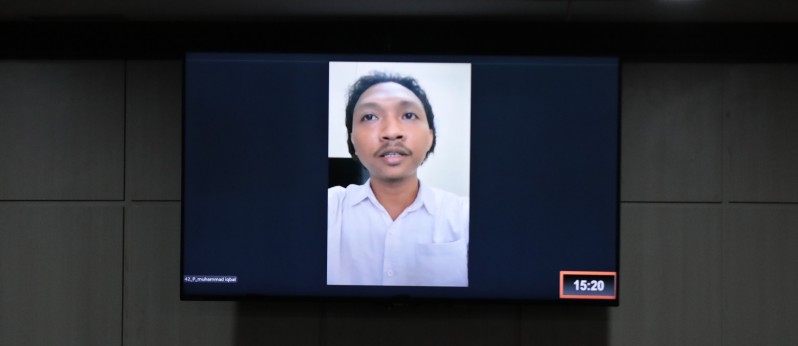
Muhammad Iqbal, Petitioner for judicial review of the Limited Liability Company Law, the Sharia Banking Law, and the Financial Sector Development and Strengthening Law, delivering his petition through a remote hearing to the Panel of Constitutional Justices, on Thursday (2/5/2026). Photo by MKRI/IlhamWM.
JAKARTA (MKRI) – Muhammad Iqbal has filed a petition to challenge several provisions in three laws governing sharia supervisory governance. The Petitioner, an active student in the Sharia Economic Law Postgraduate program at Antasari State Islamic University in Banjarmasin, believes there are fundamental, systemic flaws in the Sharia Supervisory Board (DPS) regulations.
Petitioner in Petition No. 42/PUU-XXIV/2026 challenges Article 109 paragraph (2) and paragraph (3) of Law No. 40 of 2007 on Limited Liability Companies (Law 40/2007); Article 32 paragraph (2) and paragraph (3) of Law No. 21 of 2008 on Sharia Banking (Law 21/2008); and Article 110 paragraph (2) of Law No. 4 of 2023 on Development and Strengthening of the Financial Sector (Law 4/2023) against the 1945 Constitution of the Republic of Indonesia (UUD NRI 1945).
In the hearing presided over by Constitutional Justice Enny Nurbaningsih, the Petitioner, who was present online, stated that the issue was not only found in one norm, but in the interrelationship of regulations in Law No. 40 of 2007 on Limited Liability Companies, Law No. 21 of 2008 on Sharia Banking, and Law No. 4 of 2023 on Development and Strengthening of the Financial Sector.
“Petitioner challenges three articles separately but reveals a fundamental, systemic flaw in sharia oversight in Indonesia, reflected in the pattern of repetition of the same regulations.
Petitioner believes that the structure of appointing the Sharia Supervisory Board (SSB) through the General Meeting of Shareholders (GMS) creates a conflict of interest. The SSB is said to be subordinate to the party it is supposed to supervise, potentially undermining the independence and effectiveness of oversight of compliance with Sharia principles.
Petitioner also presented comparative research between Indonesia and Malaysia. He stated that the sharia supervisory system, which places authority in the hands of regulators in Malaysia, is considered to have contributed to the higher growth of the Islamic financial industry compared to Indonesia. The Petitioner stated that Malaysia's Islamic banking market share has reached approximately 24 percent, while Indonesia's remains below 5 percent.
In addition, the Petitioner considers that the provisions in the three laws have the potential to violate a number of provisions in the 1945 Constitution of the Republic of Indonesia. These violations are related to the guarantee of fair legal certainty, protection of property rights, and the principle of non-discrimination.
According to Petitioner, the DPS's dependence on supervised entities has the potential to raise public doubts about the assurance of Sharia compliance in managing customer funds. This situation is considered detrimental to consumers who choose Sharia financial services based on their religious beliefs.
Petitioner also believes that the repetition of the Sharia Supervisory Board (DPS) regulatory model from 2007 to 2023 demonstrates the lack of reforms to sharia supervisory governance in line with international practices. Several countries have reportedly implemented reforms to their sharia supervisory systems by establishing independent supervisory bodies at the regulatory level.
On this basis, Petitioner asked Court to declare Article 109 paragraph (2) and paragraph (3) of the Limited Liability Company Law, Article 32 paragraph (2) and paragraph (3) of the Sharia Banking Law, and Article 110 paragraph (2) of the Financial Sector Development and Strengthening Law jointly to be in conflict with the 1945 Constitution.
Responding to the Petitioner's petition, Constitutional Justice Arsul Sani advised the Petitioner to adjust the petition structure to the Constitutional Court Regulation No. 7 of 2025 on Procedures in Judicial Review Cases (PMK No. 7 of 2025). "Then, regarding the legal standing, it must be sharpened and comprehensive. You must explain which article of the Constitution is in question so that it is clear. Your argument or argument is, which article contradicts the provision of Article 63 of 1964. If you use more than one provision of the Constitution as a basis for the touch reference, then you must each explain why Articles 63 and 64 contradict the Constitution. The more you mention the basis for the touch reference, the more you will explain," explained Justice Arsul.
The Panel of Justices granted the Petitioners 14 days to revise their petition. The Petitioners are to revise their petition by Wednesday, February 18, 2026, at 12:00 p.m. WIB.
Explore case No. 42/PUU-XXIV/2026 (in Indonesian).
Author : Utami Argawati.
Editor : N. Rosi
Translators : Donny Yuniarto
Disclaimer: The original version of the news is in Indonesian. In case of any differences between the English and the Indonesian versions, the Indonesian version will prevail.
Thursday, February 05, 2026 | 18:12 WIB 99