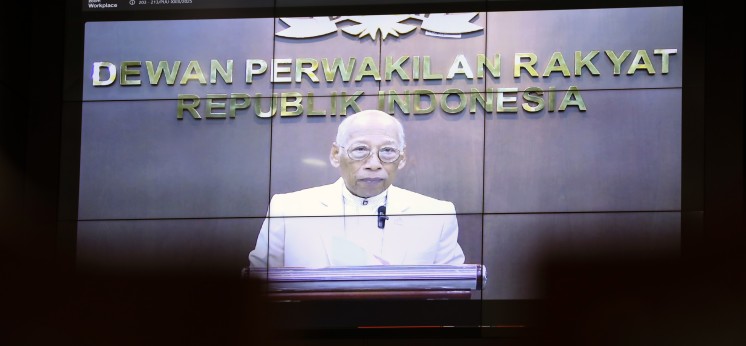
I Wayan Sudirta speaking on behalf of the House of Representatives at a hearing for case No. 213/PUU-XXIII/2025 on the Job Creation Law, Thursday (2/5/2026). Photo by MKRI/Ifa.
JAKARTA (MKRI) — The involvement of business entities in development for public interest is, in essence, intended solely to assist the Government in addressing limitations in state fiscal capacity, improving the quality of infrastructure, and encouraging domestic investment. Such business entities are engaged only as supporting partners within financing cooperation schemes to overcome fiscal constraints, without diminishing the State’s authority as the primary decision-maker. The State retains broad discretion to intervene, including through specific policies and by granting approvals in the land acquisition process.
The statement was made by Commission III member I Wayan Sudirta on behalf of the House of Representatives (DPR) at a judicial review hearing of the Job Creation Law filed by the Indonesian Farmers Association (SPI), the Agrarian Reform Consortium (KPA), village development foundation Bina Desa, the Indonesian Farmers Alliance (API), palm oil watchdog Sawit Watch, the Palm Oil Farmers Union (SPKS), and the People’s Coalition for Fisheries Justice (KIARA) as Petitioners I-VII. The third session for case No. 213/PUU-XXIII/2025 was to hear the House’s testimony on the constitutionality of Articles 10, 19A, 34, 125, 137, 138, and 173 of the Job Creation Law.
Before the plenary session chaired by Chief Justice Suhartoyo on Thursday, February 5, 2026, Sudirta stated that National Strategic Projects (PSN) are implemented by prioritizing connectivity and centers of economic activity in order to accelerate region-based economic growth, while taking into account development directions and regional planning as set out in the national development plan.
“PSN and public interest are instruments aimed at national development by granting the broadest possible mandate for the benefit of society, whether for improving public welfare, promoting economic growth, or fulfilling the fundamental rights of citizens,” he explained.
Land Bank as an Institution
Furthermore, with regard the Land Bank as an institution, the House is of the view that it must be understood as an Indonesian legal entity established by the Central Government with special authority to manage land and to ensure that land is administered in a planned, controlled, and sustainable manner, as well as to address a number of issues that cannot be resolved through ordinary mechanisms. Therefore, this special body requires a specific legal framework and possesses characteristics that differ from other government institutions. The Government exercises supervision and control over the use and/or utilization of land held under management rights in accordance with the prevailing laws and regulations. This underscores that the performance of the Land Bank’s functions is carried out under strict oversight mechanisms.
“The granting of land management authority to the Land Bank, state-owned enterprises, and legal entities designated by the Central Government is consistent with the concept of management rights as a form of delegation of a portion of the State’s authority within the framework of state control. Such delegation does not transfer the State’s control over land, but rather strengthens the State’s function in land management, and therefore does not conflict with Article 33 paragraph (3) of the 1945 Constitution,” Sudirta concluded.
Also read:
Petitioners Questions Rights to Land, Legal Protection for Communities in Forest Areas
Petitioners Affirm Petition on Land for Public Interest
At the preliminary hearing on Monday, November 17, 2025, the Petitioners conveyed their petition of articles in the Job Creation Law. They believe those articles are in violation of Article 28D paragraph (1), Article 28I paragraph (3), and Article 33 paragraph (3) of the 1945 Constitution of the Republic of Indonesia.
The Petitioners stated that the Government has designated agrarian reform as a national priority program. Its objective is to correct inequities in the structure of land tenure to make it more just, to resolve structural agrarian conflicts experienced by communities, and to strengthen land rights as a source of welfare. Agrarian reform encompasses a continuous process involving the restructuring of control, ownership, use, and utilization of agrarian resources, carried out to achieve legal certainty and protection as well as justice and prosperity for all Indonesian people.
However, the provision establishing an exception from administrative sanctions for individuals or community groups residing within and/or around forest areas for at least five consecutive years has created legal uncertainty regarding protection for these individuals or community groups. On the contrary, they must be protected by being afforded guarantees of protection and legal certainty.
The Petitioners stated that Article 123 Point 2 of the Job Creation Law has expanded the categories of land acquisition projects considered to be for the public interest. As a result, it eliminates the distinction between public interest and the business interests of companies. This expansion of the types of projects deemed in the public interest becomes the legal basis for entrepreneurs to have their businesses designated as Public Interest Projects or National Strategic Projects (PSN).
For private projects designated as PSNs, entrepreneurs receive facilities and state support as regulated in Government Regulation No. 42 of 2021 on the Facilitation of National Strategic Projects. Therefore, according to the Petitioners, the phrase “initiated and/or controlled by the Central Government, Regional Governments, State-Owned Enterprises, or Regional-Owned Enterprises” in the article in question has created legal uncertainty for the public.
The Petitioners also argued that the phenomenon of privatization of land acquisition for the public interest can likewise be observed in the Indicative List of National Strategic Projects 2025–2029. Private-sector mining projects are designated as PSNs and in their development receive various forms of facilitation, including land acquisition, as determined in Government Regulation No. 42 of 2021 on the Facilitation of National Strategic Projects. By designating private projects as being in the public interest, the public is indirectly discriminated against. This is because private projects developed using the mechanism of land acquisition for the public interest do not align with the needs of the community.
Land acquisition for private projects in the name of the public interest through the PSN designation deviates from the values and principles of Article 33 paragraph (3) of the 1945 Constitution, and even contradicts the meaning of “the greatest prosperity of the people.” Through Decision No. 3/PUU-VIII/2010, the Constitutional Court provided four benchmarks for interpreting the clause “the greatest prosperity of the people.” In short, to this day, no legal rule establishes benchmarks for determining when a land acquisition may be categorized as being for the public interest, for example whether it corresponds with the interests and needs of the community, whether development is carried out by the government, whether the results of development are owned by the Government, and whether development is not intended to generate profit.
Explore Case No. 213/PUU-XXIII/2025 (in Indonesian).
Author : Sri Pujianti
Editor : N. Rosi
PR : Raisa Ayuditha Marsaulina
Translators : Yuniar Widiastuti (NL)
Disclaimer: The original version of the news is in Indonesian. In case of any differences between the English and the Indonesian versions, the Indonesian version will prevail.
Thursday, February 05, 2026 | 15:12 WIB 102