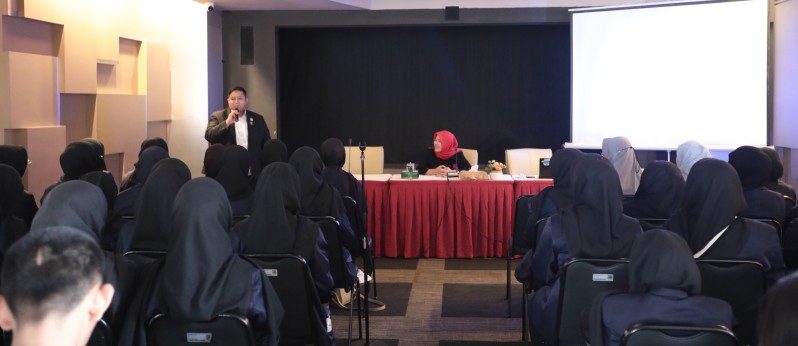
Legal counselor Achmad Junaedi delivering a presentation on the Constitutional Court to visiting students of the Faculty of Law, Universitas Muhammadiyah Magelang, at the Constitutional History Center (Puskon), 5th Floor, Tuesday (2/3/2026). Photo by MKRI PR/IlhamWM.
JAKARTA (MKRI), Seventh-semester students of Universitas Muhammadiyah Magelang paid an academic visit to the Constitutional Court (MK) on Tuesday, February 3, 2026. The activity took place in the Cinema Room and the Constitutional History Center (Pusat Sejarah Konstitusi /Puskon) at Building I of the Court. The visit aimed to provide students with first-hand insight into the Court’s roles, powers, and functions within Indonesia’s constitutional system.
In the Cinema Room, the students received a presentation from the Court’s First Expert Legal Analyst, Puguh Apriyanto. Meanwhile, at Puskon, legal counselor Achmad Junaedi explained key topics, including the concept of the constitution; the history and development of judicial review; the Court’s position in Indonesia’s constitutional structure; as well as the Court’s authorities and procedural mechanisms. The presentation also touched on the legal basis for establishing the Court, its institutional structure, and the stages of handling judicial review cases.
Junaedi also briefed the students on the key requirements to qualify as a candidate for constitutional justice. He emphasized that one non-negotiable requirement is a legal education background, namely at least a bachelor’s degree in law. In his view, a strong grounding in legal science is essential for a constitutional justice in carrying out the Court’s mandate and authority, particularly in interpreting the 1945 Constitution of the Republic of Indonesia and adjudicating constitutional cases with broad implications for the nation.
Furthermore, Junaedi comprehensively explained one of the Court’s landmark decisions concerning the civil relationship between a child born out of wedlock and the child’s biological father. The decision marked an important milestone in the development of family law and the protection of children’s rights in Indonesia. He elaborated that the Constitutional Court, through its decision, affirmed that a child born out of wedlock still has civil rights in relation to the biological father, as long as such relationship can be proven through science and technology and/or other legally valid evidence.
“At the Court, there was once a case regarding the recognition of a child born out of wedlock, and the Constitutional Court granted the petition. Once it was granted, the child could obtain a birth certificate and be included in the family card, provided that the biological father acknowledged the child and there was medical examination evidence proving that the child is indeed the biological father’s,” Junaedi said during his presentation.
Throughout the session, Junaedi was communicative and actively engaged with the students. The discussion proceeded dynamically through a question-and-answer session on the Court’s authorities, judicial review practices, and the Court’s role as the guardian of the constitution.
After the presentation, the activity continued with a guided tour of Puskon. In this session, students were invited to explore the documentation and information center on the history and practice of Indonesia’s constitution. Puskon also features historical collections and important archives owned by the Court.
Author: Adriana Airlia Yusrin
Editor: N. Rosi
Translator: Siti Rosmalina Nurhayati/VALE
Disclaimer: The original version of the news is in Indonesian. In case of any differences between the English and the Indonesian versions, the Indonesian version will prevail.
Tuesday, February 03, 2026 | 12:48 WIB 49