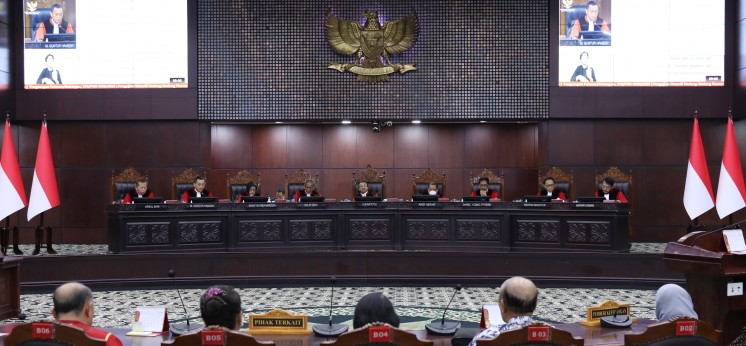
The Constitutional Court held a hearing to pronounce its decision on the judicial review of Emergency Law Number 11 of 1954 on Amnesty and Abolition, on Friday (01/30/2026) in the Court’s plenary courtroom. Photo by MKRI/Ifa.
JAKARTA, (MKRI) – The Deputy Chief Justice of the Constitutional Court, Saldi Isra, read out the Court’s legal considerations in the judicial review of Emergency Law Number 11 of 1954 on Amnesty and Abolition. The decision reading for Case Number 262/PUU-XXIII/2025, filed by Sahdan (Petitioner I), Abdul Majid (Petitioner II), Moh. Abied (Petitioner III), and Rizcy Pratama (Petitioner IV), was held on Friday (01/30/2026).
The Court noted that upon examining the petitum, particularly point 2, there was no citation specifying the article and/or paragraph of the statutory provision deemed contrary to the 1945 Constitution of the Republic of Indonesia (UUD 1945). This requirement is stipulated in Article 2 paragraph (5) of Constitutional Court Regulation (PMK) Number 7 of 2025, which provides that a judicial review petition must concern the substance of specific articles, paragraphs, and/or parts of a law or government regulation in lieu of law alleged to be inconsistent with the Constitution.
“This means that even if the petition has followed the correct systematic structure, the assessment of whether formal requirements are fulfilled does not end at structure alone. In this case, since the petitum of the Petitioners’ application was drafted without specifying the article, paragraph, and/or part of the law being challenged, the petition becomes unclear or obscure,” Saldi explained.
Based on these considerations, the Court—through Chief Justice Suhartoyo—declared that the ruling in Case Number 262/PUU-XXIII/2025 is inadmissible.
Read also:
Questioning the Limits of Presidential Authority to Grant Amnesty, Abolition, Rehabilitation, and Clemency.
Previously, the Petitioners argued that the granting of amnesty, abolition, rehabilitation, and clemency by the President constitutes a constitutional prerogative right under Article 14 of the 1945 Constitution of the Republic of Indonesia (UUD 1945), intended to provide pardon or restoration of rights. However, in the Petitioners’ view, in practice this authority may give rise to arbitrary actions and potentially broaden the interpretation of the relevant legal norms concerning the granting of amnesty, abolition, rehabilitation, and clemency.
It was further explained that within Indonesia’s constitutional system, the President is vested with several forms of prerogative powers, including clemency, amnesty, abolition, and rehabilitation. Abolition refers to the termination of judicial proceedings against an individual, while rehabilitation refers to the restoration of dignity, reputation, or rights of a person previously declared guilty by a court. In exercising these authorities, the President must consider the opinion of the House of Representatives (DPR). According to the Petitioners, this check-and-balance mechanism is normatively intended to prevent arbitrary actions by the President. However, in practice, each grant of clemency, amnesty, abolition, and rehabilitation continues to raise debates regarding the limits of executive intervention in the judicial domain.
Complete Decision: Number 262/PUU-XXIII/2025.
Author : Sri Pujianti
Editor : Lulu Anjarsari P.
PR : Fauzan Febriyan
Translator : N. Valentino Rahadityo/Agusweka Poltak Siregar
Disclaimer: The original version of the news is in Indonesian. In case of any differences between the English and the Indonesian versions, the Indonesian version prevails.
Friday, January 30, 2026 | 12:19 WIB 36