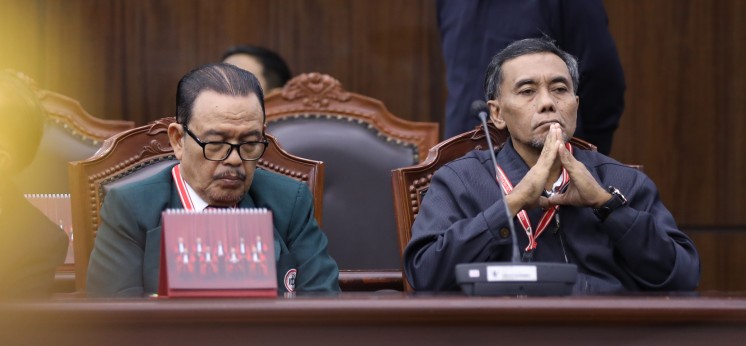
The Petitioner (right) at the ruling hearing for Case No. 264/PUU-XXIII/2025 on the material judicial review of the Mineral and Coal Mining Law, Friday (1/30/2026). Photo by MKRI/Ifa.
JAKARTA (MKRI) — The Constitutional Court ruled that the petition filed by Muhammad Mada concerning the material judicial review of Article 112 paragraph (1) of Law No. 11 of 2020 on Job Creation Law, which has been amended by Law No. 2 of 2025 on the Fourth Amendment to Law No. 4 of 2009 on Mineral and Coal Mining (Minerba Law) was inadmissible. It contended that the Petitioner did not present any argumentation or reasoning whatsoever regarding the alleged inconsistency between the provision under review and the provisions of the 1945 Constitution that were invoked as the basis for the constitutional review.
“In addition, the exposition of reasons for challenging the constitutionality of Article 112 paragraph (1) of Law No. 3 of 2020 bears no correlation with the petitums of the petition,” stated Deputy Chief Justice Saldi Isra when reading out the considerations of Decision No. 264/PUU-XXIII/2025 on Friday, January 31, 2026 in the plenary courtroom.
Furthermore, he continued, the formulation of the petitums sought by the Petitioner was unconventional and difficult to comprehend, as the intended meaning of the requested petitums could not be ascertained. This rendered it difficult for the Court to assess the norm’s alleged inconsistency with the 1945 Constitution, whether in its entirety or under a conditional interpretation.
Accordingly, without hesitation, the Court declared that the petition was unclear. In its verdict, the Court ruled that the petition was inadmissible.
Also read:
Citizen Challenges Mining Law, Seek Limits on Private Ownership in Resource Exploitation
Petitioner Seeks Restrictions on Private Exploitation of Natural Resources
Article 112 paragraph (1) of Law No. 2 of 2025 provides: “Business Entities holding Mining Business Permits (IUP) or Special Mining Business Permits (IUPK) at the Production Operation stage whose shares are owned by foreign parties shall be required to divest 51 percent (fifty-one percent) of their shares in stages to the Central Government, Regional Governments, State-Owned Enterprises (BUMN), regionally owned enterprises, and/or national private business entities.”
However, in the petitums, the Petitioner requests that the provision be reinterpreted to read: “Business Entities holding IUP or IUPK at the production operation stage whose shares are owned by foreign parties as well as national private business entities are required to divest 51 percent (fifty-one percent) of their shares in stages to the Central Government, Regional Governments, State-Owned Enterprises (BUMN), and Regionally Owned Enterprises (BUMD).”
At the preliminary hearing on Thursday, January 8, the Petitioner contended that the provision under review has not provided limits on private ownership in economic sectors that exploit natural resources, including land, water, and the natural wealth contained therein. He stated that limiting private ownership in economic sectors that exploit natural resources, land, water, and the natural wealth contained therein is an effort to return to the spirit of the 1945 Constitution, particularly Article 33. Mineral and coal mining constitute important production units that should be controlled by the state. Therefore, he argued, the state must limit the ownership or control of private companies, particularly in sectors involving state assets such as land, water, and the natural wealth contained therein.
Explore case No. 264/PUU-XXIII/2025 (in Indonesian).
Author : Mimi Kartika
Editor : N. Rosi
Translator : Yuniar Widiastuti (NL)
Disclaimer: The original version of the news is in Indonesian. In case of any differences between the English and the Indonesian versions, the Indonesian version will prevail.
Friday, January 30, 2026 | 10:53 WIB 258